

Resolving a PagerDuty alert is only half the battle; the real work begins when the incident ends. If you are searching for a PagerDuty incident analysis alternative, you likely know the frustration of manual triage. Spending hours piecing together fragmented logs into a coherent post-mortem is a drain on your most senior engineers. We agree that the current process is often inconsistent and leaves teams vulnerable during DORA or ISO 27001 audits.
This article explores how to transform raw data into structured, audit-ready root cause analysis reports while reducing lead times by over 50%. We will examine how decentralizing problem management ensures every team member can identify root causes with confidence. You will learn to move beyond simple timelines toward a mature, automated approach that satisfies both technical leads and commercial stakeholders. By the end, you will understand how to build a stabilizing force that brings order to your technical operations.
Key Takeaways
- Learn to distinguish between a chronological timeline of symptoms and a structured root cause analysis that satisfies modern auditing requirements.
- Discover how to implement a PagerDuty incident analysis alternative that reduces post-mortem effort and incident lead times by over 50%.
- Explore the essential criteria for evaluating RCA tools, focusing on automated log ingestion and compliance with DORA and ISO 27001 standards.
- Understand how to decentralize problem management, allowing your entire IT team to produce consistent, audit-ready reports using guided techniques.
Beyond Timelines: Why PagerDuty Users Seek Incident Analysis Alternatives
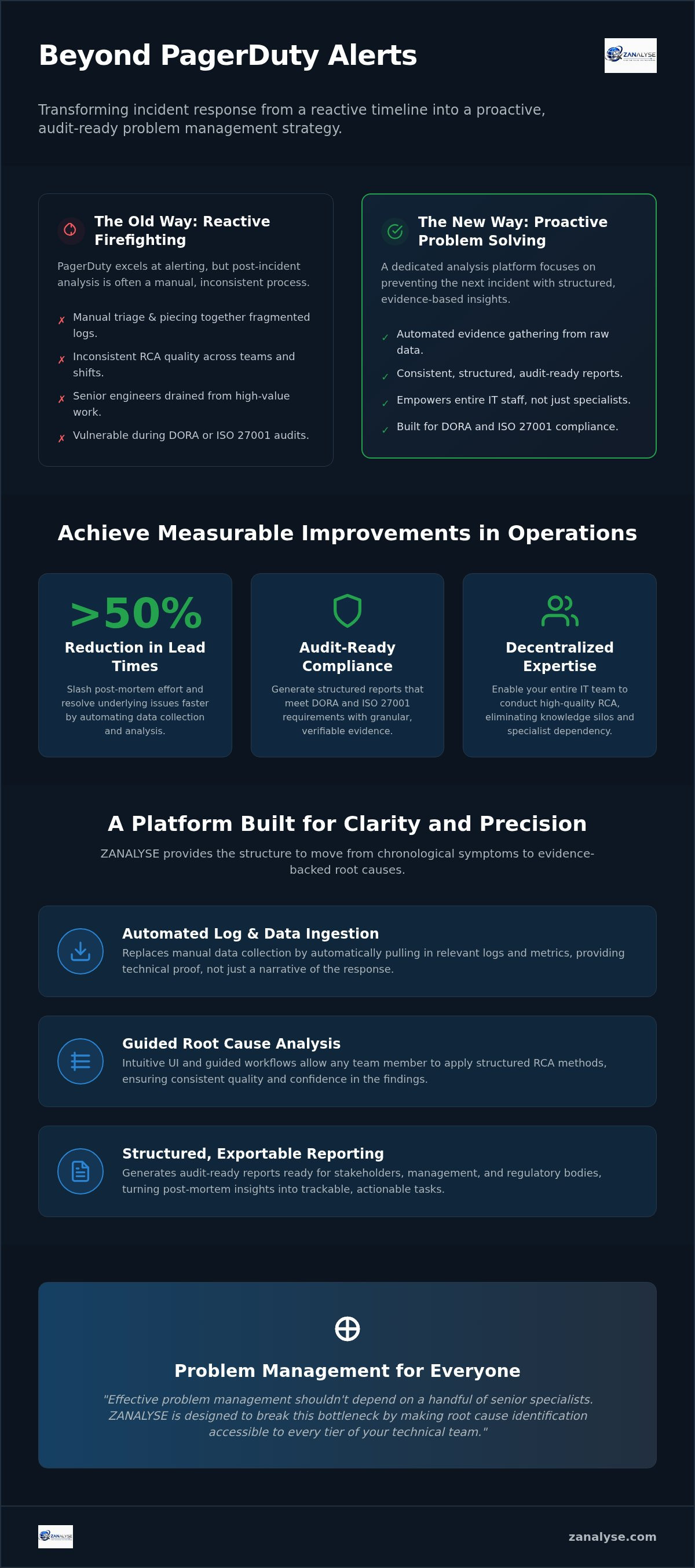
PagerDuty remains the industry standard for on-call alerting and incident response orchestration. It excels at ensuring the right person is notified when a service fails. However, a chronological record of alerts is not a root cause analysis; it is merely a timeline of symptoms. For many teams, the post-mortem phase remains a manual, time-consuming burden that pulls senior engineers away from high-value projects. It's a reactive cycle that prioritizes speed of notification over depth of understanding.
Modern IT operations require a transition from reactive triage to proactive problem management. While PagerDuty manages the immediate fire, a dedicated PagerDuty incident analysis alternative focuses on preventing the next one. This shift is essential for organizations aiming to reduce incident lead times by over 50% while maintaining audit-ready documentation for regulatory bodies.
The Gap Between Incident Response and Root Cause Identification
Many organizations rely on chat-based summaries to document incidents. While these tools capture the conversation, they often miss the underlying technical patterns hidden in logs. There's a fundamental difference in operational focus: PagerDuty identifies who is on call, whereas ZANALYSE identifies why the failure occurred. Automated evidence gathering is the missing link in the incident lifecycle.
- Evidence vs. Narrative: Chat summaries provide a story of the response; automated evidence gathering provides technical proof of the cause.
- Operational Efficiency: Manual data collection is prone to error and creates inconsistent RCA quality across different teams and shifts.
- Compliance Integrity: Structured reports ensure you meet DORA and ISO 27001 requirements without a last-minute scramble for evidence.
By moving beyond simple timelines, you decentralize the analysis process. This allows your entire IT staff to contribute to a more resilient infrastructure, ensuring that specialized knowledge doesn't stay locked within a few senior roles.
Evaluating RCA Tools: Accuracy, Evidence, and Regulatory Compliance
By 2026, incident analysis has transitioned from a technical luxury to a regulatory mandate for financial and critical infrastructure sectors. Organizations seeking a PagerDuty incident analysis alternative must prioritize tools that move beyond chronological logs toward deep technical evidence. It's no longer enough to state that a service is back online; you must prove exactly why it failed and how you've secured the system against recurrence.
Effective evaluation of an RCA tool rests on three pillars: automated log ingestion, support for diverse root cause analysis methods, and a rigid report structure. Modern platforms replace "best guesses" with confidence scoring, which uses data patterns to validate the most likely cause. When selecting a PagerDuty incident analysis alternative, look for features that turn post-mortem insights into immediate, trackable tasks that ensure long-term stability.
Meeting DORA and ISO 27001 Requirements for Incident Evidence
Regulatory frameworks now demand granular proof of incident management. The DORA incident reporting requirements for 2026 mandate that firms provide specific evidence regarding incident origins and mitigation strategies. Structured RCA reports serve as audit-ready artifacts for ISO 27001 compliance, providing a stabilizing force during high-stakes reviews. Without these structured records, teams often struggle to provide the consistency required by global auditors.
Decentralizing these capabilities is the only way to maintain this consistency across different teams and shifts. When all IT staff can generate high-quality reports, you eliminate the knowledge silos that often lead to shallow evidence. You can explore how a ZANALYSE Standard License provides the structure needed to meet these global standards while empowering your entire technical workforce ahead of the October 2026 general availability.
Decentralizing Problem Management with ZANALYSE
Effective problem management shouldn't depend on a handful of senior specialists. ZANALYSE is designed to break this bottleneck by making root cause identification accessible to every tier of your technical team. For service providers managing operational services for diverse client portfolios, this PagerDuty incident analysis alternative offers a way to standardize quality without inflating headcount. The platform’s core strength lies in its intuitive navigation, which removes the steep learning curve typically associated with deep technical forensics. By distributing these capabilities, you ensure that problem management is a continuous process rather than a periodic burden.
The ZANALYSE Standard License provides the necessary framework for this organizational transition. It utilizes a vast pool of included RCAs to guide junior responders through complex data, effectively turning every incident into a learning opportunity. This structured automation is the primary reason teams see a 50% reduction in incident lead times. For service providers, this efficiency translates directly into better service level agreement performance and higher client trust. It's about providing consistent, professional precision across every environment you manage.
Implementing a Mature RCA Program for 2026
Scaling a mature program requires a tool that fits into existing detection stacks without friction. As you integrate this PagerDuty incident analysis alternative, you can utilize RCA capacity top-ups to handle fluctuations in incident volume. This is particularly valuable for service providers who must maintain high standards across multiple client environments simultaneously. The focus shifts from merely "fixing the fire" to a disciplined cycle of system improvement. By prioritizing intuitive workflows, you make proactive problem management a standard operational reality for your entire workforce.
Securing Operational Excellence Through Automated Analysis
Transitioning from reactive triage to a mature problem management framework is essential for long-term stability. By implementing a PagerDuty incident analysis alternative, your team moves beyond simple timelines toward structured, audit-ready evidence. This shift reduces incident lead times by over 50% and ensures your reports meet the rigorous demands of DORA and ISO 27001 regulations. Decentralizing these capabilities empowers all IT tiers to identify root causes with confidence, removing the burden from senior engineers. It's a pragmatic step toward securing your process integrity and organizational excellence. You don't have to settle for manual, inconsistent post-mortems when a stabilizing force is within reach. Request a ZANALYSE Standard License Briefing to transform your incident lifecycle today. We're ready to help you build a more resilient future.
Frequently Asked Questions
Why isn’t PagerDuty’s built-in post-mortem tool enough for DORA compliance?
PagerDuty excels at incident orchestration, but its post-mortem tools often prioritize response narratives over technical evidence. 2026 DORA regulations require granular proof of incident origins and specific mitigation strategies. ZANALYSE provides the structured, audit-ready artifacts that European and Australian regulators demand. It moves beyond "what happened" so you don't just guess the "why" required for compliance.
How does ZANALYSE automate the root cause identification from raw logs?
ZANALYSE serves as a PagerDuty incident analysis alternative by ingesting raw log data and timelines to identify underlying technical patterns automatically. It utilizes a vast pool of included RCAs to guide the system through established analysis methods. This process generates comprehensive reports featuring evidence and confidence scores. By automating these steps, teams reduce incident lead times by over 50% while maintaining high standards.
Can junior IT staff perform RCA with this alternative?
Decentralizing problem management is a primary objective, allowing IT staff at all levels to contribute to system stability. ZANALYSE uses intuitive navigation and guided techniques to simplify complex investigations for junior responders. This ensures consistent RCA quality across technical teams in Canada and Europe. You don't need to wait for a senior engineer to begin a high-quality root cause analysis.
What is the difference between an incident timeline and a structured RCA report?
An incident timeline is merely a chronological record of symptoms and alerts. A structured RCA report provides technical evidence, confidence scores, and corrective actions. While timelines track the response, structured reports ensure the incident doesn't recur. This maturity is necessary for organizations in Canada and Australia to meet ISO 27001 standards and improve long-term operational quality.
Disclaimer
Some content on this website may be generated or assisted by artificial intelligence. While we strive to ensure that all information is accurate, relevant and up to date, AI-assisted content may contain errors or omissions. Content should therefore be considered informational and not as professional advice.


