

If your team handles a portion of the 10,675 monthly tickets typical for modern organizations, you know that firefighting isn't a strategy. It's a drain on your most expensive resources. You're likely exhausted by the cycle of repetitive incidents and the mounting pressure of meeting DORA reporting deadlines. Modern problem management requires a shift from reactive patching to proactive, decentralized analysis. You need to stop treating symptoms and start curing the disease.
This reference guide helps you master modern operations to eliminate recurring incidents and achieve audit-ready excellence. We'll show you how to empower your IT staff to perform their own root cause analysis (RCA) using the ZANALYSE Standard License. You'll learn how to use automated tools to reduce incident lead times by 50% while ensuring full compliance with ISO and DORA standards in the new ITIL 5 era. It's time to move toward a more stable, structured future.
Key Takeaways
- Identify the fundamental shift from symptom-based patching to identifying underlying causes for long-term operational stability.
- Master the five essential stages of the problem management lifecycle to move systematically from detection to final resolution.
- Empower your entire IT department to perform expert-level investigations through the decentralization of root cause analysis.
- Use automated templates to transform raw technical evidence into structured, audit-ready reports that meet ISO and DORA standards.
The Fundamentals of IT Problem Management
Problem management is the disciplined practice of identifying and resolving the underlying causes of service disruptions. While many teams focus on restoring uptime, this process digs deeper to prevent incident recurrence. Its core objective is to minimize the impact of unavoidable failures and eliminate the root causes of those that can be avoided. By shifting from reactive fixes to structural improvements, organizations enhance service availability and overall operational quality. Over time, this discipline builds valuable organizational knowledge, turning raw incident data into a library of proven solutions.
Rooted in the ITIL framework, this practice acts as a stabilizing force in high-pressure environments. It moves beyond the chaos of the immediate outage to find the "why" behind the "what." This methodical approach is essential for meeting modern regulatory expectations like DORA, where consistency and evidence-based reporting are mandatory. By decentralizing these capabilities through tools like the ZANALYSE Standard License, you ensure that every team member contributes to a more resilient infrastructure.
Problem vs. Incident Management: Why the Distinction Matters
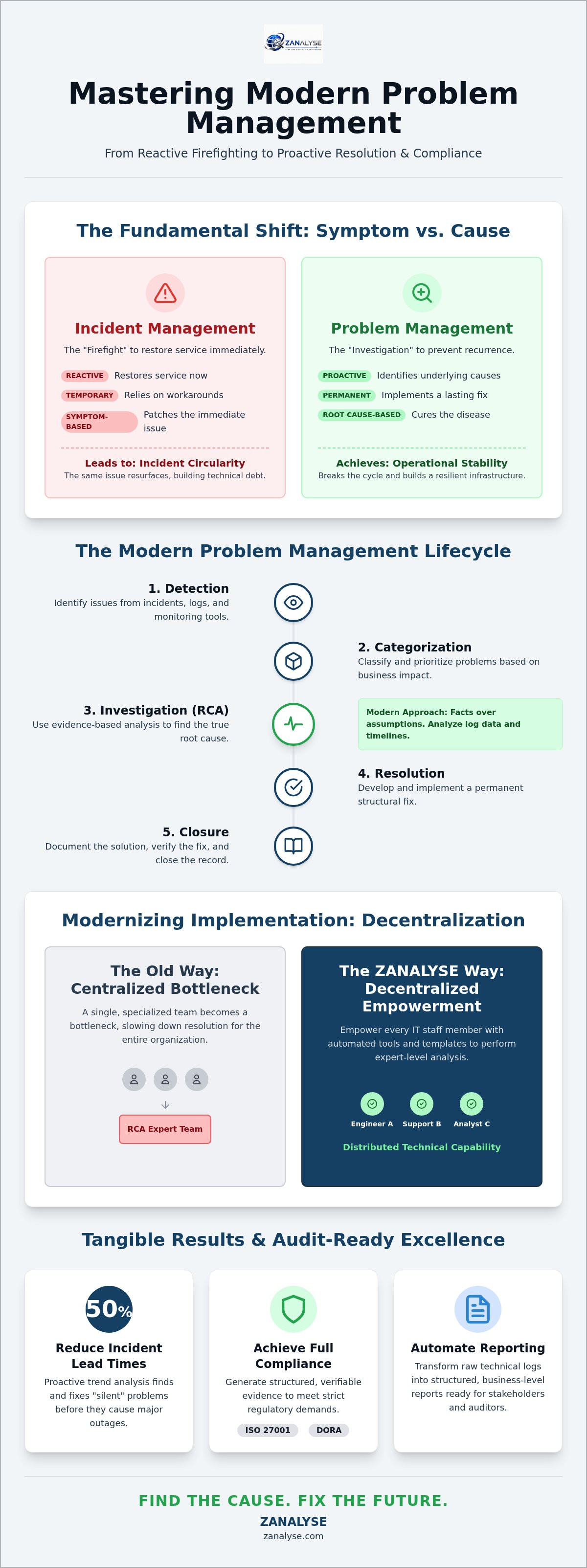
Incident management is firefighting; this discipline is the investigation into the arson itself. One restores service immediately, while the other identifies the source of the spark. In high-pressure IT environments, teams often rely on workarounds to hit service level targets. However, a workaround is a temporary bandage, not a cure. Relying on them indefinitely creates incident circularity, where the same issue resurfaces repeatedly. This cycle builds technical debt that eventually drains team resources and compromises operational excellence. A permanent fix is the only way to break this loop and ensure audit-ready stability.
The Problem Management Lifecycle: From Detection to Resolution
Modern problem management follows a disciplined five-step lifecycle: detection, categorization, investigation (RCA), resolution, and closure. While many organizations rely on manual brainstorming, mature teams use log data and precise timelines as primary evidence. This shift ensures that investigations are based on facts rather than assumptions. For a broader look at these stages, you can consult this problem management overview.
During the investigation phase, identifying the most likely root cause among dozens of variables is a significant challenge. Structured processes use confidence scores to rank potential causes, allowing teams to focus on the highest-probability issues first. Once identified, technical findings must be converted into structured reports. These reports translate complex logs into business-level corrective action plans that stakeholders can understand and approve. Using the ZANALYSE Standard License helps automate this conversion, ensuring your findings are always audit-ready.
Proactive vs. Reactive Problem Management: Building Resilience
Reactive management responds to major incidents that have already caused pain. Proactive management analyzes trends and logs to find "silent" problems before they trigger an alert. By identifying these hidden patterns, organizations can reduce incident lead times by over 50%. This proactive stance is vital for maintaining ISO 27001 incident reporting standards and meeting 2026 DORA requirements. It's the difference between waiting for a system crash and strengthening the infrastructure in advance.
Modernizing Implementation: Decentralization and Compliance
Centralized teams often become bottlenecks. In a high-velocity environment, waiting for a specialized RCA expert isn't feasible. Decentralizing problem management empowers every IT staff member to contribute to operational stability. Automated tools provide the necessary guardrails. They allow junior engineers to perform expert-level root cause analysis using established, evidence-based templates. This shift transforms the process from a niche administrative task into a distributed technical capability that scales with your organization.
In highly regulated sectors like finance and healthcare, "good enough" isn't acceptable. Auditors require structured, verifiable evidence for every major disruption. The ZANALYSE Standard License facilitates this transition by providing the structured RCA capacity teams need. It ensures that every investigation produces a consistent, high-quality output that stands up to professional scrutiny. For service providers, this consistency is the key to maintaining client trust and meeting strict contractual obligations.
Leveraging Automation to Meet DORA and ISO Standards
By 2026, DORA (Digital Operational Resilience Act) incident reporting deadlines demand precise, rapid documentation of technical failures. These requirements mandate detailed evidence of the incident lifecycle, including the identification of the root cause and the specific steps taken to prevent recurrence. Structured, evidence-based reports satisfy these requirements while simultaneously meeting ISO 27001 standards for continuous improvement. Automation reduces the manual effort of report generation, allowing teams to focus on resolution rather than administrative paperwork. This efficiency provides a clear ROI by maintaining high quality without increasing headcount. It's a stabilizing force that brings order to problem management in an increasingly complex regulatory world.
Achieve Operational Resilience and Compliance
The shift toward a decentralized, automated approach is no longer optional in a high-stakes regulatory environment. By moving beyond temporary workarounds and embedding root cause analysis throughout your organization, you transform problem management from a bottleneck into a strategic asset. You've seen how factual log data and structured reporting can eliminate the cycle of repetitive incidents while meeting the stringent evidence requirements of DORA and ISO standards.
Don't let technical debt compromise your operational excellence. Empower your team with the ZANALYSE Standard License for automated RCA to reduce incident lead times by over 50% and generate audit-ready reports with precision. Taking these steps today ensures a more stable infrastructure and a team that's prepared for the challenges of 2026. You have the tools to move from chaos to control.
Frequently Asked Questions
What is the primary difference between a problem and an incident in ITIL?
An incident is an unplanned interruption or reduction in quality of an IT service that requires immediate restoration. In contrast, a problem is the underlying cause of one or more incidents. While incident management focuses on speed and workarounds, problem management prioritizes investigation and permanent resolution to prevent future disruptions. This distinction ensures teams address both the symptom and the actual disease.
How does automated root cause analysis improve problem management speed?
Automation accelerates the investigation phase by instantly processing logs and timelines to identify correlations. Platforms like ZANALYSE use confidence scores to rank potential causes, reducing incident lead times by over 50%. Instead of manual brainstorming sessions, teams receive structured data that points directly to the fault. This efficiency allows service providers in Australia and Canada to scale their operations without increasing specialist headcount.
Why is DORA compliance important for IT problem management in 2026?
The Digital Operational Resilience Act (DORA) mandates strict incident reporting and risk management for financial entities in Europe. By 2026, firms must provide audit-ready evidence of how they identify and mitigate technical failures. Effective problem management serves as the primary mechanism for generating these reports. It proves to regulators that your organization isn't just reacting to outages but is actively strengthening its long-term stability.
Can junior IT staff perform problem management effectively?
Yes, junior staff can perform these tasks effectively when they use structured guidance and automated tools. Decentralizing these capabilities is a core goal of the ZANALYSE Standard License. By using established RCA templates and automated evidence gathering, junior staff can conduct expert-level investigations. This approach removes the bottleneck of relying on senior specialists, ensuring teams don't lose momentum during complex investigations.
Disclaimer
Some content on this website may be generated or assisted by artificial intelligence. While we strive to ensure that all information is accurate, relevant and up to date, AI-assisted content may contain errors or omissions. Content should therefore be considered informational and not as professional advice.


