


A network can return before every dependent service is ready. In the reported Melbourne outage, estimates ranged from recovery over the following hours and days to resolution by Saturday morning, with systems expected to be largely back to normal around midday the next day. IT outage analysis in Melbourne should distinguish between connectivity returning and business operations fully recovering.
That gap matters when staff still cannot access essential tools after a provider restores service. This article explains what affects restoration times during telecommunications and internet outages, why recovery can happen in stages, and how to assess the operational cost to your business. It also covers how reviewing incident timelines and evidence can help teams identify causes and prevent repeated disruption.
Key Takeaways
- Service restoration can happen in stages; distinguish restored connectivity from the return of dependent business systems.
- Assess outage costs by tracing which work, services and teams were disrupted, not just by measuring downtime.
- The July 2026 Telstra outage was linked to a network time protocol issue, showing how a timing fault can affect connected services.
- Use structured incident evidence to identify root causes and corrective actions; ZANALYSE Standard License supports this review process.
Business outage costs
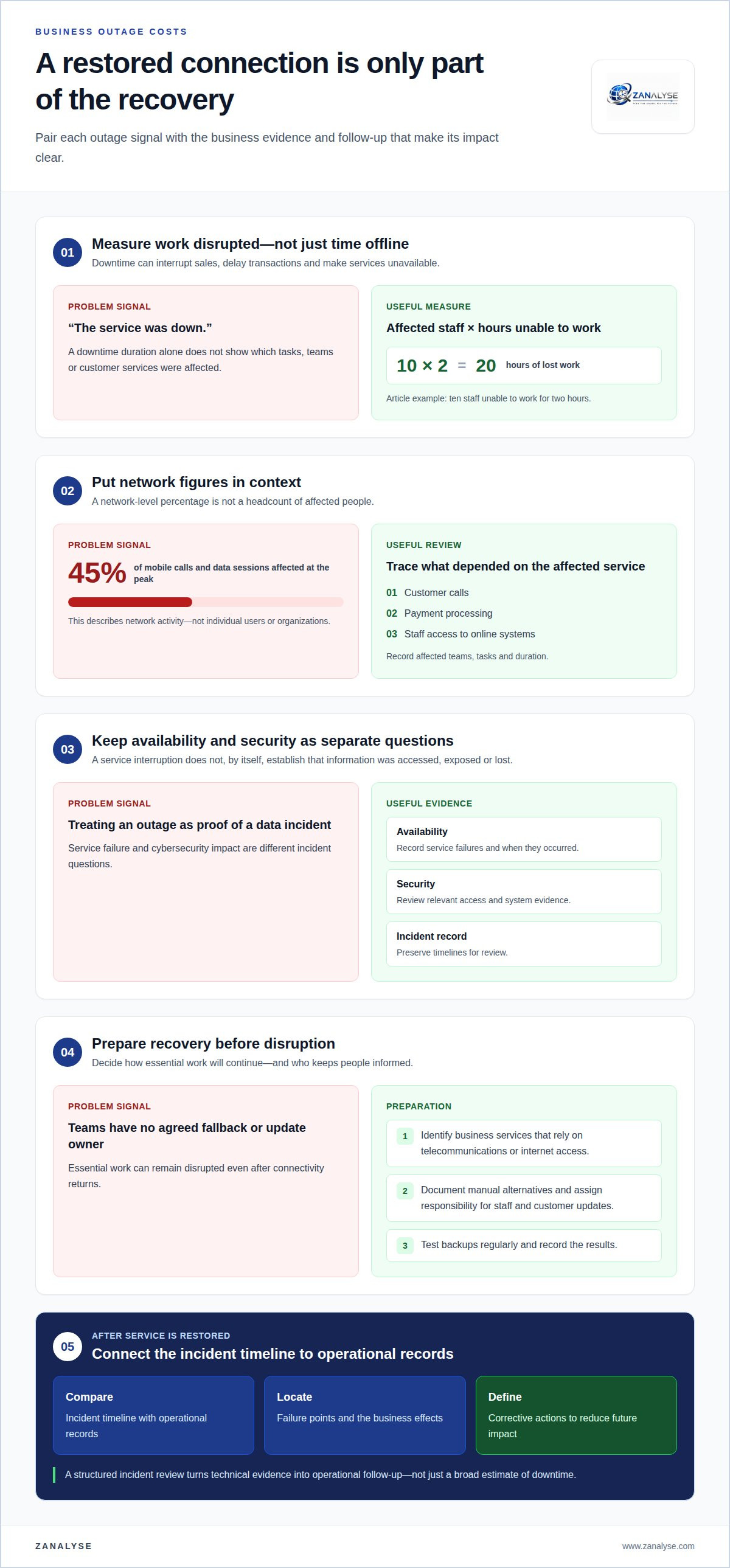
Downtime creates direct and indirect costs. Interrupted sales, delayed transactions and unavailable services can compound quickly. A Melbourne business can estimate lost productivity by multiplying the number of affected staff by the hours they could not work. For example, ten staff unable to work for two hours represent twenty hours of lost work.
During the July 2026 Telstra outage, approximately 45 per cent of calls and data sessions on its mobile network were affected at the peak. That figure describes network activity, not a count of individual users or organizations. For a business, the operational impact depends on which work relies on the affected service, such as customer calls, payment processing or staff access to online systems. Record the affected teams, tasks and duration to build a useful impact estimate.
An interruption alone does not establish that information was accessed, exposed or lost. Track availability and cybersecurity as separate incident questions: record service failures, review relevant access and system evidence, and preserve incident timelines. If an incident involves cross-border data disclosure, Australian Privacy Principle 8 governs that disclosure under Australia’s Privacy Act 1988, according to the Office of the Australian Information Commissioner.
To reduce the impact of future outages, set recovery priorities before disruption occurs. Identify business services that depend on telecommunications or internet access, document manual alternatives, and assign responsibility for updates to staff and customers. Test backups regularly and record the results. After service is restored, compare the incident timeline with operational records to locate failure points and define corrective actions. IT outage analysis in Melbourne can connect technical evidence to business effects, helping managers prioritise improvements instead of relying on broad estimates.
What caused the recent IT outage in Melbourne?
On July 8, 2026, Telstra’s mobile outage was linked to a network time protocol (NTP) fault. NTP helps computer and network systems keep their clocks aligned. The issue involved a Melbourne timing unit called an SSU 2000. When its GPS card, which receives timing information from satellites, restarted, the clock jumped backwards by 19.7 years, from July 2026 to November 2006.
A timing unit was powered up after maintenance. Mobile network impacts began about 70 minutes later. Incorrectly dated information for approximately 30,000 IP address prefixes was blocked from network access. These prefixes are groups of network addresses used to direct traffic. Incorrect timing affected the information that helped the network route connections.
The issue had warning signs. In October 2025, Telstra personnel investigated repeated connection loss between Melbourne’s stratum 3 clock and its Sydney stratum 2 source. These labels describe levels in a time-supply chain: the Sydney source provided time to Melbourne’s clock. Scientific Devices reminded Telstra about a firmware update for the SSU 2000 GPS card in January 2026.
Azure Australia East experienced a separate, nearly 8-hour outage on 29 May 2026. Keep the incidents distinct. For the Telstra review, compare maintenance records, clock changes, network alerts and service impacts in a single timeline. A structured root cause analysis process can help teams organize evidence and corrective actions.
Which Melbourne businesses, services, and regions were affected?
The reported effects varied by organisation and service. At Melbourne’s Tullamarine Airport, some airlines experienced check-in system issues on Friday. Melbourne Airport said domestic and international flight operations could be affected, and advised passengers to allow extra time and monitor flight updates. The incident shows how a network disruption can affect customer-facing services even while the airport itself remains operational.
Health services also had to adapt. Western Health, in Melbourne’s western suburbs, switched to paper-based patient records during the outage. This manual process kept record-keeping moving while changing how staff worked. In an incident review, document which systems failed, what fallback teams used, and how they resumed normal processes.
Essential services did not all experience the same impact. Public-facing emergency services may not experience the same effects as other services during an outage. Ambulance Victoria, ESTA/Triple-0 and Fire Rescue Victoria also said their internal and external communications remained unaffected. Victoria’s electricity system was not affected, although Powercor’s internal corporate IT system was impacted. These examples distinguish public-facing service continuity from disruption to an organization’s internal tools.
Telstra reported delays for some customers, while its fixed and mobile networks continued to operate. The outage therefore did not mean every connection or service in Melbourne stopped. Map impact by location, provider, affected system and business function rather than treating the event as a uniform regional failure. Note both disruption and unaffected services to clarify dependencies and exposure. Use a structured approach to organize incident evidence and identify where service effects differed across teams.
ZANALYSE: ZANALYSE Standard License
The ZANALYSE Standard License gives IT teams a structured way to investigate service disruptions and document findings. Use it after restoration, when the priority shifts from recovering access to understanding why the outage occurred and how to prevent recurrence.
The platform turns logs, timelines and incident data into structured root cause analysis reports. It guides users through recognised techniques and records supporting evidence, confidence scores and corrective actions. Process managers, IT support teams and service providers can work from a shared incident record instead of scattered notes or individual recollections.
For Melbourne teams reviewing telecommunications or internet disruptions, structured analysis can link technical events to business impacts and follow-up actions. ZANALYSE offers the Standard and Full Licenses, annual or multi-annual price plans, and RCA Capacity Top-ups.
Contact ZANALYSE to discuss using structured root cause analysis in your outage review process.
Build a stronger response for the next outage
Use each incident to improve how your teams capture evidence, share findings and assign corrective actions. A consistent process helps IT support staff, process managers and decision-makers turn an urgent disruption into practical operational learning. The aim is not just to close an incident, but to clarify its causes and follow-up for everyone responsible for service reliability.
IT outage analysis in Melbourne can give teams a repeatable way to review incidents and apply lessons to future planning. Agree who records the timeline, where evidence is retained and how corrective actions are tracked. Clear ownership makes the review useful beyond the technical team.
When you’re ready to strengthen your outage review process, contact ZANALYSE about outage analysis. A clear process helps your team move forward with greater control.
Frequently Asked Questions
When will it be fixed?
There is no single restoration time for every outage. For the July 2026 Telstra incident, forecasts ranged from recovery over the next hours and days to resolution by Saturday morning. Systems were expected to be largely back to normal around midday the following day. Track service restoration separately from the availability of business applications that depend on the network.
When did the outage start, and how long did recovery take?
Telstra mobile users began experiencing service impacts around 4am on July 8, 2026, about 70 minutes after Melbourne’s SSU 2000 timing unit was powered up at 2:50 AM. Recovery expectations included Saturday morning and systems largely back to normal around midday the following day. These milestones describe forecasts, not a single measured recovery duration for every affected service.
Which IT providers or systems were involved in the Melbourne outage?
The outage involved Telstra’s mobile network and a timing issue linked to the Melbourne SSU 2000 system. Its GPS card restart caused the clock to move backwards, affecting network information. Telstra’s fixed network continued operating, though some customers experienced delays. Azure Australia East had a separate outage on 29 May 2026, so it should not be conflated with the July Telstra event.
What did affected organizations report about financial losses or recovery costs?
Reported examples describe operational disruption, not a shared financial total. Western Health switched to paper-based patient records, while some airline check-in systems at Melbourne Airport were affected. To assess your organisation’s costs, reconcile incident times with interrupted transactions, staff time, manual workarounds, postponed tasks and recovery expenses. Track these categories separately to show where the greatest operational impact occurred.
Disclaimer
Some content on this website may be generated or assisted by artificial intelligence. While we strive to ensure that all information is accurate, relevant and up to date, AI-assisted content may contain errors or omissions. Content should therefore be considered informational and not as professional advice.


