


With the EU Cyber Resilience Act now enforcing 24-hour incident reporting windows, your manual post-mortem process isn't just slow; it's a legal liability. You know the drill: a major outage hits, and while the technical fire is out, the exhausting work of manual documentation begins. It's repetitive, prone to human error, and often results in inconsistent root cause analysis across different teams. We understand the pressure to maintain audit-ready standards while your staff is already stretched thin. This article shows how you can automate IT incident reports to reduce lead times by 50% without losing the technical depth or evidence required for ISO and DORA compliance. We'll explore the transition from centralized expert silos to a decentralized model that empowers junior staff to generate senior-level reports with confidence and precision.
Key Takeaways
- Learn why automated reporting actually increases technical accuracy by enforcing a rigorous investigative logic that manual processes often skip.
- Discover how to decentralize problem management so junior staff can produce expert-level root cause analysis using intuitive, guided techniques.
- See how you can automate IT incident reports to reduce resolution lead times by 50% while staying audit-ready for strict 2026 regulations.
- Understand how to turn historical incident data into a strategic asset that prevents recurring outages and protects your organization's bottom line.
The Speed vs. Quality Fallacy in IT Incident Reporting
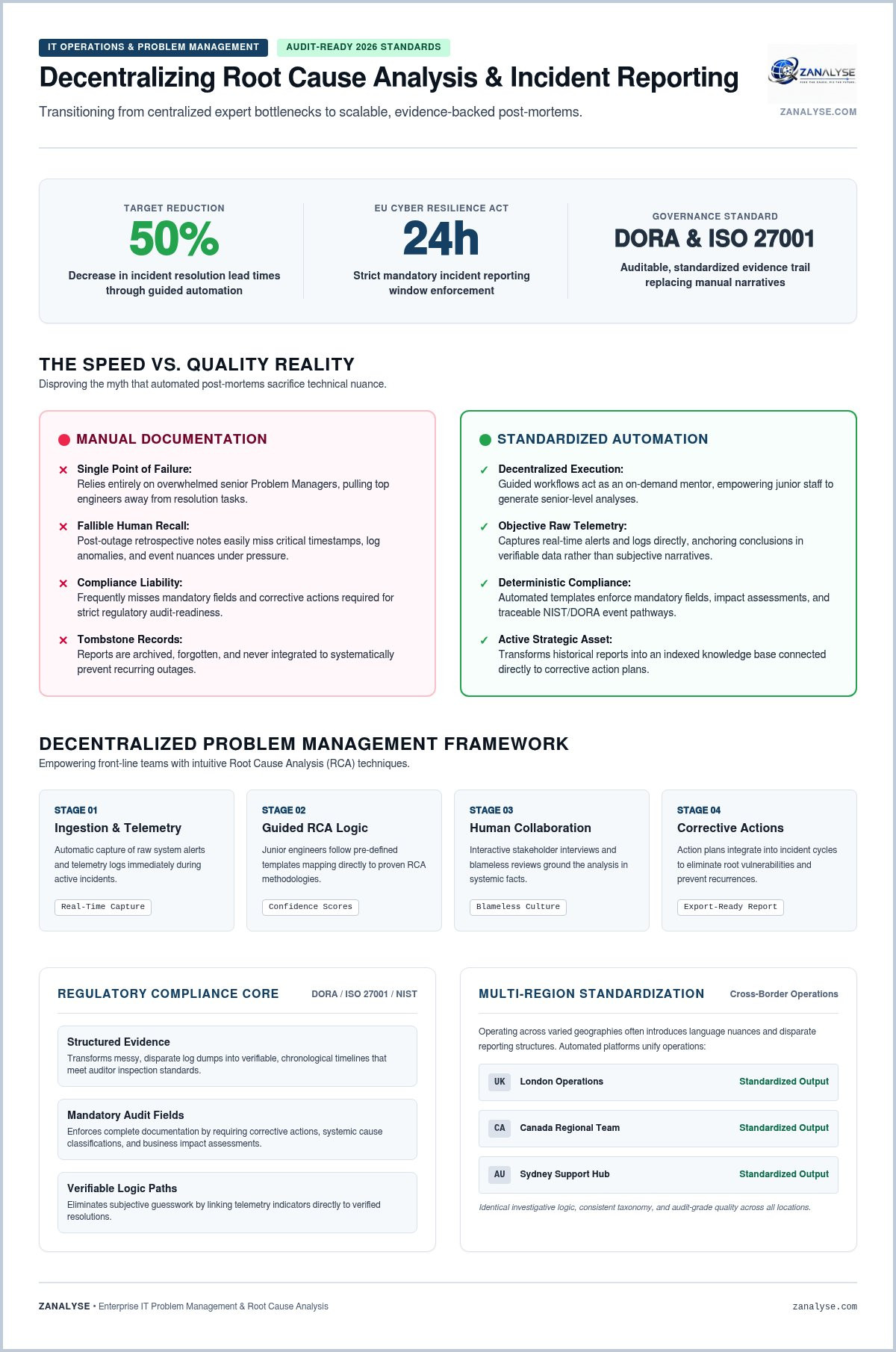
A common myth suggests that automated reports are surface-level documents lacking the technical nuance required by senior stakeholders. In reality, manual reporting is often the weaker link. Human memory is fallible. It's especially unreliable during high-pressure outages where details are easily lost. When you choose to automate IT incident reports, you aren't just gaining speed. You're implementing a structured logic that prevents experts from skipping critical investigative steps. Automation captures raw telemetry and system alerts in real time, creating an evidence trail far more accurate than any retrospective manual entry.
Modern platforms utilize confidence scores to validate these findings. Instead of guessing, the system maps events to proven root cause analysis methodologies. This ensures every conclusion is backed by hard data from logs and timelines. It moves the process from an opaque narrative to a transparent, auditable sequence of events. This level of precision provides commercial leaders with the clarity they need and allows junior staff to contribute meaningfully to complex investigations.
Meeting DORA and ISO 27001 Rigor Without the Manual Effort
Compliance isn't optional, yet manual reporting frequently fails to meet the strict DORA incident reporting requirements. Auditors demand verifiable evidence, not just summaries. Automated templates bridge this gap by ensuring consistency across every submission:
- Structured Evidence: Transform chaotic log files into auditable timelines.
- Mandatory Fields: Ensure corrective actions and impact assessments are never omitted.
- Verifiable Logic: Provide a clear path from alert to resolution that any auditor can follow.
It's the most reliable way to achieve audit-ready compliance while reducing the administrative burden on your technical staff. By standardizing the evidence trail, you protect the organization from the fear of audit failure and ensure that every report meets the highest governance standards.
Myth: Automated RCA is a "Black Box" Only Experts Can Trust
The assumption that high-quality root cause analysis requires a senior Problem Manager is a bottleneck you can't afford. Organizations often struggle because their most experienced engineers are constantly pulled into documentation tasks. This creates a single point of failure. When you automate IT incident reports, you remove this reliance on a few overwhelmed experts. Guided workflows and a vast library of pre-defined RCAs act as an on-demand mentor for junior staff. They can produce senior-level results by following established investigative paths.
This shift changes the organizational culture from "who is the expert?" to "what does the evidence say?". By following the documentation standards found in the NIST Computer Security Incident Handling Guide, teams ensure every report is a strategic asset rather than just a box-ticking exercise. It's about distributing knowledge across the entire team. If you want to see how this works in practice, you can explore our intuitive RCA platform.
Scaling Problem Management Across Global IT Teams
Maintaining a standardized problem management workflow is difficult when teams are spread across Canada, Australia, and Europe. Time zones and language nuances often lead to inconsistent terminology. Automated reporting solves this by enforcing a uniform structure. It ensures that a report generated in London follows the exact same logic and evidence requirements as one from Sydney. This consistency reduces the pressure on local SMEs. It ensures every stakeholder receives a high-quality, readable document regardless of who authored it.
Turning Incident Reports from Historical Records into Strategic Assets
Many teams treat the incident report as a tombstone for a resolved issue. Once filed, it's archived and forgotten. This reactive approach ignores the long-term value of structured data. When you automate IT incident reports, the document becomes a living strategic asset. It creates a searchable organizational knowledge base that prevents recurring failures. By integrating corrective action plans directly into the reporting lifecycle, you ensure that lessons learned are actually applied. Achieving a 50% reduction in incident lead time is only possible when reports drive these proactive changes rather than just documenting the past.
This transition requires a shift in how teams perceive the review process. Adopting a blameless postmortem culture ensures that the focus remains on systemic improvements rather than individual errors. Automated workflows make this easier by presenting objective evidence that guides the discussion toward permanent structural fixes. It moves the conversation from "what went wrong?" to "how do we prevent this forever?".
Building a Proactive IT Organization with Evidence-Based RCA
Moving beyond a culture of blame requires using established RCA methods to identify the true origin of a failure. High-quality reports provide the data needed to justify infrastructure investments or capacity top-ups to senior leadership. Instead of making anecdotal requests, you present evidence-backed trends that commercial decision makers can understand. This link between automated reporting and operational intelligence leads to long-term stability. It transforms the IT department from a reactive fire-fighting unit into a disciplined, proactive force that protects service margins and organizational integrity.
Transitioning to a Mature Incident Reporting Framework
The shift toward automation is no longer a matter of convenience; it's a requirement for operational stability in 2026. You've seen how moving beyond manual documentation eliminates the fallacy that speed sacrifices quality. By implementing a decentralized model, you empower every member of your team to produce expert-level results. When you automate IT incident reports, you aren't just saving time. You're building a searchable knowledge base that prevents the same failures from recurring. This structured approach reduces incident lead times by over 50% and ensures your organization remains audit-ready for ISO and DORA compliance. It's time to replace repetitive manual tasks with a precise, evidence-based workflow that protects your service margins.
See how ZANALYSE Standard License automates your RCA workflow. Take control of your operational resilience and lead your team toward a more predictable, secure future.
Frequently Asked Questions
Can automated incident reports really satisfy DORA regulators?
Automated reports are specifically designed to meet the rigorous evidence requirements of the Digital Operational Resilience Act. DORA mandates strict windows, including initial notifications within 4 hours of classification. By using ZANALYSE, teams generate audit-ready documentation that captures every required technical detail. It ensures your submissions are consistent, verifiable, and compliant with the latest 2026 regulatory standards across Europe.
How does ZANALYSE handle complex incidents with multiple root causes?
ZANALYSE manages complexity by guiding users through a vast pool of included RCAs and established investigative techniques. Instead of identifying a single point of failure, the platform maps multiple causal paths using structured evidence. It provides confidence scores for each finding, allowing teams to validate complex interactions between different systems. This methodical approach ensures that even multi-layered incidents are documented with technical precision.
Do I still need a Problem Manager if we automate IT incident reports?
Automation doesn't eliminate the need for oversight, but it does remove the requirement for a centralized bottleneck. When you automate IT incident reports, you decentralize problem management across your entire organization. Senior experts shift their focus toward long-term strategic improvements while junior staff use guided workflows to produce high-quality reports. This model scales expertise across teams in Canada, Australia, and Europe effectively.
What kind of data sources are needed to automate an IT incident report?
To automate IT incident reports, the platform ingests raw data from system logs, incident timelines, and monitoring alerts. ZANALYSE transforms these fragmented data points into a cohesive, structured narrative. You don't need manual hardware log collectors; instead, the system utilizes existing digital telemetry to build a verifiable evidence trail. This ensures that every report is grounded in hard facts rather than human recall.
Disclaimer
Some content on this website may be generated or assisted by artificial intelligence. While we strive to ensure that all information is accurate, relevant and up to date, AI-assisted content may contain errors or omissions. Content should therefore be considered informational and not as professional advice.


