


Automation doesn’t remove the need for human judgment during a production incident. Automated root cause analysis software in Canada can bring logs, timelines and incident data together to surface likely causes, organize evidence and guide corrective actions. People still validate the findings and decide what to do next.
Manual analysis remains valuable, especially when context is incomplete or an incident is unusually complex. But reconstructing events across scattered records can slow investigations and make findings harder to document consistently. This article explains what root cause analysis tools do, how AI-supported analysis compares with manual methods, and when each approach is useful. You’ll also see how structured techniques such as the 5 Whys help teams move beyond symptoms toward causes and preventive actions.
Key Takeaways
- AI can help connect incident evidence across logs and timelines, but teams still need to assess whether a proposed cause fits the operational context.
- Machine-learning methods can surface patterns across incident data; structured RCA techniques help turn those patterns into evidence-backed findings and corrective actions.
- Manual analysis offers human context, while automation can make investigations more consistent. Choose the balance based on incident complexity and the evidence available.
- ZANALYSE Standard License supports structured root cause analysis, helping IT teams share problem-management work beyond a small group of specialists.
Can an AI agent find the root cause of a production incident?
An AI agent can connect incident evidence and suggest a likely cause, but people must judge whether the evidence supports it. In IT incident management, this is the difference between a useful lead and a verified finding. A timeline may show that a disruption followed a system change, for example, but timing alone doesn’t prove causation.
IT Incident RCA and Incident Data
Root cause analysis examines why an IT incident occurred by considering current signals and historical records. Comparing a service outage with earlier incidents can reveal recurring patterns. Teams can document findings, assign corrective actions and track progress in an incident report. Workplace investigations may involve physical safety, so the evidence must match the event being examined, rather than relying only on IT records.
Tool Features and Integrations
RCA tools vary in how they collect evidence, build timelines, guide analysis and document findings. When comparing automated root cause analysis software in Canada, assess how each option handles relevant logs, incident data, evidence review and corrective actions. Integrations matter when records are spread across systems. Combining service alerts with incident records, for instance, can help analysts see what changed before an outage.
Canadian privacy and security requirements vary by organization, sector and the information being handled. Assess access controls, data handling, retention, audit records and safeguards for sensitive incident details.
Canadian data residency depends on where information is hosted and processed. Compare documented storage and processing locations with your organization’s data-handling requirements.
Implementation involves defining workflows, connecting relevant data sources, setting access roles and testing reports. Start with a representative incident to assess the quality of its evidence.
For Canadian organizations selecting automated root cause analysis software, key risks include incomplete data, weak access controls and treating AI suggestions as proven causes. Require evidence review and record who approved each corrective action.
AI- and machine-learning-driven RCA
Machine-learning-driven root cause analysis uses incident records to identify patterns that may explain service failures. An AI system can group related events, compare them with earlier incidents and rank possible causes for investigation. If repeated outages follow a particular type of configuration change, for example, the system can surface that relationship for review. This helps analysts focus on evidence instead of searching every record manually.
The result depends on data quality and context. A useful investigation may draw on event timestamps, system logs, incident descriptions and records of recent changes. Inconsistent timestamps or incomplete incident reports can make a pattern misleading. Treat an AI-generated cause as a hypothesis, then compare it with the event sequence and operational context before deciding which corrective actions to take.
Different analysis methods can complement machine learning. Pareto analysis uses an approximation that 80% of effects come from 20% of causes, helping teams prioritize recurring contributors. A cause-and-effect, or fishbone, diagram organizes possible causes into categories; Kaoru Ishikawa created this method in the 1960s. These methods give teams a structured way to examine patterns that an automated system surfaces.
Keep people accountable for validating findings and tracking actions. A practical review checks whether the proposed cause fits the timeline, whether other evidence supports it, and whether the corrective action addresses that cause. If teams want a structured way to organize this work, RCA workflows and reporting can be part of their evaluation.
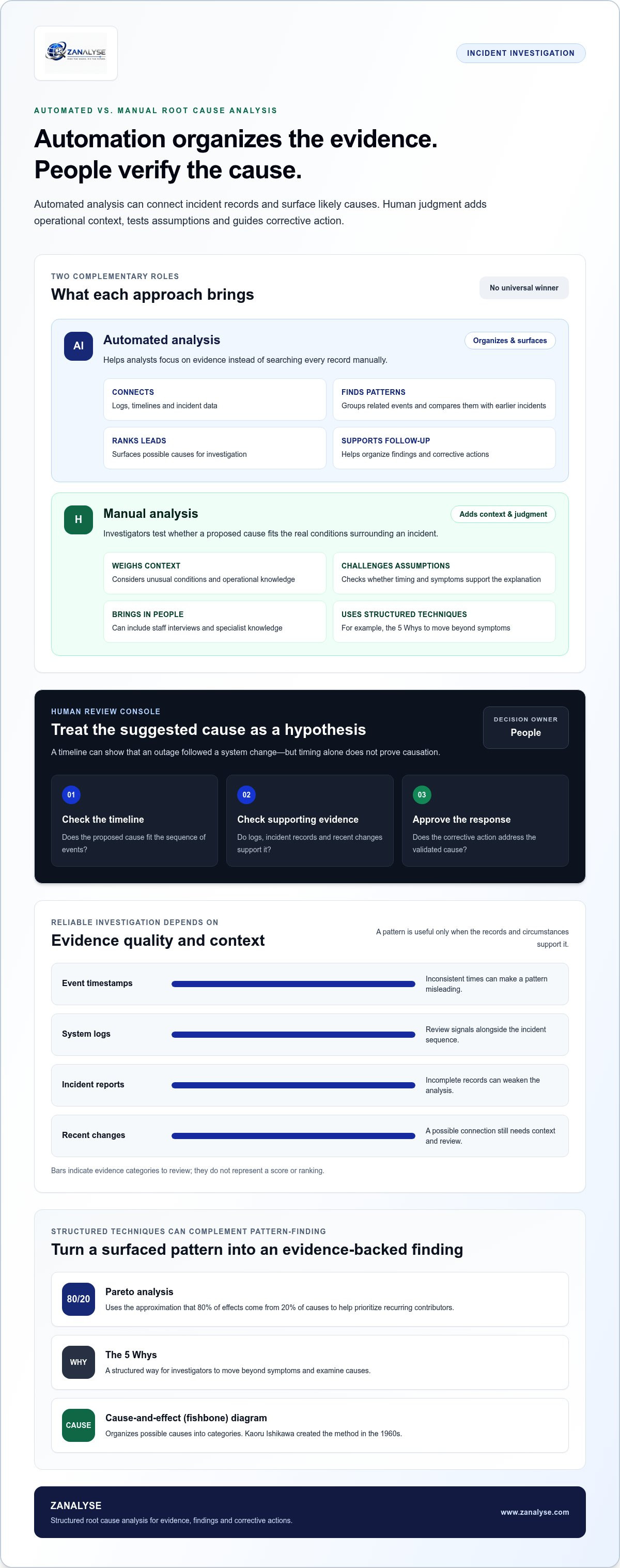
Automated versus manual root cause analysis
Automated analysis helps teams organize evidence and spot recurring patterns; manual analysis adds context and challenges assumptions. Software might connect an outage with a recent change, for example, while an analyst checks whether that change explains the symptoms. The strongest approach gives each method a clear role.
Which platforms work best for Canadian organizations? There’s no universal winner. Compare how each tool handles your incident records, evidence, integrations, reporting and data requirements. A platform is useful when its findings fit your investigation process and your team can review how it reached them.
AI-powered RCA can organize large sets of incident evidence, highlight recurring patterns and help teams prioritize investigations. Its limits include incomplete records, misleading correlations and missing operational context. Treat its output as a lead, then have a responsible person test the proposed cause against the evidence before approving corrective actions.
Manual analysis gives investigators room to weigh unusual conditions, interview staff, and apply techniques such as the 5 Whys. It can be slower when evidence sits across separate records or specialists hold key knowledge. Automation can make evidence review more consistent, but it can’t replace informed judgment when an incident has several contributing causes.
Canadian industries with complex IT operations, including finance, healthcare, manufacturing, and telecommunications, can use RCA software to investigate service disruptions. The right fit depends on the incidents teams need to resolve, the data they can use, and how they document follow-up. Explore structured RCA workflows to see how automation can support a consistent investigation process.
ZANALYSE: ZANALYSE Standard License
ZANALYSE Standard License gives IT teams a structured way to investigate incidents using logs, timelines and incident data. It guides users through established root cause analysis techniques and helps produce reports with evidence, confidence scores and corrective actions. It can suit teams that want process managers, support personnel and other IT staff to contribute to problem management, rather than concentrating every investigation among a small group of specialists.
Choose a Standard License when structured RCA workflows fit your team’s needs. ZANALYSE also offers a Full License, annual or multi-annual price plans, and RCA Capacity Top-ups. These options accommodate different licensing and capacity needs while supporting consistent investigations and documented findings.
To discuss how ZANALYSE can fit your RCA process, contact ZANALYSE.
Make Your Next RCA Process More Consistent
Start with a practical assessment: identify a recurring incident type, map where its evidence currently lives and decide who should review proposed causes. This gives your team a focused way to assess automated root cause analysis software in Canada against its actual workflow, rather than an abstract feature list. Agree on how investigators will document supporting evidence, assign corrective actions and track whether those actions address the underlying cause.
Then consider how to make root cause analysis accessible to the people involved in service delivery. A shared, structured approach can help process managers, IT support staff and decision-makers contribute while maintaining accountability for findings. The goal isn’t automation for its own sake. It’s a repeatable process your team can apply to incidents and learn from over time.
Contact ZANALYSE to discuss your RCA process and consider a clear next step for your team.
Frequently Asked Questions
What Are Root Cause Analysis Tools?
Root cause analysis tools help teams organize investigations and preserve findings. After a service outage, for example, a team can record the affected service, key events, suspected contributing factors and assigned follow-up actions in one investigation record. Later reviewers then have a clearer basis for understanding the decisions and checking whether the same issue recurs.
Does it show evidence chains and confidence for each hypothesis?
ZANALYSE provides confidence scores for each hypothesis and retains an audit trail of inputs, questions, answers and revisions for the life of the record. Reviewers can trace how an investigation developed and see which information informed a proposed cause. A confidence score supports review, but the team still decides whether the evidence justifies accepting a hypothesis.
Should you build or buy automated RCA?
Buy when an existing platform fits your investigation workflow and your team wants established RCA methods without having to build and maintain them. Build when your organization has distinct requirements and the technical capacity to own the system over time. For Canadian organizations, include data handling, access governance, integration needs and ongoing maintenance in the decision, not just the initial development effort.
What does production-grade automated RCA architecture look like?
A sound design separates evidence intake, analysis, review and recordkeeping. It should preserve the source and timing of relevant information, present proposed findings for human review and capture decisions and revisions in the investigation record. For example, an incident timeline should let reviewers connect an event to its source record rather than rely on an unsupported summary.
Why does automated RCA matter now?
Automated RCA is useful when incident knowledge is spread across teams and records, making consistent investigations difficult to sustain. A structured process helps organizations retain reasoning beyond the people who handled a particular outage. A new support analyst, for example, can review an earlier investigation’s evidence and decisions before addressing a recurring service problem, instead of starting over with scattered notes.
Disclaimer
Some content on this website may be generated or assisted by artificial intelligence. While we strive to ensure that all information is accurate, relevant and up to date, AI-assisted content may contain errors or omissions. Content should therefore be considered informational and not as professional advice.


