

Manual root cause analysis remains one of the most significant drains on senior engineering talent, often leaving IT leaders caught between operational recovery and strict regulatory deadlines. You likely recognize the frustration of inconsistent report quality and the looming pressure of DORA or ISO 27001 audits. The ZANALYSE Standard License provides a stabilizing force in these high-pressure environments by automating the transition from raw logs to structured, evidence-based insights.
This guide explores how the ZANALYSE Standard License decentralizes problem management across your entire team, reducing incident lead times by over 50%. We'll examine the core capabilities that transform chaotic incident data into audit-ready reports with clear confidence scores. You'll discover how to move away from temporary fixes toward a mature, structured approach that protects your process integrity and significantly lowers your mean time to repair.
Key Takeaways
- Meet DORA and ISO 27001 requirements by automating root cause analysis, cutting incident lead times by more than 50%.
- See how the ZANALYSE Standard License decentralizes problem management, allowing all IT personnel to generate structured reports without specialized training.
- Evaluate the technical and commercial differences between license tiers to ensure your organization has the right capacity for upcoming infrastructure migrations.
- Secure your operational foundation before the October 2026 general release by leveraging early-bird pricing and multi-year commitment discounts.
Scaling RCA Capabilities Beyond the Incident Team
Traditional IT organizations often treat Root Cause Analysis (RCA) as a specialist discipline reserved for a handful of senior architects. This creates a dangerous bottleneck. When an incident occurs, teams wait for these experts to become available, which extends the mean time to repair (MTTR) and stalls progress. It's a stabilizing force for technical operations when this knowledge is shared. The ZANALYSE Standard License changes this dynamic by putting expert-level capabilities into the hands of every team member. It acts as a mentor for junior sysadmins, guiding them through complex troubleshooting workflows without needing a senior engineer present at every step.
The Compliance Crisis in Modern IT
Manual processes are failing under the weight of new regulations. Relying on disorganized spreadsheets or verbal debriefs no longer meets the rigorous standards of the Digital Operational Resilience Act (DORA). If your evidence is inconsistent, you risk failing ISO 27001 audits. Audit-ready reports require more than just a guess; they demand a verifiable cause chain. The compliance gap exists because manual logs lack the structure and confidence scoring required to prove a permanent fix was implemented.
Empowering the Front Line
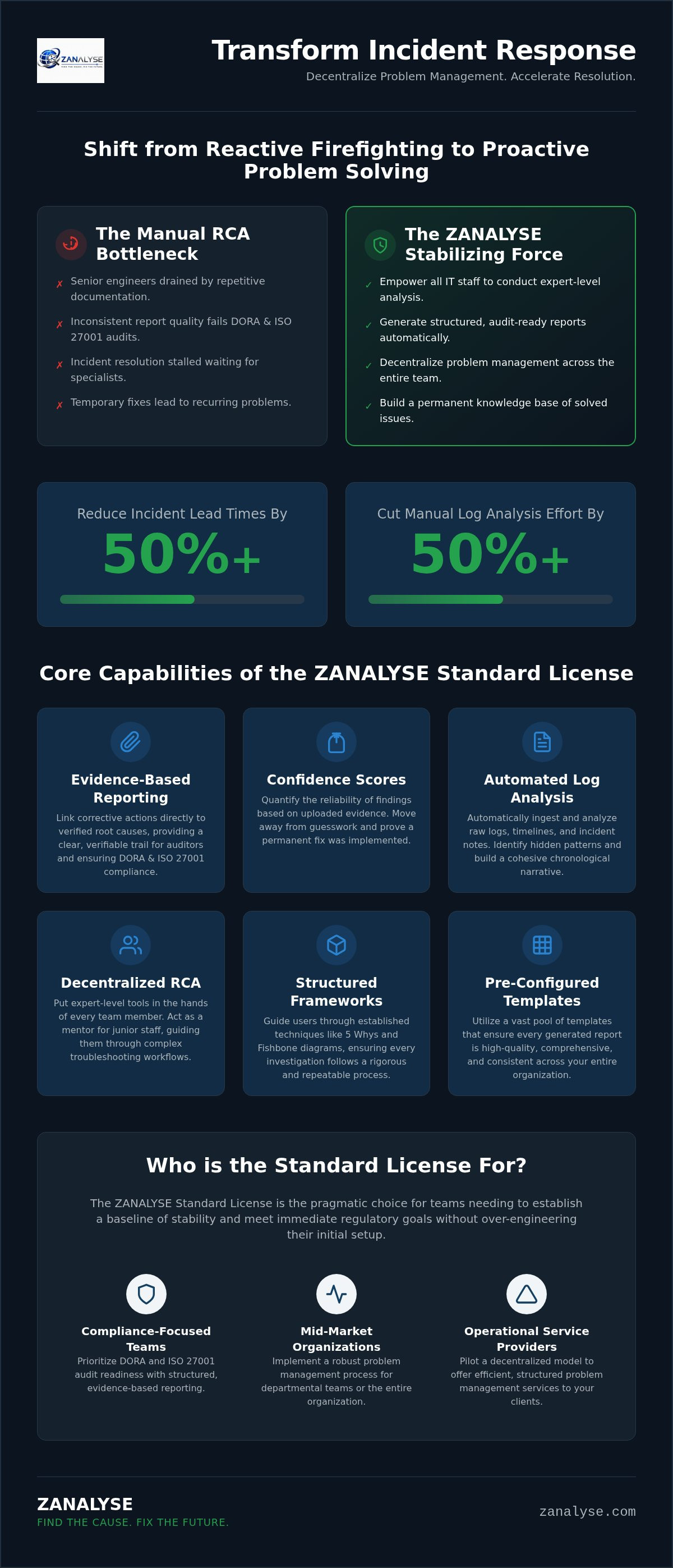
Instead of escalating every issue, front-line IT staff can now identify root causes independently. This shift reduces the constant firefighting burden on senior leaders. The ZANALYSE Standard License offers a vast pool of pre-configured templates that ensure every report is high-quality and audit-ready. By decentralizing these tasks, you transition from a reactive posture to a proactive model of problem management. Senior engineers don't have to spend their time on repetitive documentation and can focus on strategic improvements instead. When every staff member contributes to the knowledge base, the entire department becomes more resilient.
Core Features of the ZANALYSE Standard License
The ZANALYSE Standard License serves as the essential foundation for organizations seeking to professionalize their incident response. It doesn't just store data; it provides a comprehensive framework for root-cause analysis that translates technical chaos into actionable business value. By guiding users through established techniques like the 5 Whys and Fishbone diagrams, the platform ensures every investigation follows a rigorous, repeatable process. This structure is critical for maintaining consistency across different IT teams and service providers.
Automated Log and Timeline Analysis
Raw log files are frequently overwhelming and difficult to parse during high-pressure outages. This license automates the ingestion of logs, timelines, and incident notes, reducing manual effort by over 50%. It identifies hidden patterns that manual analysis often overlooks, turning fragmented data points into a cohesive chronological narrative. This shift allows your staff to focus on solving the problem rather than getting lost in data entry. The intuitive navigation ensures that even those outside the core incident team can contribute effectively.
Evidence-Based Reporting and Confidence Scores
High-quality reporting is the backbone of ITIL maturity and regulatory compliance. Every report generated includes a confidence score, which quantifies the reliability of the findings based on the uploaded evidence. This feature is vital for DORA compliance. It links corrective actions directly to verified root causes, providing a clear trail for auditors. By using the ZANALYSE Standard License, you build a permanent organizational knowledge base of solved issues. It's a structured way to ensure your automated problem management process remains audit-ready and resilient at all times.
ZANALYSE Standard vs. Full License: Which is Right for You?
Choosing the right tier depends on your organization's current maturity and future scale. While both licenses utilize the same core methodology for Root Cause Analysis, they serve different operational scopes. The ZANALYSE Standard License is the pragmatic choice for teams that need to establish a baseline of stability without over-engineering their initial setup. It provides a structured entry point that respects your time and technical expertise.
Standard License Use Cases
This tier is ideal for mid-market organizations or specific departmental teams focusing on immediate regulatory requirements. It's built for those who value intuitive navigation and straightforward functionality. Consider the Standard tier if your primary goals include:
- Prioritizing DORA or ISO 27001 audit readiness with structured evidence.
- Piloting a decentralized problem management model across general IT staff.
- Applying core RCA techniques like the 5 Whys without requiring complex enterprise integrations.
Full License Differentiators
For global, multi-region IT organizations, the Full License extends beyond the initial analysis phase. It's designed for high-volume environments that require complete lifecycle automation and advanced reporting. You should evaluate the Full tier if your organization demands:
- Automation of the entire problem management lifecycle from detection to closure.
- Advanced analytics and reporting for complex, multi-region infrastructures.
- Deep integration capabilities with broader ITIL ecosystems and existing toolsets.
Your investment remains future-proof regardless of where you start. Many organizations begin with a ZANALYSE Standard License to stabilize their internal processes and reduce incident lead times. Transitioning to the Full tier is a logical, managed step as your organizational knowledge matures and your operational needs expand.
Capacity and Growth: Managing Your RCA Volume
Managing technical operations requires more than just the right tool; it requires a predictable way to handle fluctuating incident volumes. The ZANALYSE Standard License addresses this through scalable capacity plans designed to grow with your organization. Instead of worrying about rigid user limits, you focus on the number of analyses your team actually needs. This approach allows you to predict your annual requirements based on historical incident data, ensuring your budget remains as stable as your infrastructure.
Understanding RCA Capacity Top-ups
High-pressure events like major infrastructure migrations often lead to a temporary spike in technical issues. When you exceed your included RCA pool, RCA Capacity Top-ups provide a flexible way to maintain momentum without the need to change your entire license tier. This ensures your teams don't lose access to automated analysis during critical periods. These top-ups act as a safety net, preventing service degradation during outages by ensuring every incident is documented with the same level of rigor as the first.
Annual and Multi-Annual Planning
Strategic leaders look beyond immediate needs toward long-term budget stability. Multi-annual price plans allow you to lock in capacity for long-term IT transformation projects, protecting your department from future price fluctuations. This approach aligns perfectly with 2026 fiscal planning for financial institutions facing strict DORA mandates. By securing your investment early, you ensure that process integrity remains a permanent part of your operational culture. It's a pragmatic way to move from temporary fixes to a mature, structured environment.
Ready to secure your team's operational future? Explore our multi-annual price plans to lock in your capacity today.
Securing Your Investment: Annual Plans and Early-Bird Pricing
Moving from manual spreadsheets to a structured platform is a critical step for any IT leader aiming for operational excellence. Fragmented data and inconsistent reports are operational risks you can't afford. The ZANALYSE Standard License provides the necessary framework to make this transition seamless. By adopting the Early-bird Pricing Plan before the general availability launch on October 1, 2026, you maximize your return on investment while securing a stabilizing force for your technical operations. This early commitment lowers the total cost of ownership for the first 24 months and positions your organization as a pioneer in automated DORA compliance.
Early-Bird Advantages
Early adopters gain more than just financial benefits. You secure priority support and implementation guidance from the experts at ZANGAARD, a brand known for stability and innovation in digital solutions. This partnership ensures your team isn't just buying a tool; you're adopting a better way of working that protects process integrity. It's the expert mentorship your team needs during high-pressure outages. By acting now, you ensure your department is audit-ready well before the 2026 regulatory deadlines.
Implementation and Onboarding
The onboarding process is designed for maximum efficiency. Because ZANALYSE is a pure SaaS platform, there's no need for complex on-premise installation or expensive hardware log collectors. Your team can be fully trained and generating structured, audit-ready reports in under a week. This rapid deployment means you start reducing incident lead times by over 50% almost immediately. It's time to replace temporary fixes with permanent structural improvements that respect your staff's expertise and time.
Take the next step in your technical evaluation and procurement process. Secure your ZANALYSE Standard License early-bird plan today to ensure your department is ready for the regulatory challenges of 2026 and beyond.
Building a Resilient Operational Foundation
Transitioning from reactive firefighting to a mature, decentralized problem management model is no longer optional for modern IT leaders. By adopting the ZANALYSE Standard License, your organization gains the ability to reduce incident lead times by over 50% while maintaining absolute compliance with DORA and ISO 27001 standards. This SaaS platform, backed by the expert innovation of ZANGAARD Digital Solutions, ensures that every team member can produce high-quality, audit-ready reports with verifiable evidence scores. You aren't just buying a tool; you're securing a long-term strategy for operational stability and process integrity.
Don't wait for the next major outage to professionalize your root cause analysis. View ZANALYSE Standard License Pricing and Early-Bird Options to lock in your ROI before the October 2026 launch. This is a methodical step toward achieving lasting clarity and control over your technical environment.
Frequently Asked Questions
What is the main difference between the ZANALYSE Standard and Full License?
The primary difference lies in operational scope and automation depth. The ZANALYSE Standard License focuses on decentralizing root cause analysis and ensuring DORA compliance through structured reporting. In contrast, the Full License automates the entire problem management lifecycle, offering advanced global reporting and deeper integrations with complex ITIL ecosystems. Standard is the pragmatic starting point for most mid-market teams.
How does the Standard License help with DORA compliance?
The ZANALYSE Standard License automates the evidence collection process required by the Digital Operational Resilience Act. It transforms raw incident data into structured reports that include clear cause chains and confidence scores. This ensures your documentation is audit-ready and consistent across all teams. By replacing manual spreadsheets with this automated framework, you significantly reduce the risk of non-compliance.
Can I buy extra RCA capacity if I have a major incident year?
Yes, you can manage incident spikes by purchasing RCA Capacity Top-ups. This flexibility allows your organization to add more analysis runs to your existing license without changing tiers. It's an ideal solution during major infrastructure migrations or unexpected high-volume periods. These top-ups ensure your team maintains momentum and keeps lead times low even when operational pressure increases.
Does ZANALYSE require on-premise installation for log analysis?
ZANALYSE is a browser-based SaaS platform that requires no on-premise installation. You don't need to deploy hardware log collectors or manage complex local software updates. Users simply upload logs, timelines, and incident notes directly through the secure interface. This streamlined approach allows your team to begin conducting professional root cause analysis in under a week without technical overhead.
When will the ZANALYSE Standard License be available for purchase?
The ZANALYSE Standard License is scheduled for general availability on October 1, 2026. IT leaders can currently leverage the Early-bird Pricing Plan to secure their investment before the official launch. This early access allows organizations to begin planning their transition from manual processes to a more mature, automated problem management framework while locking in favorable commercial terms.
Is there an early-bird discount for multi-annual plans?
Yes, early adopters benefit from the Early-bird Pricing Plan available until the October 2026 launch. Additionally, multi-year commitments provide significant budget stability. A three-year term includes a 10% discount on the final year, while a five-year commitment offers a 15% discount on the final year. These plans are designed to help organizations manage long-term fiscal planning effectively.
How does the confidence score in RCA reports work?
The confidence score quantifies the reliability of your findings based on the strength of the uploaded evidence. It evaluates how well the logs and timelines support the identified root cause. This metric is essential for ITIL maturity, as it provides auditors and stakeholders with a clear indication of data certainty. It helps teams move away from guesswork toward evidence-based decision-making.
Does the Standard License support ISO 27001 incident reporting?
Yes, the Standard tier is built to satisfy the rigorous documentation requirements of ISO 27001. It ensures that incident evidence is collected consistently across different IT departments and service providers. The resulting reports provide the transparency and structure needed during compliance audits. By using this tool, you create a permanent organizational knowledge base that supports long-term process integrity.
Disclaimer
Some content on this website may be generated or assisted by artificial intelligence. While we strive to ensure that all information is accurate, relevant and up to date, AI-assisted content may contain errors or omissions. Content should therefore be considered informational and not as professional advice.


