

Can your IT operations realistically classify a major incident and notify regulators within a four-hour window while your team is still scrambling through messy logs? You likely feel the pressure of the dora incident reporting requirements, where the ambiguity of classification criteria often causes more friction than the technical failure itself. It's a high-pressure environment; every minute spent debating a 'major incident' status is a minute lost against a ticking regulatory clock.
This guide helps you master DORA’s complexities to ensure your organization remains audit-ready and compliant by 2026. We'll break down the latest classification criteria, provide a clear reporting roadmap, and show how automated root cause analysis can reduce incident lead times by over 50%. You'll learn how to transform chaotic log data into structured evidence that satisfies both technical staff and commercial decision-makers, bringing order to your compliance strategy.
Key Takeaways
- Navigate the 3-step reporting cycle, starting with the critical four-hour initial notification window that serves as the most demanding compliance hurdle.
- Understand the seven classification criteria and materiality thresholds to accurately identify when a disruption triggers the official dora incident reporting requirements.
- Learn how to replace manual RCA bottlenecks with automated evidence collection, generating structured reports and confidence scores directly from messy logs.
- Empower your entire IT staff to decentralize problem management, reducing incident lead times by over 50% while maintaining a state of constant audit-readiness.
The 3-Step DORA Reporting Cycle: Timelines and Obligations
Compliance with the dora incident reporting requirements isn't a single event; it's a methodical process. Regulators expect a chain of evidence that begins the moment a disruption surfaces and ends only when the organization proves it has eliminated the underlying vulnerability. This cycle forces IT teams to move away from ad-hoc troubleshooting toward a structured, audit-ready workflow.
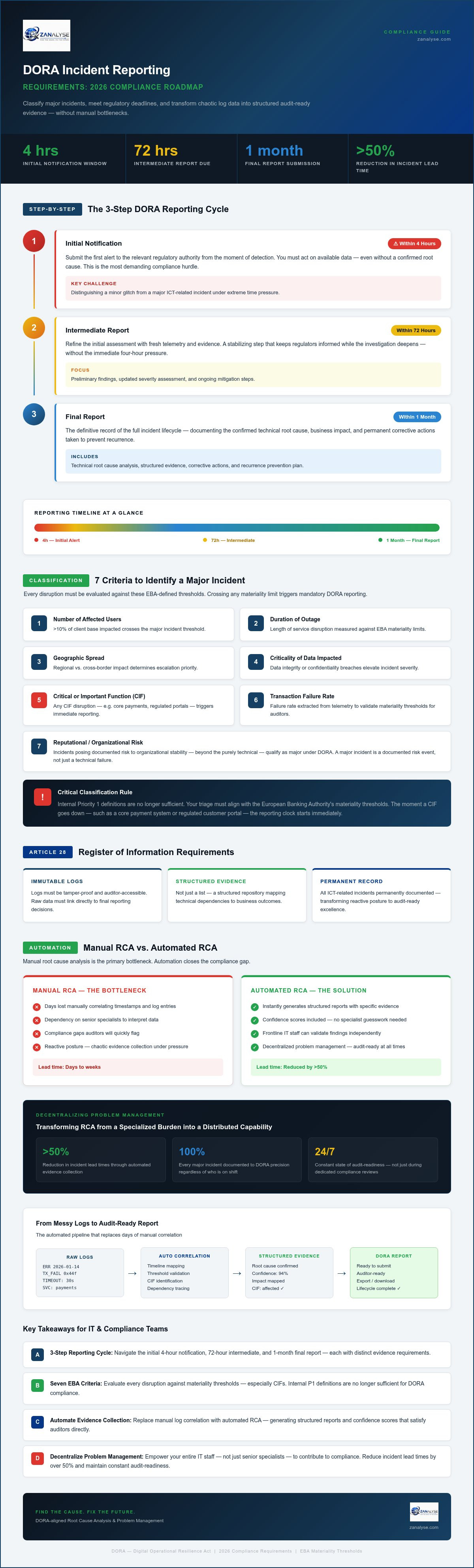
The initial notification represents the most significant operational hurdle. You have only four hours from the moment of detection to inform the relevant authority. At this stage, teams often struggle to distinguish between a minor glitch and a major ICT-related incident. Waiting for perfect information is a luxury you don't have. You must act on the data available, even if the root cause remains hidden within messy logs.
The intermediate report follows as the situation evolves. This phase allows you to refine the initial assessment with fresh telemetry and evidence. It's a stabilizing step that keeps regulators informed without the immediate pressure of the four-hour clock. Finally, you must submit a comprehensive closing document to settle the matter.
Navigating the Reporting Deadlines in 2026
Meeting these milestones requires a clear understanding of the 2026 timeline:
- 4 Hours: Initial notification due after detection of a major incident.
- 72 Hours: Intermediate report providing detailed status updates and preliminary findings.
- 1 Month: Final report submission detailing the full incident lifecycle.
In a modern, automated monitoring environment, detection happens the second an alert triggers based on pre-defined materiality thresholds. The Final Report serves as the definitive record of the incident's lifecycle, documenting the technical root cause and the permanent corrective actions taken to prevent recurrence.
Classifying Major ICT-Related Incidents under DORA
Classification is the pivot point for compliance. Under the dora incident reporting requirements, you must evaluate every disruption against seven specific criteria to determine if it qualifies as a major incident. These include the number of affected users, duration of the outage, geographic spread, and the criticality of the data impacted. It's no longer enough to rely on internal Priority 1 definitions; your triage must align with the European Banking Authority's thresholds for materiality.
A glitch becomes a major incident the moment it hits these defined limits. For instance, if a service disruption affects more than 10% of your client base or impacts a Critical or Important Function (CIF), you've likely crossed the line. Identifying these CIFs early is essential because they dictate your reporting priority. If a core payment system or a regulated customer portal goes down, the clock starts immediately. To simplify this, teams can automate evidence collection to quickly validate these thresholds without manual log digging.
Defining Materiality and Evidence Requirements
Meeting the dora incident reporting requirements depends on mapping technical dependencies to business outcomes during the initial triage. This requires extracting specific metrics from your telemetry, such as transaction failure rates or data integrity hashes, to justify your classification to auditors. A major incident isn't just a technical failure; it's a documented risk to organizational stability.
Maintaining a Register of Information, as required by Article 28, ensures you have a permanent record of all ICT-related incidents. This isn't just a list; it's a structured repository of evidence. Ensure your logs are immutable and accessible, as auditors will look for the direct link between raw data and your final reporting decisions. This discipline moves your team from a reactive posture to one of controlled, audit-ready excellence.
Automating Root Cause Analysis for DORA Audit-Readiness
Manual root cause analysis (RCA) remains the primary bottleneck in meeting the 2026 dora incident reporting requirements. While regulators demand rapid notifications and detailed final reports, most teams still lose days manually correlating timestamps and filtering through thousands of log entries. This delay doesn't just impact operations; it creates a compliance gap that auditors will quickly flag. Automated platforms solve this by instantly generating structured reports that include specific evidence and confidence scores.
Decentralizing problem management allows frontline IT staff to contribute directly to compliance efforts. Instead of waiting for a senior specialist to interpret the data, support personnel can use automated tools to validate findings. This shift transforms RCA from a specialized burden into a distributed capability. It ensures that every major incident is documented with the precision DORA demands, regardless of who is on shift when the alert triggers.
Turning Technical Logs into Audit-Ready Reports
The process involves mapping fragmented log timelines directly to DORA's corrective action requirements. Manual documentation is slow and prone to error. By contrast, the ZANALYSE Standard License empowers teams to produce compliant reports in half the time. It ensures every submission features a clear root cause, identified and validated by automated logic rather than human guesswork.
Adopting this structured approach reduces incident lead times by over 50%. It moves the organization from a state of reactive panic to one of controlled audit-readiness. Every report becomes a stable record of process integrity, providing the exact evidence needed to satisfy regulatory scrutiny without draining internal resources.
Securing Your Operational Resilience for 2026
Adhering to the dora incident reporting requirements is no longer a matter of manual effort; it's a test of your organization's technical maturity. The four-hour notification window and strict classification criteria demand a shift from reactive troubleshooting to structured, evidence-based management. Success in this high-stakes environment depends on your ability to bridge the gap between messy technical logs and audit-ready documentation.
By decentralizing problem management, you empower your entire team to act as guardians of process integrity. You can explore how ZANALYSE automates DORA-compliant RCA reports to reduce incident lead times by over 50% while generating structured evidence for ISO and DORA audits. Transitioning to an automated workflow ensures that your IT operations remain stable, transparent, and fully prepared for the regulatory landscape of 2026. You have the tools to turn compliance from a burden into a strategic advantage.
Frequently Asked Questions
What are the specific DORA incident reporting timelines for 2026?
The 2026 timelines require an initial notification within 4 hours of detecting a major incident. You must then submit an intermediate report within 72 hours and a final report within one month. For organizations in Europe or service providers in Canada and Australia, these dora incident reporting requirements are non-negotiable. Meeting these speeds requires moving away from manual tracking toward automated, real-time reporting systems.
How do I classify an incident as 'major' under DORA regulations?
Classification depends on seven criteria including user impact, duration, and geographic spread across regions like Europe. You must assess if a disruption affects Critical or Important Functions (CIF) to determine its materiality. Understanding these dora incident reporting requirements is vital for triage. If a glitch hits specific thresholds for data integrity or service availability, it's legally classified as a major incident requiring immediate regulatory attention.
Is a root cause analysis mandatory for all DORA incident reports?
A detailed root cause analysis is a mandatory component of the Final Report under DORA. Regulators expect a clear chain of evidence that explains why a failure occurred and what permanent corrective actions you've implemented. Manual RCA often takes too long to meet these standards. Using automated platforms to generate structured reports with confidence scores ensures your documentation is audit-ready and compliant with global governance frameworks.
What happens if our organization fails to meet the 4-hour notification deadline?
Missing the four-hour notification window can lead to significant regulatory scrutiny, including administrative fines and public reprimands from European authorities. Regulators use this deadline to gauge your organization's internal control maturity and operational resilience. If your team can't notify within this window, it suggests a lack of visibility into your technical environment. Establishing automated alerting and decentralized problem management is the best way to prevent these delays.
Disclaimer
Some content on this website may be generated or assisted by artificial intelligence. While we strive to ensure that all information is accurate, relevant and up to date, AI-assisted content may contain errors or omissions. Content should therefore be considered informational and not as professional advice.


