

A corrective action plan is only as strong as the evidence that created it; however, most teams still rely on manual log-diving and "band-aid" fixes that crumble under regulatory scrutiny. You've likely felt the exhaustion of chasing recurring downtime while struggling to produce the structured evidence required by DORA and ISO 27001. It's a high-stakes environment where manual errors aren't just inconvenient; they're a compliance risk. This guide explores how to implement an automated corrective action plan that transforms raw incident data into audit-ready reports with high confidence scores. You'll discover how to decentralize problem management to reduce incident lead times by over 50% and empower junior staff to handle complex root cause analysis. We'll move beyond temporary fixes toward a mature, structured approach that brings order to technical operations before the October 2026 general availability of advanced automation tools.
Key Takeaways
- Learn how to generate structured evidence that satisfies the rigorous audit demands of DORA and ISO 27001 without manual data entry.
- Discover the methodology for linking every remediation task to specific log events to ensure your automated corrective action plan addresses systemic failures rather than symptoms.
- Understand how to empower junior IT staff to participate in high-level problem management using intuitive, pre-defined templates that decentralize organizational knowledge.
- Identify the steps to eliminate recurring downtime by replacing "band-aid" fixes with permanent structural improvements across your global operations.
The Evolution of IT Governance: Why Manual Corrective Action Plans Fail
Manual IT governance often relies on "copy-paste" post-mortems. These documents satisfy immediate internal deadlines but fail to drive structural change. When a team identifies "human error" without digging into the systemic failure, they're just applying a band-aid. This lack of depth leads to recurring incidents that drain resources and erode trust. Transitioning to an automated corrective action plan replaces this reactive firefighting with a disciplined, evidence-based framework. It ensures every remediation task is a permanent fix rather than a temporary workaround.
Traditional ticketing systems aren't built for the scrutiny of modern audits. They capture what happened but struggle to prove why it won't happen again. In the high-stakes environment of 2026, regulators demand more than just a closed ticket; they require a clear link between technical logs and organizational response. Relying on manual log-diving during root cause analysis is too slow and error-prone for today's operational pace.
Meeting DORA and ISO 27001 Requirements with Automated Evidence
The regulatory landscape has shifted significantly. The Digital Operational Resilience Act (DORA), fully applicable since January 2025, mandates a comprehensive risk management framework for financial institutions and their IT providers. Meeting DORA incident reporting requirements requires structured, defensible audit trails that manual spreadsheets can't reliably produce. Similarly, maintaining ISO 27001 certification depends on providing concrete evidence of continuous improvement and corrective action. An automated corrective action plan bridges this gap by generating audit-ready reports directly from raw incident data. This approach moves problem management away from senior silos and decentralizes it across the entire IT team, ensuring compliance is a natural byproduct of daily operations.
Core Components of a High-Confidence Automated Corrective Action Plan
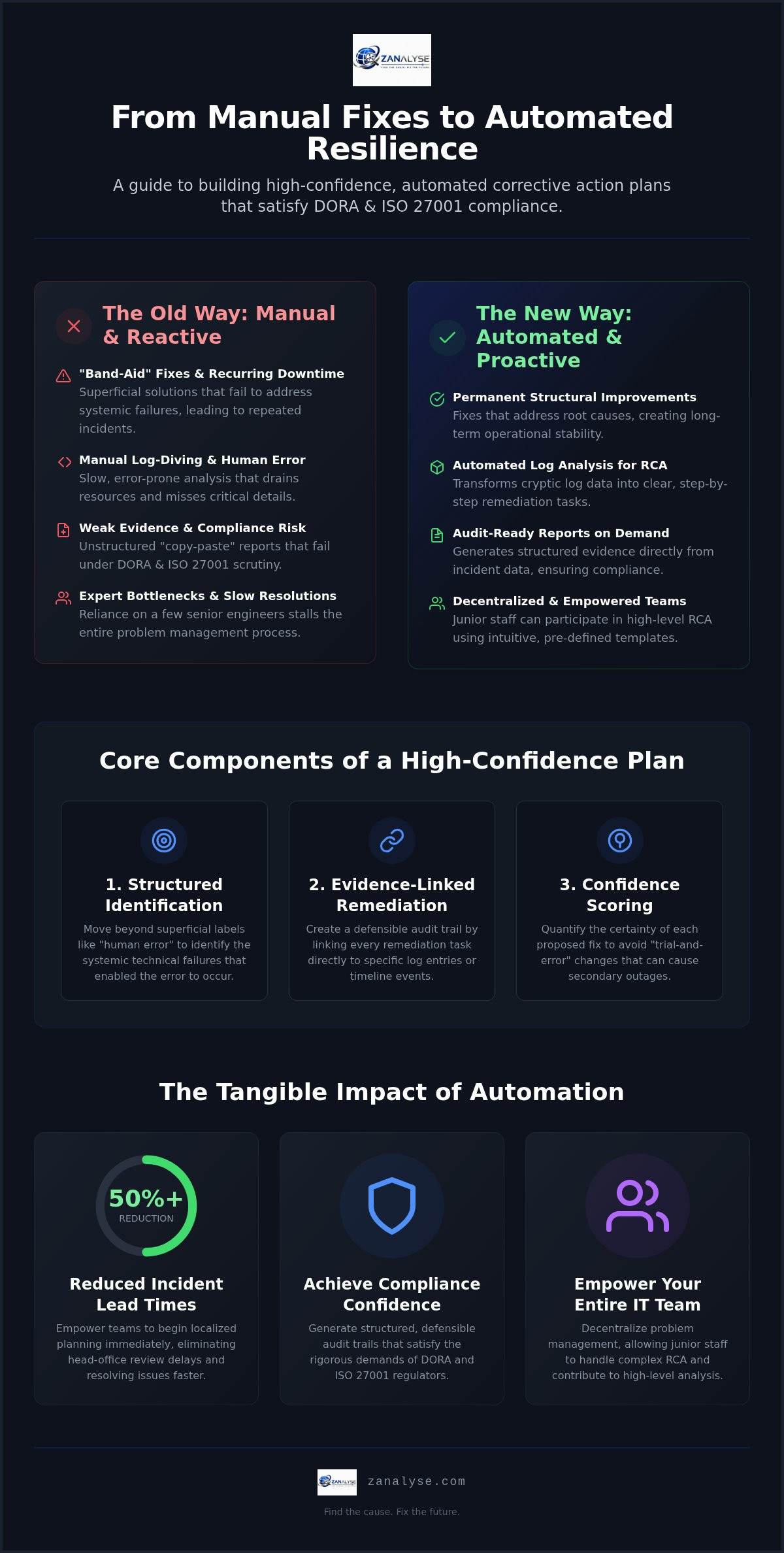
A high-confidence automated corrective action plan must move beyond superficial labels like "human error." Real progress requires identifying systemic technical failures that allowed the error to occur in the first place. This transition relies on three pillars: structured identification, evidence-linked remediation, and confidence scoring. By quantifying certainty, teams avoid the "trial-and-error" fixes that often lead to secondary outages. Every proposed change should be backed by a specific score that reflects the strength of the underlying data.
Consistency is the goal. When your remediation steps are directly justified by a specific log entry or timeline event, you create a defensible audit trail. This level of detail is exactly what regulators look for during a DORA or ISO 27001 review. You're no longer guessing; you're executing a strategy based on verified facts. If you're ready to move away from manual spreadsheets, exploring a ZANALYSE Standard License provides the structured framework needed to begin this transition.
Integrating Log-Based Insights into Actionable Tasks
Effective automation starts with the data. Utilizing automated log analysis for RCA provides the raw material for every corrective action. This process transforms complex, cryptic log patterns into straightforward, step-by-step instructions that even junior IT support personnel can follow with precision. It decentralizes expertise, ensuring that high-level problem management isn't trapped within a small group of senior engineers.
Each task must include a verification step. It isn't enough to simply apply a patch; the system must confirm the issue is permanently resolved through automated checks. This closed-loop approach ensures that your automated corrective action plan delivers long-term stability rather than just a temporary reprieve from alerts.
Decentralizing Problem Management: Implementing CAPA Across Global IT Teams
Traditional problem management often suffers from an expert bottleneck. When only senior engineers can finalize reports, the entire process stalls. Transitioning to an automated corrective action plan changes this dynamic by empowering junior staff with pre-defined RCA templates and automated report generation. This shift allows teams to reduce incident lead times by over 50% through immediate, localized planning. You're no longer waiting for a head-office review; you're fixing the problem where it lives.
Scaling global operations across Canada, Australia, and Europe shouldn't require a constant increase in headcount. Automation provides the structure needed to maintain consistency across decentralized teams. It ensures that every region follows the same rigorous standards without needing a senior manager in every time zone. This distributed approach creates a more resilient organization that responds to failures with speed and precision.
Leveraging ZANALYSE to Bridge the Technical-Commercial Gap
Technical post-mortems often fail to resonate with commercial decision-makers or auditors. They're often too dense or lack the context needed for governance. ZANALYSE presents these findings in a clear, structured format that bridges this gap. By utilizing the ZANALYSE Standard License, organizations can facilitate a standardized workflow that works for both technical and commercial stakeholders.
This ensures your automated corrective action plan remains consistent regardless of which team member initiates it. It builds a robust organizational knowledge base. You prevent the same incident from occurring in different regions by turning localized fixes into global standards. This proactive stance ensures long-term stability and process integrity across the entire enterprise.
Securing Operational Resilience in 2026
Manual governance is no longer a viable strategy in a landscape defined by DORA and ISO 27001. You've seen how moving beyond "band-aid" fixes and empowering your entire team with structured data can stabilize even the most chaotic technical environments. By implementing an automated corrective action plan, you replace guesswork with evidence-linked remediation and confidence scoring. This shift doesn't just satisfy auditors; it fundamentally changes how your organization handles failure. You can reduce incident lead times by over 50% while producing audit-ready reports that protect your operational integrity. It's time to move away from the expert bottleneck and toward a decentralized, scalable future. Explore the ZANALYSE Standard License for Automated RCA to bring order and consistency to your global IT operations. Building a more resilient, proactive team starts with the right framework.
Frequently Asked Questions
What is the difference between a corrective action and a preventive action in IT?
Corrective action addresses the root cause of an existing incident to prevent recurrence. Preventive action identifies potential risks before an incident occurs. Both are essential for long-term stability in complex IT environments across Europe and Australia. An automated corrective action plan ensures that the reactive side of this equation is handled with data-driven precision rather than subjective guesswork.
How does automation improve the confidence score of a corrective action plan?
Automation removes the subjective bias often found in manual post-mortems by linking every proposed fix directly to specific log entries and timeline events. By analyzing vast pools of existing RCA data, the system quantifies how likely a specific action is to resolve the systemic failure. This objective validation provides a high confidence score, ensuring teams in Canada and Europe implement permanent structural improvements.
Can automated corrective action plans replace manual ITIL problem management?
Automation doesn't replace the ITIL framework; it matures it by decentralizing the most time-consuming tasks. While manual problem management often creates bottlenecks around senior staff, an automated corrective action plan empowers all IT personnel to participate in root cause analysis. This shift allows global teams to reduce incident lead times by over 50% while maintaining the rigorous standards required by modern governance.
How does ZANALYSE help with DORA compliance for financial institutions?
ZANALYSE provides the structured evidence and audit-ready reports that the Digital Operational Resilience Act (DORA) requires. The platform guides users through established RCA techniques to produce comprehensive documentation from raw incident data. This ensures that financial institutions in Europe and beyond can demonstrate a disciplined approach to risk management and operational resilience, moving away from fragmented manual spreadsheets toward verified process integrity.
Disclaimer
Some content on this website may be generated or assisted by artificial intelligence. While we strive to ensure that all information is accurate, relevant and up to date, AI-assisted content may contain errors or omissions. Content should therefore be considered informational and not as professional advice.


