

Gartner projects that 40% of enterprise applications will incorporate task-specific AI agents by the end of 2026, yet many IT departments still rely on a handful of "hero" experts to manually untangle every root cause. You've likely felt the pressure of these bottlenecks as incident volumes rise and regulators demand more structured evidence under frameworks like DORA. Scaling IT problem management doesn't require hiring more senior engineers; it requires a fundamental shift toward decentralized, automated analysis. This article demonstrates how to distribute the burden of investigation across your global organization. We'll examine the transition from expert-dependent silos to a standardized model that leverages ZANALYSE to reduce incident lead times by over 50%. You'll discover how to achieve compliance with ISO standards and the EU Cyber Resilience Act while maintaining rigorous operational quality through guided, structured reporting.
Key Takeaways
- Centralized problem management models often create "expert traps" where a few senior engineers become bottlenecks; decentralizing RCA is the only way to keep pace with modern cloud infrastructure.
- Standardizing evidence collection and using guided logic frameworks like Fishbone diagrams allows non-experts to conduct high-quality investigations without constant supervision.
- Integrating automated SaaS platforms into your workflow is essential for scaling IT problem management, as it provides the structure required to meet strict DORA and ISO reporting standards globally.
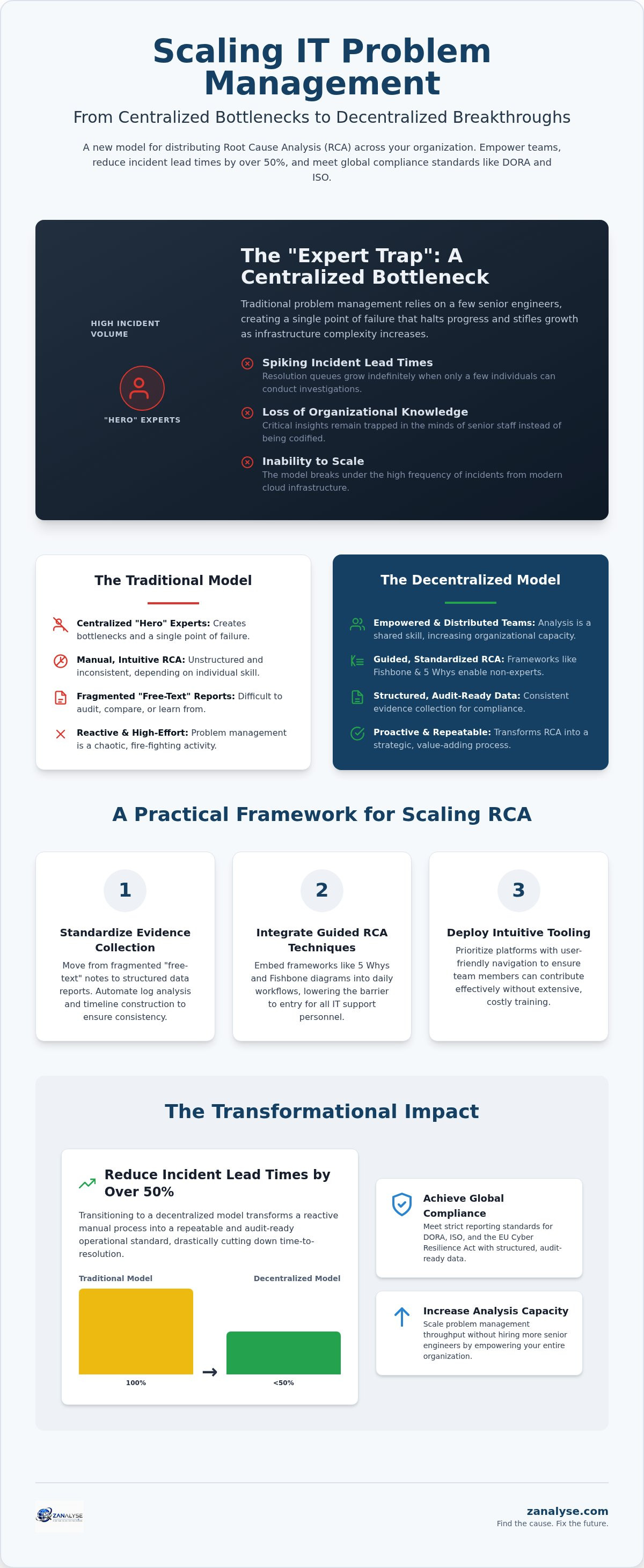
- Transitioning to a decentralized model helps organizations reduce incident lead times by over 50%, transforming a reactive manual process into a repeatable and audit-ready operational standard.
Scaling IT Problem Management: Moving Beyond the Centralized Bottleneck
The traditional Problem Management Office (PMO) often fails to keep pace with the 2026 technical landscape. As microservices and cloud infrastructure increase in velocity, a centralized team can't possibly oversee every failure point. Many organizations fall into the "Expert Trap," where a small group of senior engineers handles all Root Cause Analysis (RCA). This creates a single point of failure that halts progress. Effective scaling IT problem management requires treating analysis as a distributed skill rather than a siloed function.
Achieving sustainable scaling IT problem management means increasing the analysis capacity of your entire organization. By empowering more staff to participate in the process, you remove the reliance on "hero" experts who are already overstretched. This shift brings order to chaotic environments. It ensures that problem management evolves from a reactive task into a proactive strategic asset. Relying on a SaaS platform allows teams to maintain high standards without requiring a centralized gatekeeper for every single report.
The Limitations of Expert-Only RCA Models
Incident lead times inevitably spike when non-experts are excluded from the problem management lifecycle. If only a few individuals possess the authority or tools to conduct an investigation, the queue for resolution grows indefinitely. This isolation also leads to a significant loss of organizational knowledge; critical insights remain trapped in the minds of senior staff instead of being codified for the wider team. The RCA bottleneck is the operational gap between the high frequency of modern incidents and the limited availability of qualified experts.
Decentralizing Analysis: A Practical Framework for Scaling RCA
True scaling IT problem management requires a framework that moves beyond the intuition of senior engineers. You must standardize how evidence is collected to ensure logs and timelines are captured consistently by all staff. This shift allows your organization to treat root cause analysis as a repeatable process rather than an art form. It aligns with technical advancements in Decentralized Root Cause Analysis in Nonlinear Dynamical Systems, proving that distributed analysis is the most resilient path for complex networks.
Implementation involves three distinct steps. First, move away from fragmented "free-text" post-mortems and adopt structured data reports. Second, integrate guided RCA techniques like the 5 Whys or Fishbone diagrams directly into your daily operations. This lowers the barrier to entry for IT support personnel. Finally, prioritize tools with intuitive navigation so that team members can contribute without extensive training. As you prepare for the General Availability of ZANALYSE in October 2026, you can explore how the ZANALYSE Standard License facilitates this transition by providing the necessary structure for junior staff.
Standardizing Evidence Collection and Reporting
Manual timeline construction is an expensive drain on resources. Automated log analysis is critical for scaling IT problem management because it removes the manual burden of forensic data collection. By adopting problem management workflow automation, you ensure that every team follows the same rigorous standards regardless of their location. Managers can then rely on "confidence scores" to validate the quality of investigations performed by non-specialists. This allows for rapid scaling without compromising the integrity of your operational data.
Leveraging Automation to Meet Global Compliance and Scale
Effective scaling IT problem management isn't just an operational goal; it's a regulatory necessity. For financial services, meeting dora incident reporting requirements demands a level of speed and accuracy that manual systems simply can't sustain. Automated platforms like ZANALYSE enable teams to reduce incident lead times by over 50% by distributing the analysis burden across the entire department. This decentralized approach ensures that reporting keeps pace with the high-stakes environment of 2026. Global teams can further manage seasonal or project-based incident spikes by utilizing RCA Capacity Top-ups. These provide the flexibility needed to maintain throughput without permanent headcount increases or sacrificing report quality.
The ZANALYSE Standard License serves as the foundational tool for building this scalable practice. It provides the structured environment necessary to ensure every investigation is audit-ready from the start. By moving away from inconsistent manual logs, organizations create a stable record of their technical maturity. This allows commercial and technical managers to align on risk management goals through a single, reliable source of truth. Relying on a SaaS-based model ensures that these standards remain consistent across all global locations without the complexity of local installations.
Aligning Scaled Operations with DORA and ISO 27001
Manual reporting fails when faced with the strict timelines of modern digital operational resilience acts. Structured RCA reports act as audit-ready evidence for ISO 27001, which significantly reduces the friction and stress of compliance cycles. This shift improves operational quality scores, providing IT directors with the consistent data needed for strategic decision-making. Decentralizing these tasks ensures that compliance becomes a natural byproduct of daily work rather than a frantic end-of-quarter exercise. It transforms problem management from a hidden cost into a visible indicator of organizational resilience.
The Future of Distributed Operational Excellence
The shift from centralized expert silos to a distributed model is no longer optional for organizations facing the technical velocity of 2026. By empowering your entire IT staff with structured logic and automated evidence collection, you remove the bottlenecks that stall resolution. Scaling IT problem management ensures your organization remains resilient under the pressure of modern cloud environments and strict regulatory frameworks.
You can reduce incident lead times by over 50% while generating consistent, audit-ready evidence for DORA and ISO 27001. This transition turns a chaotic manual process into a stable, repeatable standard that grows with your business. Don't let your senior engineers remain a single point of failure when you can decentralize RCA capabilities across your entire organization today. Empower your team with the ZANALYSE Standard License; Automate your RCA today. Your path to operational maturity starts with a single, structured report.
Frequently Asked Questions
How does decentralizing problem management improve incident lead times?
Decentralization improves incident lead times by removing the reliance on a small group of senior experts who often become operational bottlenecks. When analysis is distributed across the IT organization, investigations begin immediately rather than waiting in a queue. This shift allows teams in Canada and Europe to reduce lead times by over 50%, ensuring that scaling IT problem management becomes a reality through increased throughput.
Can non-technical staff perform Root Cause Analysis effectively?
Non-technical staff can perform effective Root Cause Analysis when provided with structured guidance and intuitive navigation tools. By using a ZANALYSE Standard License, users are led through established techniques like the 5 Whys or Fishbone diagrams. The platform generates confidence scores for each report, allowing managers in Australia and beyond to validate findings without needing to conduct the entire investigation themselves.
What is the role of automation in scaling IT problem management for global teams?
Automation serves as the engine for scaling IT problem management by standardizing evidence collection from logs and incident data. For global teams operating across Europe and Canada, SaaS-based automation ensures that reporting quality remains consistent regardless of location. Organizations can also utilize RCA Capacity Top-ups to handle seasonal spikes, ensuring that global operations maintain high analysis standards without increasing permanent headcount.
How does structured RCA help with DORA and ISO 27001 compliance?
Structured RCA reports provide the documented evidence required to meet the rigorous standards of DORA and ISO 27001. Instead of fragmented notes, the platform generates comprehensive reports that detail corrective actions and evidence timelines. This level of precision is essential for financial services in Europe and other highly regulated markets, where manual reporting cannot meet the strict deadlines mandated by modern resilience acts.
Disclaimer
Some content on this website may be generated or assisted by artificial intelligence. While we strive to ensure that all information is accurate, relevant and up to date, AI-assisted content may contain errors or omissions. Content should therefore be considered informational and not as professional advice.


