

An AI agent can investigate a production incident by bringing together logs, timelines, and incident data to identify likely root causes and supporting evidence. Automated RCA software for DORA compliance can help structure that investigation, but teams still need to review its findings and connect them to corrective actions. DORA became fully applicable in the European Union on January 17, 2025.
Incident analysis is difficult when evidence is scattered across systems and the same specialists lead every review. A structured, evidence-based investigation makes root-cause work clearer and creates a useful record of what happened.
This article explains how AI agents investigate incidents, where root cause analysis fits into ICT risk management, and how DORA-focused platforms compare with multi-framework tools. Use these points to assess which approach suits your operational and reporting needs.
Key Takeaways
- Learn how AI-assisted investigations use incident evidence to develop root-cause hypotheses that teams can review and act on.
- Understand how incident analysis contributes to broader ICT risk management and digital operational resilience under DORA.
- Compare DORA-native and multi-framework platforms by the compliance scope and operational needs they are designed to support.
- See how the ZANALYSE Standard License can help structure root cause analysis using incident data and established RCA techniques.
Automated root cause analysis for production incidents
Automated investigations organize logs, timelines, and incident data into findings for review. For financial entities in Canada, Australia, and Europe, this record can support post-incident assessment, while incident classification and reporting remain separate decisions.
Post-Incident Reviews
A post-incident review examines what happened, why it happened, and what should change. Root-cause analysis connects operational symptoms to causes such as a code change, configuration issue, dependency, or process gap. For example, an investigation can compare a service disruption with a recent deployment and supporting log entries. This evidence helps teams test hypotheses, document corrective actions, and strengthen relevant controls and risk management. A structured record also helps institutions review recurring problems.
RCA Mapping and Compliance Risks
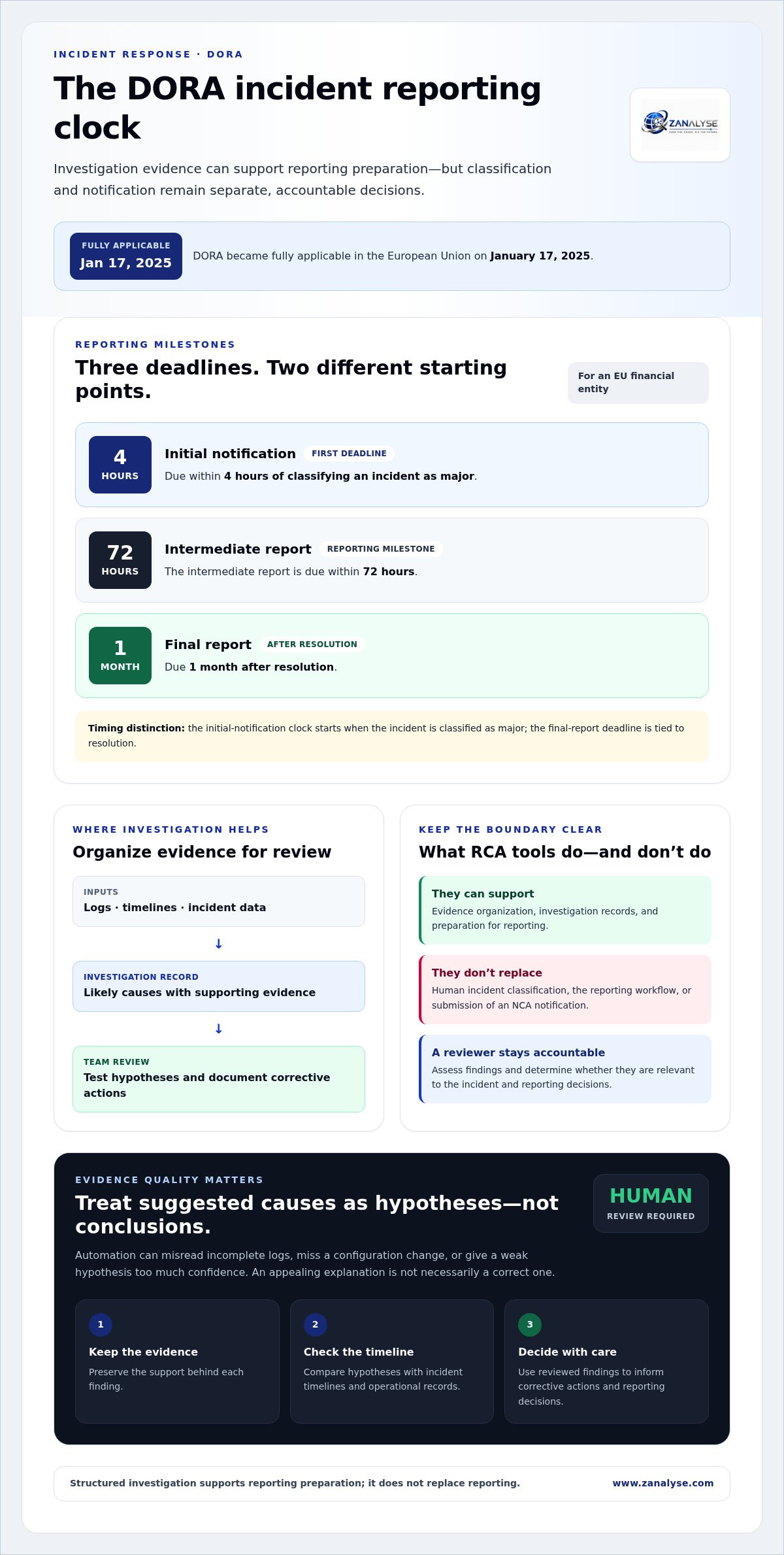
RCA tools support DORA incident classification and reporting by organizing evidence for human assessment; they don’t determine whether an incident is major or submit an NCA notification by themselves. Under the DORA ITS Regulation, an EU financial entity’s initial notification is due within 4 hours of classifying an incident as major, the intermediate report within 72 hours, and the final report 1 month after resolution. An investigation record can help teams prepare reporting, but it doesn’t replace the reporting workflow.
Automation can misread incomplete logs, miss a configuration change, or give a weak hypothesis too much confidence. Treat suggested causes as evidence to assess, not as a final classification. Keep an accountable reviewer involved, preserve the evidence behind each finding, and compare it with incident timelines and operational records. This helps prevent an appealing but incorrect explanation from driving corrective actions or reporting.
ICT risk management and digital operational resilience
Under DORA, digital operational resilience includes ICT risk management and incident handling. It also covers resilience testing, third-party risk, information sharing, and oversight of critical ICT providers. These areas connect operational workflows rather than treating each control as isolated.
DORA requires executive management and boards to approve ICT risk management frameworks and oversee resilience testing strategies, linking controls to operational priorities. Map each critical service to its owner, supporting systems, and recovery workflow. This helps teams assess whether a control protects the service or merely records activity.
A software bill of materials (SBOM) records software components and can improve ICT asset visibility. Software teams can use it to support supply-chain transparency, third-party risk management, and vulnerability response. Link each vulnerability to an owner, remediation status, and affected service. Review outstanding remediation alongside controls and service risk.
DORA requires organizations to manage risks from third-party ICT vendors. Connect each provider dependency to incident reporting and continuity workflows. Automated monitoring can flag potential provider risks or compliance gaps, but teams must assess each alert’s relevance to their services. Record the vendor, affected service, identified risk, accountable owner, and mitigation status in a workflow that can be reviewed.
Teams can connect incident findings with ICT risk reviews through structured root cause analysis workflows, helping operational teams carry lessons into control and remediation decisions.
Comparing DORA-native and multi-framework platforms
A DORA-native platform organizes work around DORA’s terminology and requirements. A multi-framework platform brings requirements from DORA, GDPR, ISO 27001, and NIS2 into a shared view. The practical distinction is whether financial institutions need focused DORA workflows or coordinated oversight across several frameworks.
For a DORA-focused program, assess how directly a platform connects ICT risk, incident response, third-party risk, and resilience testing. Can an identified vendor risk be linked to its control, accountable owner, and remediation status? Can testing results inform the next risk review? Direct links help teams in Canada, Australia, and Europe follow DORA-related work without treating every task as a separate record.
A multi-framework platform can help organizations reuse evidence and controls across overlapping requirements. This can reduce duplicate tracking, but mappings must preserve each regulation’s context. One shared control may support several frameworks, while DORA may require different evidence, ownership, or responses. Review how the platform shows those distinctions rather than relying on a single combined status.
Compare platforms against your operating model. List the frameworks in scope, identify who owns each workflow, and trace one example from risk identification through testing, remediation, and review. Include a vendor dependency or incident response scenario. The right fit depends on whether your priority is DORA-specific execution or continuous coordination across frameworks and teams. Assess whether structured RCA capabilities can support consistent investigation records as part of that comparison.
ZANALYSE: ZANALYSE Standard License
The ZANALYSE Standard License gives teams a consistent way to investigate incidents and document root causes. It uses logs, timelines, and incident data to guide users through established RCA techniques, producing structured reports with evidence, confidence scores, and corrective actions.
For problem managers, IT support teams, and service providers, this approach makes problem management easier to share instead of relying on a few specialists. Use it when investigations need a repeatable structure and findings should lead to practical follow-up. ZANALYSE also offers the Full License, annual or multi-annual price plans, and RCA Capacity Top-ups.
RCA supports incident analysis; it doesn’t replace DORA classification, reporting, or broader ICT risk management. Contact ZANALYSE to discuss its root cause analysis platform.
Build a repeatable path from incident to improvement
When choosing automated RCA software for DORA compliance, start by defining how your teams will turn investigation findings into lasting operational changes. Assign ownership for reviewing evidence, agreeing corrective actions, and tracking whether they address the underlying cause. This makes learning part of everyday problem management for process managers, IT teams, and service providers, rather than a task reserved for a few specialists.
Use that operating model to assess whether a platform fits your people and workflows. The right approach should help teams investigate consistently while keeping classification, reporting, and governance decisions with the accountable organization. If you’re ready to discuss how structured root cause analysis could fit your operations, contact ZANALYSE to discuss your needs. A clearer learning process can help your teams move forward with greater confidence.
Frequently Asked Questions
Can an AI agent find the root cause of a production incident?
An AI agent can compare incident records and suggest a likely cause, such as a dependency failure after a service change. Its value lies in surfacing possible connections across records that might otherwise be reviewed separately. Provide relevant incident context and operational data, then assess whether the suggested cause explains the affected service and observed symptoms.
Does it show evidence chains and confidence for each hypothesis?
Some tools show which records support each hypothesis and provide a confidence score. Use these details to compare explanations. For example, check whether the timing of a configuration change matches the reported service impact. Seeing the underlying records helps investigators identify which explanation merits further review and where the incident record has gaps.
Should you build or buy automated RCA?
Buying software can suit teams that want a repeatable investigation process without maintaining custom analysis tools. Building may suit organizations with specialized workflows and the internal capacity to develop and maintain software. Compare the ongoing work involved, including data connections, changes to investigative methods, and user support. A pilot using a representative incident can reveal practical differences.
What does production-grade automated RCA architecture look like?
A practical architecture defines how incident information enters an investigation, who can access it, and how records remain useful afterward. It may connect incident-management records with operational data while preserving the context investigators need. For example, teams should be able to associate a report with its service, incident owner, and follow-up actions. Design these connections around existing workflows and data-handling controls.
What does DORA require for ICT incident root cause analysis and reporting?
DORA requires a standardized process for reporting significant ICT-related incidents to authorities. Operational teams need to define how information moves from detection through assessment and reporting, with clear ownership at each handoff. Root-cause findings can support post-incident learning and improvements to systems or processes. Keep these reviews connected to the institution’s established incident workflow.
Disclaimer
Some content on this website may be generated or assisted by artificial intelligence. While we strive to ensure that all information is accurate, relevant and up to date, AI-assisted content may contain errors or omissions. Content should therefore be considered informational and not as professional advice.


