

What if your most junior IT analyst could perform a root cause analysis with the same precision as your lead architect? Implementing a problem management workflow automation strategy allows you to stop repetitive incidents from draining your team's capacity. You've likely felt the frustration of RCA remaining a bottleneck for a few senior experts. It's a common struggle to gather structured evidence when DORA enforcement cycles or ISO 27001 audits loom on the horizon. A mature operation requires a process that doesn't rely on tribal knowledge.
In this article, you'll discover how to transform chaotic responses into a decentralized, audit-ready engine. We'll provide a 2026 template designed to reduce incident lead times by over 50%. You'll learn how to standardize your evidence gathering and empower your entire IT staff to generate professional reports that satisfy even the strictest regulatory requirements. This approach ensures your operations stay resilient and transparent.
Key Takeaways
- Learn how to shift Root Cause Analysis from a senior-level bottleneck to a decentralized process that any IT staff member can navigate.
- Discover a 5-step template for problem management workflow automation that replaces manual log analysis with structured, guided evidence collection.
- Understand how to turn raw incident logs into audit-ready reports that meet the rigorous 2026 enforcement standards of DORA and ISO 27001.
- Identify the specific data aggregation techniques required to reduce incident lead times by over 50% while maintaining operational excellence.
The Architecture of a Decentralized Problem Management Workflow
Traditional IT structures often treat root cause analysis (RCA) as a specialized craft reserved for senior engineers. This centralized model creates a dangerous bottleneck. When your experts are overwhelmed, the queue for permanent fixes grows indefinitely. Modern problem management workflow automation shifts this responsibility away from a central core and distributes it across the entire IT organization. By moving from a "hero-based" system to a process-driven one, you ensure that every incident is met with immediate, structured investigation.
Manual log analysis is the primary failure point in current operations. Sifting through thousands of lines of data is not just inefficient; it's unsustainable in complex cloud environments. A mature approach utilizes the ITIL framework to move beyond simple firefighting. Instead of reactive patching, teams use a "Problem-and-Resolution" framework to identify recurring pain points and resolve them before they escalate into high-priority outages. This creates a stabilizing force that brings order to technical chaos.
Breaking the Expert Bottleneck with Automated Guidance
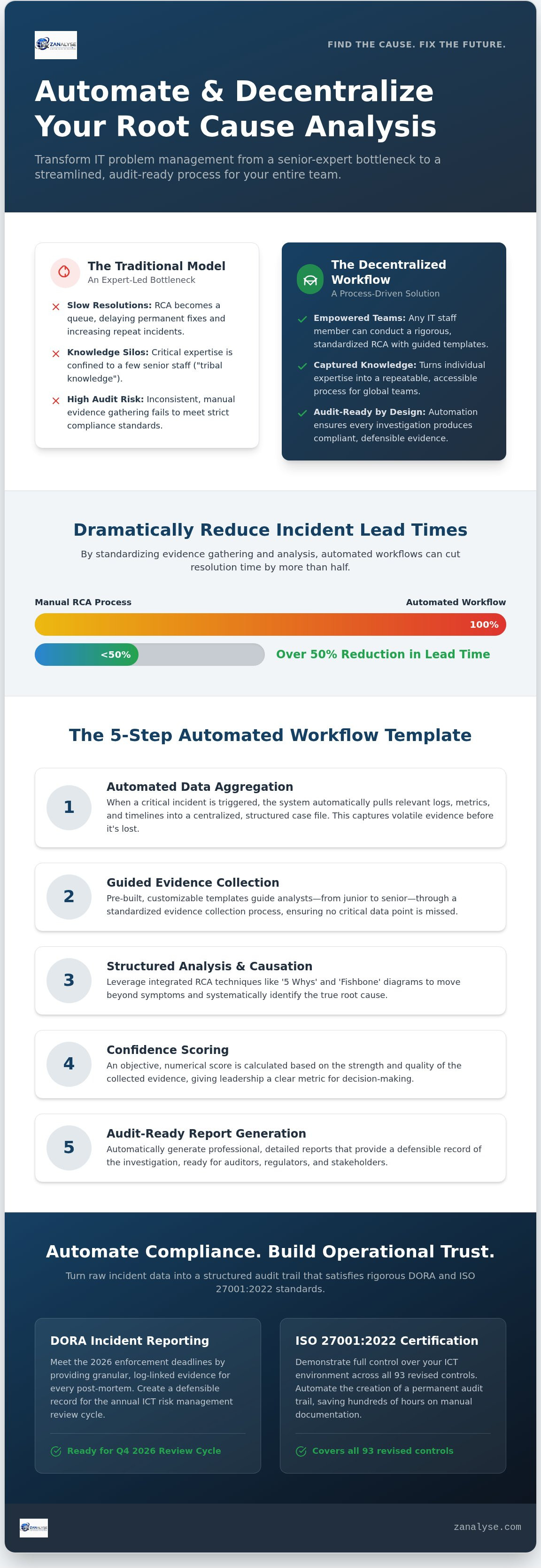
Decentralization only works if your staff has the right tools to succeed. Automated platforms like ZANALYSE guide junior analysts through rigorous techniques such as the "5 Whys" or "Fishbone" diagrams. By using pre-built RCA templates, you standardize the quality of every report. This ensures that a Tier 1 analyst produces the same audit-ready evidence as a senior director, effectively reducing incident lead times by over 50%. This structure captures organizational knowledge, making it accessible to global teams rather than letting it sit in a single expert's head.
The 5-Step Automated Workflow Template for 2026
Effective problem management workflow automation follows a rigorous, repeatable sequence that eliminates guesswork. It begins with an automated trigger. When a critical incident occurs, the system immediately pulls logs and timelines into a structured environment. This data aggregation phase ensures that volatile evidence is captured before it's overwritten or lost. By centralizing this information, teams avoid the chaos of searching through disparate systems during a crisis.
The next phase involves guided evidence collection and identification. Staff identify specific data points to prove or disprove a hypothesis, moving from symptoms to technical errors. This logic-based approach aligns with NIST security and privacy controls, providing a defensible foundation for every investigation. Finally, the workflow culminates in report generation. These reports aren't just summaries; they're audit-ready documents featuring confidence scores that validate the findings for leadership.
Implementing the Workflow in High-Stakes Environments
Success in complex environments requires seamless integration with your existing IT Service Management platforms. This ensures that every RCA is linked to its parent incident without manual data entry. To maintain trust, every report should include a Confidence Score. Confidence Scoring is a numerical representation of evidence strength in an RCA. This metric allows stakeholders to make informed decisions quickly. If you're ready to stabilize your operations, exploring a Standard License is a pragmatic first step toward decentralization.
Automating Compliance: Meeting DORA and ISO 27001 Standards
Regulatory expectations have reached a critical maturity level in 2026. For financial institutions in Europe and Canada, generic incident summaries no longer satisfy supervisory authorities. You must provide granular evidence that links specific log entries to verified corrective actions. Implementing problem management workflow automation ensures that every technical post-mortem aligns with DORA incident reporting requirements. This isn't just about avoiding fines. It's about building a defensible record of operational integrity that stands up to the first annual ICT risk management review cycle due in Q4 2026.
Audit-ready evidence is the backbone of ISO 27001:2022 certification. By turning raw incident log files into structured timelines, you create a permanent audit trail that demonstrates control over your ICT environment across the revised 93 controls. This structured approach allows teams to reduce incident lead times by over 50% while maintaining rigorous oversight. You stop wasting hours on manual document compilation. You start focusing on service stability. It's the difference between a reactive scramble and a disciplined, automated governance model that respects your team's time and expertise.
Building Long-Term Operational Quality
True resilience requires moving from perpetual firefighting to permanent structural improvement. Automated corrective action plans ensure that root causes aren't just identified but are systematically eliminated through tracked tasks. This decentralization is vital for global scaling. It allows regional teams to maintain compliance without waiting for a central audit committee to validate every step. By empowering all IT staff with standardized tools, you ensure that quality remains consistent across every jurisdiction and time zone. This creates a stabilizing force that protects your organization's long-term value and security posture.
Securing Operational Excellence in 2026
Transitioning to a decentralized model isn't just a technical upgrade; it's a strategic shift toward organizational resilience. By adopting problem management workflow automation, you break the expert bottleneck and empower every member of your IT staff to conduct high-quality root cause analysis. This standardized approach doesn't just clear incident queues. It builds a permanent, audit-ready record that satisfies the most demanding DORA and ISO 27001 requirements. You've seen how structured evidence and confidence scores transform chaotic responses into disciplined operations.
Now is the time to stabilize your environment and reduce incident lead times by over 50%. You can start this journey today by choosing a solution that prioritizes clarity and consistency. Empower your team with the ZANALYSE Standard License to ensure your workflow remains robust, compliant, and scalable. Your team's capacity is your most valuable asset. Protect it with a process that works.
Frequently Asked Questions
How does workflow automation differ between incident and problem management?
Incident management automation prioritizes the rapid restoration of services, often through automated alerts and basic troubleshooting scripts. In contrast, problem management workflow automation focuses on identifying the underlying technical error to prevent recurrence. It moves beyond immediate fixes by aggregating logs, guiding staff through structured analysis, and generating evidence-based reports that address the root cause rather than just the symptom.
Can junior IT staff perform root cause analysis with the right automation?
Junior staff can effectively perform root cause analysis when provided with guided automation and pre-built templates. These tools eliminate the reliance on senior engineers by providing step-by-step instructions for techniques like the "5 Whys." This decentralized approach ensures that any team member can produce high-quality, structured reports, which helps maintain operational consistency across global sites in Canada, Australia, and Europe.
What are the specific DORA requirements for IT problem management workflows?
DORA requires financial entities to maintain a rigorous ICT risk management framework, focusing on service continuity and thorough post-mortem analysis. Workflows must be capable of generating reports that satisfy the first annual review cycle due in Q4 2026. This involves documenting how technical risks are managed and ensuring that every major incident is investigated with a level of detail that permits regulatory oversight.
How much can automation reduce incident resolution lead times?
Standardizing your process through automation can reduce incident lead times by over 50%. This is primarily achieved by removing the manual effort required to aggregate logs and build timelines from scratch. When these steps are automated, the time between incident resolution and root cause identification shrinks, allowing your staff to implement permanent fixes much faster than traditional manual methods allow.
Disclaimer
Some content on this website may be generated or assisted by artificial intelligence. While we strive to ensure that all information is accurate, relevant and up to date, AI-assisted content may contain errors or omissions. Content should therefore be considered informational and not as professional advice.


