

Imagine spending your Saturday afternoon parsing fragmented log files across multiple servers just to identify a single configuration error. Most sysadmins accept this manual grind as an inevitable part of the job, yet it leads to inconsistent report quality and immense pressure from directors who need audit-ready evidence. You're likely familiar with the frustration of knowing the answer is buried in the data while lacking the structured tools to extract it efficiently.
This article explains how automated RCA for sysadmins transforms chaotic incident response into a structured, decentralized process. You will learn how to reduce incident lead times by over 50% while generating reports that satisfy strict ISO and DORA compliance standards. We will examine how this approach empowers junior staff to handle complex problem management and builds a reliable repository of organizational knowledge for the entire IT team.
Key Takeaways
- Replace the manual grind of log-diving with software-led investigations that correlate data into actionable, real-time hypotheses.
- Discover how automated RCA for sysadmins transforms raw telemetry into structured, audit-ready reports with clear confidence scores.
- Meet rigorous ISO and DORA compliance standards by automating the collection of evidence and timelines during incident response.
- Decentralize complex problem management to junior staff, effectively reducing incident lead times by over 50% across the organization.
Beyond Manual Troubleshooting: Why Sysadmins Need Automated Root Cause Analysis
Manual troubleshooting is often a chaotic race against the clock. While Root Cause Analysis (RCA) is essential for long-term stability, the traditional approach relies heavily on individual expertise and fragmented log files. This creates a "weekend-killing" cycle where senior staff spend hours correlating data points across disconnected systems. Automated RCA for sysadmins changes this dynamic by introducing software-led investigations that correlate telemetry into evidence-backed conclusions. It moves the team away from manual log correlation toward real-time, logic-driven hypothesis generation.
This transition is about more than just speed; it's about accuracy and consistency. Manual methods are prone to "gut feel" decisions that often miss the underlying trigger. Implementing automated RCA for sysadmins ensures that every incident is met with a rigorous, repeatable process. By identifying the specific event that caused a symptom, IT teams can implement permanent structural improvements rather than temporary fixes. This creates a stabilizing force that brings order to even the most complex technical environments.
The High Cost of Reactive Problem Management
Repetitive incidents act as a silent productivity drain on any organization. Inconsistent manual methods lead to high-stakes environments where human error is almost inevitable. When you're under pressure to restore a critical service, the focus is often on recovery rather than discovery. This is why modern IT departments are prioritizing a shift toward problem management as a proactive discipline. By decentralizing the ability to perform deep analysis, you reduce the reliance on a few key specialists. This structured approach ensures that every investigation meets a high standard, providing the audit-ready evidence required by today's regulatory frameworks while reducing incident lead times by over 50%.
How Automated RCA Platforms Transform Incident Timelines into Evidence
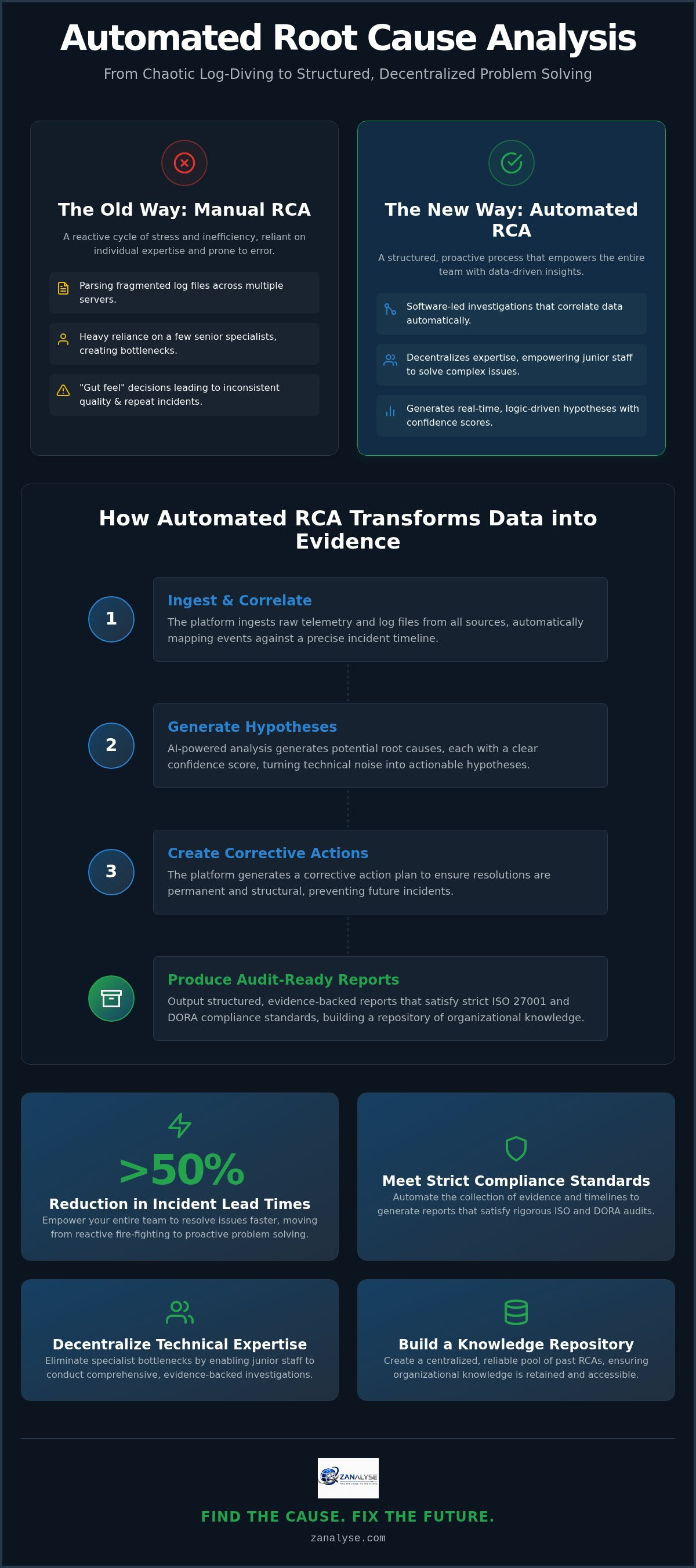
Transitioning from manual log-diving to structured output requires a platform that does more than just aggregate data. Automated RCA for sysadmins ingests raw telemetry and maps it against a precise timeline of events. This process converts technical noise into verifiable evidence. By assigning confidence scores to each automated hypothesis, the platform allows technical staff to validate findings quickly rather than second-guessing the machine. It ensures teams systematically prevent and solve for underlying issues instead of merely patching symptoms.
A complete investigation must include a corrective action plan. Modern automated RCA for sysadmins generates these steps alongside the root cause, ensuring that every resolution is permanent and structural. This structured approach helps maintain consistency, regardless of which team member is on call. If you're looking for a way to standardize this process, you might consider how a structured RCA platform can unify your team's output.
Building Audit-Ready Evidence for ISO and DORA
In highly regulated environments, a simple "fixed it" note in a ticket is insufficient. Modern dora incident reporting requirements demand high-quality, evidence-backed documentation that proves a thorough investigation occurred. Structured reports serve as primary evidence for ISO 27001 and DORA audits. By maintaining a centralized pool of RCAs, organizations build a robust repository of organizational knowledge. This consistency ensures that even as staff changes, the logic behind past resolutions remains accessible and audit-ready.
Decentralizing Expertise: Empowering Every Sysadmin to Resolve Complex Incidents
Technical silos are a significant risk to operational stability. Senior specialists often become bottlenecks during major outages, leaving the rest of the team waiting for guidance. This dependency on a few "problem managers" creates a single point of failure within the IT organization. By implementing automated RCA for sysadmins, you distribute technical expertise across the entire team. This shift ensures that complex investigations aren't delayed because a specific expert is unavailable. It fosters a collaborative culture where every team member contributes to the permanent resolution of structural issues.
Intuitive platforms simplify the investigation process for all staff levels. Junior sysadmins can now produce comprehensive, evidence-backed reports that previously required years of deep-dive experience. This capability reduces incident lead times by over 50%. It transforms the role of junior personnel from basic responders to active participants in the problem management lifecycle. High-quality analysis becomes a standard output rather than an occasional luxury. When automated RCA for sysadmins is integrated into the daily routine, the entire department moves from a reactive state to a model of continuous improvement.
Implementing a Standardized RCA Workflow
Moving from chaotic response to a mature operational model requires a clear path. Organizations can transition to a higher maturity level by adopting a ZANALYSE Standard License. This framework uses guided techniques to ensure every report meets professional and technical standards. These guided workflows provide the necessary structure to maintain consistency across different shifts and teams. For organizations planning their 2027 operational strategy, general availability is scheduled for October 2026. Standardizing the workflow involves several key steps:
- Assessment of current incident lead times and manual bottlenecks.
- Integration of existing telemetry into the automated RCA platform.
- Training junior staff on guided investigation techniques and evidence collection.
- Generating structured, audit-ready reports to build organizational knowledge.
This timeline allows for a deliberate transition toward a decentralized, audit-ready environment that values evidence over intuition. By establishing these standards now, IT leaders ensure their teams are prepared for the regulatory and operational demands of the coming years.
Securing a Structured Future for IT Operations
Transitioning from manual log-diving to an automated framework isn't just about operational speed; it's about long-term organizational maturity. We've explored how automated RCA for sysadmins replaces chaotic troubleshooting with structured evidence, ensuring every incident leads to a permanent structural improvement rather than a temporary patch. By decentralizing expertise, you empower your entire team to resolve complex issues while maintaining rigorous ISO and DORA compliance standards. The era of losing weekends to fragmented log files and inconsistent reporting is over.
It's time to move toward a more stable, predictable environment where data drives every decision. Empower your team with a ZANALYSE Standard License to reduce incident lead times by over 50% with guided RCA techniques. Act as a guardian of process integrity with audit-ready reporting and bring lasting order to your technical environment today. Your team deserves a process that scales as fast as your infrastructure.
Frequently Asked Questions
How does automated RCA differ from standard AIOps tools?
Automated root cause analysis differs from standard AIOps by focusing on evidence-backed conclusions rather than just alert correlation. While many AIOps platforms prioritize reducing noise, automated RCA for sysadmins uses software-led investigation to identify the specific event that triggered a symptom. It generates structured reports with confidence scores, allowing teams in Canada and Europe to move beyond basic anomaly detection toward permanent structural improvements.
Can automated RCA tools help with DORA compliance in 2026?
Yes, these tools are specifically designed to meet DORA incident reporting requirements by providing high-quality, evidence-backed documentation. By the scheduled general availability in October 2026, the platform will offer audit-ready reports that satisfy regulatory standards across Australia and Europe. This ensures that every investigation is consistent and transparent, acting as a guardian of process integrity during critical compliance audits.
What kind of data sources are required for effective automated root cause analysis?
Effective analysis requires raw telemetry, including server logs, timelines, and incident data. The platform ingests these data points to map out a precise sequence of events. By correlating these diverse sources, the system can guide users through established techniques to include evidence and confidence scores. This structured approach ensures that IT teams in Canada and beyond maintain a reliable repository of organizational knowledge.
How much can automated RCA actually reduce incident resolution times?
Implementing automated RCA for sysadmins reduces incident lead times by over 50% by eliminating manual log-diving. By decentralizing problem management, the platform allows every team member to produce comprehensive reports in a fraction of the usual time. This efficiency is crucial for organizations in Europe and Australia looking to stabilize complex environments while empowering junior staff to handle high-pressure investigations with confidence.
Disclaimer
Some content on this website may be generated or assisted by artificial intelligence. While we strive to ensure that all information is accurate, relevant and up to date, AI-assisted content may contain errors or omissions. Content should therefore be considered informational and not as professional advice.


