


What if the hardest part of a network outage isn’t restoring service, but proving why it happened?
For Australian IT teams, root cause analysis for network outages Australia often starts with evidence scattered across logs, timelines and team notes. Service may return quickly, yet the cause remains uncertain and follow-up work starts from scratch. That is an operational challenge, not a failure of effort.
A structured, evidence-led process can turn incident records into a clear timeline, document supported causes and assign corrective actions. This guide explains how to investigate outages, compare RCA approaches and make post-incident work more consistent across support, operations and service-provider teams. It also explains how ZANALYSE organises logs, timelines and incident data into reports with evidence, confidence scores and corrective actions, making problem management more accessible across the organisation.
Key Takeaways
- Separate outage symptoms from supported causes by connecting incident evidence to a clear, shared timeline.
- Use a consistent sequence to define impact, collect evidence, test possible causes and assign corrective actions.
- Compare manual reviews, monitoring tools and structured RCA platforms by the distinct role each plays in an investigation.
- Root cause analysis for network outages Australia can become more repeatable when teams preserve findings, evidence and actions in structured reports.
Why network outages in Australia need evidence-led root cause analysis
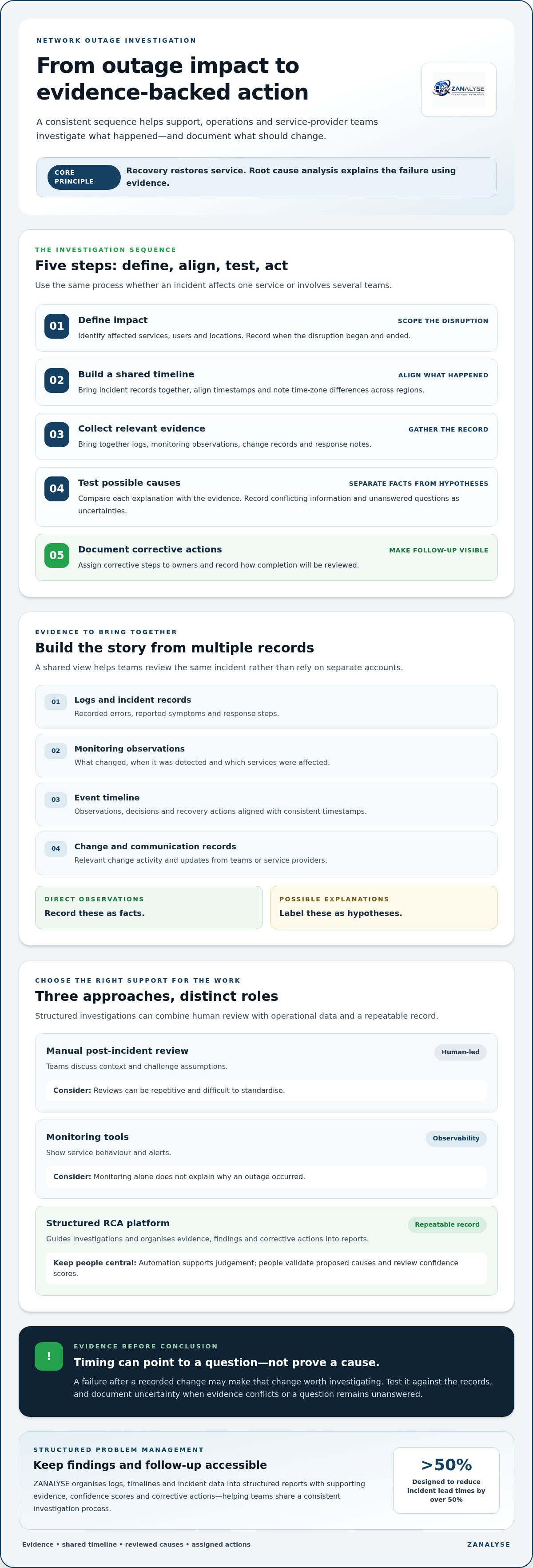
Restoring a network service and explaining its failure are different tasks. Recovery addresses the immediate disruption; root cause analysis examines the evidence to determine what contributed to it and what could prevent a repeat. Recording that a connection failed describes a symptom. A useful RCA links the disruption to evidence-supported causes and makes clear where information is incomplete.
For Australian teams, a shared timeline is essential to root cause analysis for network outages Australia-wide, particularly when an incident involves multiple teams or service providers. Support, operations and external service teams may hold separate records, use different monitoring tools or record events at different times. Teams working across Australia, Canada and Europe may also need to reconcile timestamps across time zones. Without a shared timeline, accounts can conflict and assumptions can be mistaken for facts. Root Cause Analysis provides a broader introduction to the method; the right technique depends on the incident and the evidence available.
Which outage evidence helps establish what happened?
Bring relevant records together before settling on an explanation:
- Logs and incident records: note recorded errors, reported symptoms and response steps.
- Monitoring observations: capture what changed, when it was detected and which services were affected.
- Event timeline: align observations, decisions and recovery actions using consistent timestamps.
- Change and communication records: include relevant change activity and updates from teams or service providers.
Mark direct observations as facts and possible explanations as hypotheses. Record missing logs, unclear timing and conflicting accounts as uncertainties rather than filling gaps with assumptions. This makes the reasoning easier for other teams to review and supports consistent handovers. For Australian teams choosing an approach to root cause analysis for network outages Australia-wide, see this root cause analysis methods reference. A structured investigation turns restored service into a learning opportunity, with evidence that can inform corrective action.
How to investigate an Australian network outage and compare RCA approaches
A reliable investigation moves from impact to action in a clear sequence. This gives technical teams, managers and service providers a shared process for root cause analysis for network outages Australia. Use the same sequence whether the incident affects one service or involves several teams:
- Define impact: identify affected services, users and locations, and record when the disruption began and ended.
- Build a timeline: align incident records and timestamps, noting time-zone differences across regions.
- Collect evidence: bring together relevant logs, monitoring observations, change records and response notes.
- Test causes: compare each explanation with the available evidence and record what remains uncertain.
- Document actions: assign corrective steps to owners and record how completion will be reviewed.
Each RCA approach has a distinct role. Manual post-incident reviews let teams discuss context and challenge assumptions, but can be repetitive and difficult to standardise. Monitoring tools show service behaviour and alerts, but do not by themselves explain why an outage occurred. Structured RCA platforms guide investigations and organise evidence, findings and corrective actions into reports. Automation should support judgement, not replace it. Check that conclusions can be traced to evidence, review confidence scores and have people validate proposed causes.
How can teams move from outage timeline to supported cause?
Compare the sequence of events with incident records, allowing for different time zones and inconsistent timestamps. Test each proposed explanation against what the records actually show. For example, a failure occurring after a recorded change may make the change worth investigating, but timing alone does not prove it caused the outage. If evidence conflicts or a question remains unanswered, document that uncertainty rather than presenting an assumption as fact. This keeps conclusions transparent for teams and clients reviewing the incident. For more on evaluating evidence and confidence, read IT incident confidence scoring.
To make this process easier to repeat across teams, explore ZANALYSE’s structured RCA platform.
Turn outage findings into repeatable problem management with ZANALYSE
An investigation creates lasting value when its reasoning and follow-up actions remain accessible after the incident closes. Structured reports connect findings to supporting evidence, record confidence scores and capture corrective actions for later review. Teams can then see what was concluded, why it was concluded and what follow-up was assigned.
ZANALYSE uses logs, timelines and incident data to guide users through established RCA techniques and produce structured reports. Its intuitive workflows are designed to make problem management more accessible across IT support, operations and service-provider teams. Instead of leaving investigations to a small group of specialists, teams can share a consistent process and carry documented learning into future reviews. This supports more repeatable root cause analysis for network outages Australia-wide, while keeping automated guidance distinct from a confirmed cause.
ZANALYSE’s platform is designed to reduce incident lead times by over 50%. Teams can use the structured workflow to make investigation steps and follow-up actions clearer across their organisation.
What should teams evaluate in an outage RCA platform?
Choose a workflow that support staff, operations teams, managers and service providers can follow without unnecessary complexity. Reports should make it easy to trace findings to evidence, understand confidence scores and identify corrective actions. These links help reviewers distinguish supported conclusions from unresolved questions and make reports useful beyond the original incident. For teams operating across Australia, Canada and Europe, consistent reports and clear timestamps also support handovers between locations.
For more detail on the ZANALYSE Standard License, read the ZANALYSE Standard License buying guide.
Make every outage investigation count
Strong root cause analysis for network outages Australia turns incident evidence into learning teams can use. A clear timeline and tested explanation help distinguish underlying causes from symptoms, while documented corrective actions give teams a practical way to address repeat failures.
ZANALYSE supports this process with structured reports that connect findings to evidence, confidence scores and corrective actions. Its platform is designed to reduce incident lead times by over 50%, and its guided workflow helps IT support, operations and service-provider teams make investigations more consistent and accessible.
Build a more repeatable approach to problem management with the ZANALYSE Standard License. Explore ZANALYSE for structured, evidence-led root cause analysis and give your teams a clearer path from outage findings to lasting improvement.
Frequently Asked Questions
How do you perform root cause analysis after a network outage?
Start by defining which services and users were affected, then build a timeline of detection, response and recovery. Gather relevant records, compare possible explanations with the evidence, and separate confirmed facts from assumptions. For Australian teams, this process makes outage investigations more consistent. Record unanswered questions and assign corrective actions to owners so the findings can guide follow-up work.
What evidence should an outage RCA report include?
Include relevant logs, monitoring observations, incident records and response notes, with timestamps that let reviewers follow events in order. Record affected services and observed impact, then connect each finding to its supporting evidence. Note gaps, conflicting records and confidence in proposed causes. Capture corrective actions and ownership too, so later reviewers can understand the conclusion and track the planned follow-up.
Can automated root cause analysis identify the cause of a network outage?
Automation can organise incident data and guide teams through a structured analysis, but people should review its output. ZANALYSE uses logs, timelines and incident data to create reports with evidence, confidence scores and corrective actions. Check that each proposed finding is supported by the records, and document any uncertainty before treating a possible cause as established.
How can Australian IT teams reduce repeat network outages?
Turn investigation findings into specific corrective actions, assign owners and review whether each action is completed. Consistent reports help support, operations and service-provider teams refer to earlier incidents and spot recurring issues. For organisations working across Australia, Canada and Europe, a shared process and clear timestamps can make it easier to hand over incident findings between teams in different locations.
Disclaimer
Some content on this website may be generated or assisted by artificial intelligence. While we strive to ensure that all information is accurate, relevant and up to date, AI-assisted content may contain errors or omissions. Content should therefore be considered informational and not as professional advice.


