


A root cause isn’t audit-ready just because the team agrees with it. When reports rely on assumptions, teams can waste time pursuing false leads and struggle to show auditors why a conclusion was reached. IT incident confidence scoring gives investigations a consistent way to connect each root-cause claim to the evidence behind it.
That matters to technical teams working through messy logs and to leaders facing expectations around DORA and ISO 27001. You need more than a confident-sounding summary. You need a repeatable method for assessing investigation quality and making findings traceable.
In this article, you’ll learn how to turn subjective guesses into evidence-based, reviewable RCA reports, distribute problem management across IT staff, and use confidence scores without treating them as proof on their own. We’ll also show how ZANALYSE connects raw logs and incident data to structured reports with evidence, confidence scores, and corrective actions.
Key Takeaways
- Use IT incident confidence scoring to show how strongly evidence supports a root cause, rather than relying on investigator instinct.
- Bring together logs, metrics, and incident timelines, then link each finding directly to the proposed cause.
- Treat confidence scores as a review aid that helps teams identify where an RCA needs stronger evidence before it is shared.
- Use structured reports and corrective actions to make investigations easier to review and problem management easier to distribute across IT teams.
The Role of Confidence Scoring in Modern IT Incident Management
IT incident confidence scoring measures how strongly the available evidence supports a proposed root cause. Instead of recording a conclusion as certain because it feels plausible, teams assess whether logs, metrics, and incident timelines support the claim. The score helps show where an investigation is well supported and where more validation is needed.
Guesswork has a cost. If a team mistakes correlation for cause, it may apply a corrective action that treats a symptom while leaving the underlying problem in place. The incident can recur, and the next investigation starts with less trust in the previous report. Root Cause Analysis (RCA) is intended to identify underlying causes, not simply assign blame or describe what happened.
Moving Beyond Intuition to Evidence-Based Analysis
A blame-focused post-mortem can reward confident opinions over careful investigation. An evidence-focused review asks what the records support. For example, a timeline may show that a service slowdown began before a configuration change, challenging an initial assumption that the change caused the incident. Shared evidence gives participants a common reference point and reduces the influence of the loudest voice in the room.
Structured scoring also helps teams distribute problem management beyond a small group of experts. A consistent way to document evidence, reasoning, and confidence lets more IT staff contribute while maintaining a reviewable standard. As problem management practices develop, organizations can use explicit quality measures to make investigations more consistent rather than relying on individual habits. ZANALYSE supports this approach by turning logs and incident data into structured RCA reports with evidence, confidence scores, and corrective actions. Evidence-backed RCA gives teams clearer findings, repeatable learning, and conclusions others can verify.
How to Calculate and Interpret IT Incident Confidence Scores
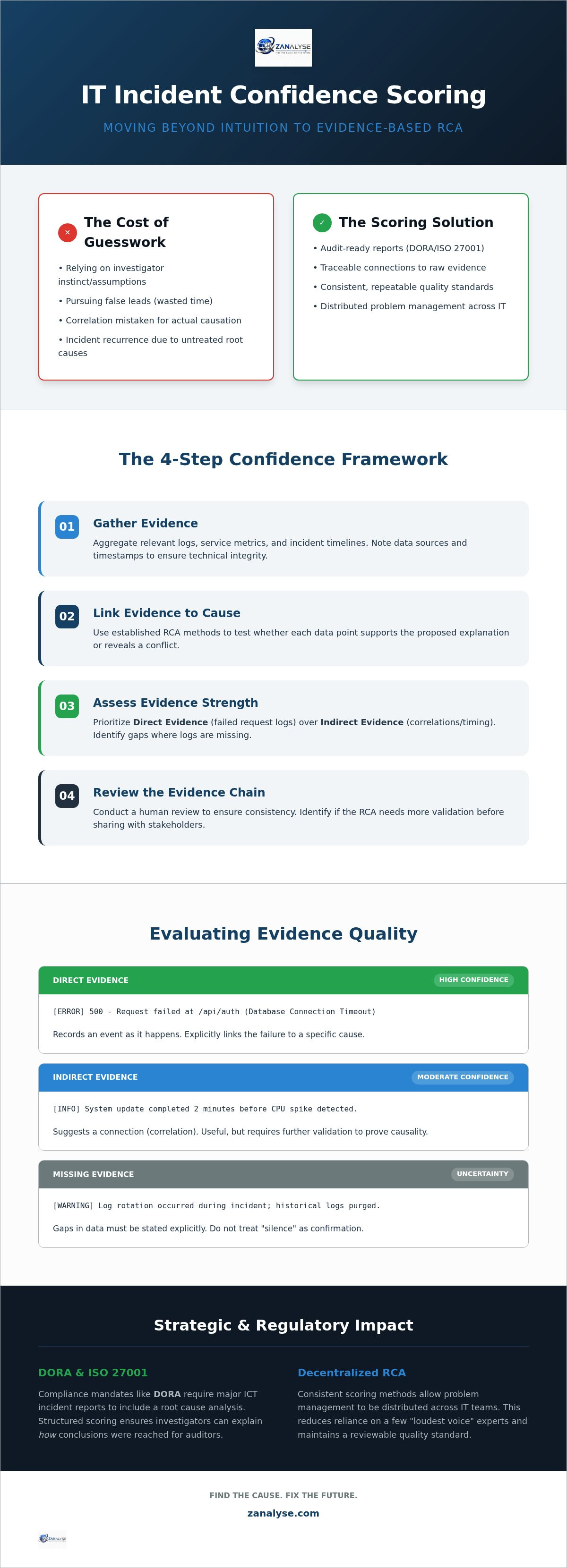
A useful confidence score should be traceable, not mysterious. IT incident confidence scoring works best when teams can see which evidence supports a root cause, how strong that evidence is, and what remains unverified. There’s no universal formula established here, so define a consistent scoring method for your organization rather than treating a number as proof by itself.
Build the assessment in four steps:
- Gather evidence: Bring together relevant logs, service metrics, and a timeline of incident events. Note where each item came from and when it was recorded.
- Link evidence to the cause: Use established root cause analysis methods to test whether each item supports the proposed explanation.
- Assess evidence strength: A log directly recording a failed request may support a claim more strongly than the fact that a change happened shortly before an outage. Look for corroborating evidence and note anything that conflicts with the explanation.
- Review the evidence chain: Consider how complete and consistent the supporting evidence is, and record gaps that still need investigation.
The Key Components of a Reliable Scoring Framework
Direct evidence records an event, while indirect evidence suggests a connection. Both can be useful, but correlation alone doesn’t establish cause. Missing evidence matters too: if relevant logs weren’t retained, state that limitation rather than treating silence as confirmation. This makes the score easier for another investigator to interpret and challenge.
Keep human review in the process. The NIST Computer Security Incident Handling Guide provides guidance for incident handling and post-incident analysis, supporting a disciplined review approach. ZANALYSE automates RCA reporting with evidence, confidence scores, and corrective actions, helping decentralized teams apply a consistent process. Explore ZANALYSE’s RCA approach to see how structured reporting can connect raw logs to reviewable findings.
Leveraging High-Confidence RCA for Regulatory Compliance and DORA
For financial entities in scope, DORA’s major ICT incident reporting process includes a final report with root cause analysis. The Digital Operational Resilience Act (DORA) establishes the wider resilience framework, while teams still need clear records to explain how they reached an RCA and what they plan to change. A structured report linking evidence, findings, and corrective actions makes that reasoning easier to review. See the guide to DORA incident reporting requirements for further context.
Use confidence scores as an internal quality gate, not as a guarantee of regulatory compliance. Before finalizing a report, check whether the score reflects traceable evidence, whether gaps are acknowledged, and whether proposed actions address the identified cause. A low or uncertain score can flag the need for further investigation before a conclusion is relied on in an audit or review. For teams operating in Europe, Canada, or Australia, align incident records with the requirements relevant to their operations rather than assuming one framework applies everywhere.
Standardizing Incident Reports with ZANALYSE Confidence Metrics
ZANALYSE turns raw logs and incident data into structured RCA reports featuring evidence, confidence scores, and corrective actions. This gives staff across IT a consistent reporting approach, rather than reserving investigations for a small group of specialists. The ZANALYSE Standard License supports these reporting capabilities, and the ZANALYSE Full License is also available to organizations.
High-confidence findings can help teams choose corrective actions that address causes rather than symptoms. ZANALYSE reports reducing incident lead times by over 50%; this is a reported outcome, not a guaranteed effect of any single score or action. The value of IT incident confidence scoring is a clearer basis for review, follow-up, and organizational learning.
Make Every Investigation Easier to Trust
Strong incident management depends on more than identifying a likely cause. Teams need to show how evidence supports that conclusion, recognize what remains uncertain, and turn findings into corrective action. IT incident confidence scoring provides a consistent way to assess evidence and make reports clearer for technical teams and reviewers.
With structured RCA, problem management can extend beyond a small group of specialists, helping IT staff contribute to investigations and shared learning. ZANALYSE reports reducing incident lead times by over 50% and provides structured evidence and corrective actions to support DORA and ISO audit preparation. Outcomes depend on the organization’s processes and use of the platform.
Ready to make evidence-based RCA part of your team’s workflow? Explore ZANALYSE licensing and take the next step toward more consistent, reviewable investigations. Better evidence helps your team move forward with confidence.
Frequently Asked Questions
What is a “good” confidence score for an IT incident root cause?
There’s no universal score that makes a root cause “good.” Set a consistent scale for your organization and define what evidence supports each level. A strong score should reflect relevant, traceable evidence, such as logs and incident records, while accounting for conflicting information and gaps. Record the reasoning too, so another reviewer can understand how the team reached its conclusion.
How does confidence scoring help with DORA and ISO 27001 compliance?
Confidence scoring helps make investigation findings easier to review by showing how evidence supports a root cause and which gaps remain. It doesn’t, by itself, establish compliance or replace applicable reporting requirements. Organizations in Europe, Canada, and Australia should align incident records with the requirements relevant to their operations. For DORA-related reporting, structured evidence and clear RCA findings can support a more traceable report.
Can confidence scoring be fully automated without human input?
Automation can organize incident data and generate structured RCA reports with evidence and confidence scores, but it shouldn’t remove human review. People need to validate whether the evidence supports the proposed cause, identify missing context, and decide whether corrective actions are appropriate. ZANALYSE automates RCA reporting to support a consistent process, while teams remain responsible for reviewing findings and decisions.
How do confidence scores reduce the time spent on IT problem management?
IT incident confidence scoring can help teams focus investigation effort by making evidence gaps and weakly supported causes easier to identify. That reduces time spent pursuing assumptions and repeating analysis. ZANALYSE reports reducing incident lead times by over 50%; this is a reported outcome, not a guaranteed result for every organization. Structured RCAs also help distribute problem management across IT staff.
Disclaimer
Some content on this website may be generated or assisted by artificial intelligence. While we strive to ensure that all information is accurate, relevant and up to date, AI-assisted content may contain errors or omissions. Content should therefore be considered informational and not as professional advice.


