


A polished RCA report still needs to show how the team moved from incident evidence to its root-cause conclusion. Audit readiness depends on traceable reasoning, not presentation alone. Audit ready rca reports connect logs, timelines, and team notes to clear findings. When evidence is scattered or reports rely on individual specialists, that connection can be difficult to review.
This challenge is familiar to teams working to make problem management more consistent. This article explains how to build reports that link evidence to defensible conclusions and trackable corrective actions. You’ll learn what information to capture, how to distinguish incident response from root cause analysis, and how guided workflows can help more technical and operational staff contribute. A structured record can support review, but it doesn’t guarantee compliance. The reasoning still needs to stand up to scrutiny.
Key Takeaways
- Make audit ready rca reports traceable by showing how incident facts support each finding.
- Set the incident scope, gather relevant evidence, and build a timeline before drawing conclusions.
- Give each corrective action a clear owner and a way to track follow-up.
- Use guided workflows to help more staff follow a consistent RCA process, while keeping evidence review visible.
What Makes an RCA Report Audit-Ready? Start with Traceable Evidence
An audit-ready RCA report is a structured record connecting incident facts to analysis, findings, and follow-up actions. It lets a reviewer trace how the investigation reached its conclusion, rather than relying on a confident summary or the memory of the specialist who led it. There’s no single universal definition of audit readiness. The practical test is whether the report makes its reasoning clear and reviewable.
Root-cause analysis is a systematic way to investigate why a problem occurred and identify its underlying cause. In an IT investigation, document the path from the incident’s symptoms to the cause the team identifies, while keeping evidence distinct from assumptions.
Which elements make an RCA report easier to review?
Give the reader enough context to understand what was investigated and what fell outside the investigation’s scope. Include a clear timeline, relevant records, and an explanation of how each key item supports the findings. Timestamps alone aren’t enough: state what a log entry or incident note shows and why it matters.
For example, a timeline might show that a service error began after a configuration change. That sequence supports a lead, but it doesn’t prove the change caused the incident. Show what additional evidence supports the conclusion, and identify any remaining uncertainty.
- Incident context: Describe the affected service and observed impact.
- Scope: State what the investigation examined.
- Evidence and timeline: Link relevant records to events in sequence.
- Reasoning and follow-up: Explain the conclusion and record actions to address the cause.
Readable summaries help people understand what happened. Audit ready rca reports go further: they make the evidence-to-conclusion chain visible. That structure supports review, but it doesn’t by itself establish compliance with any framework or requirement.
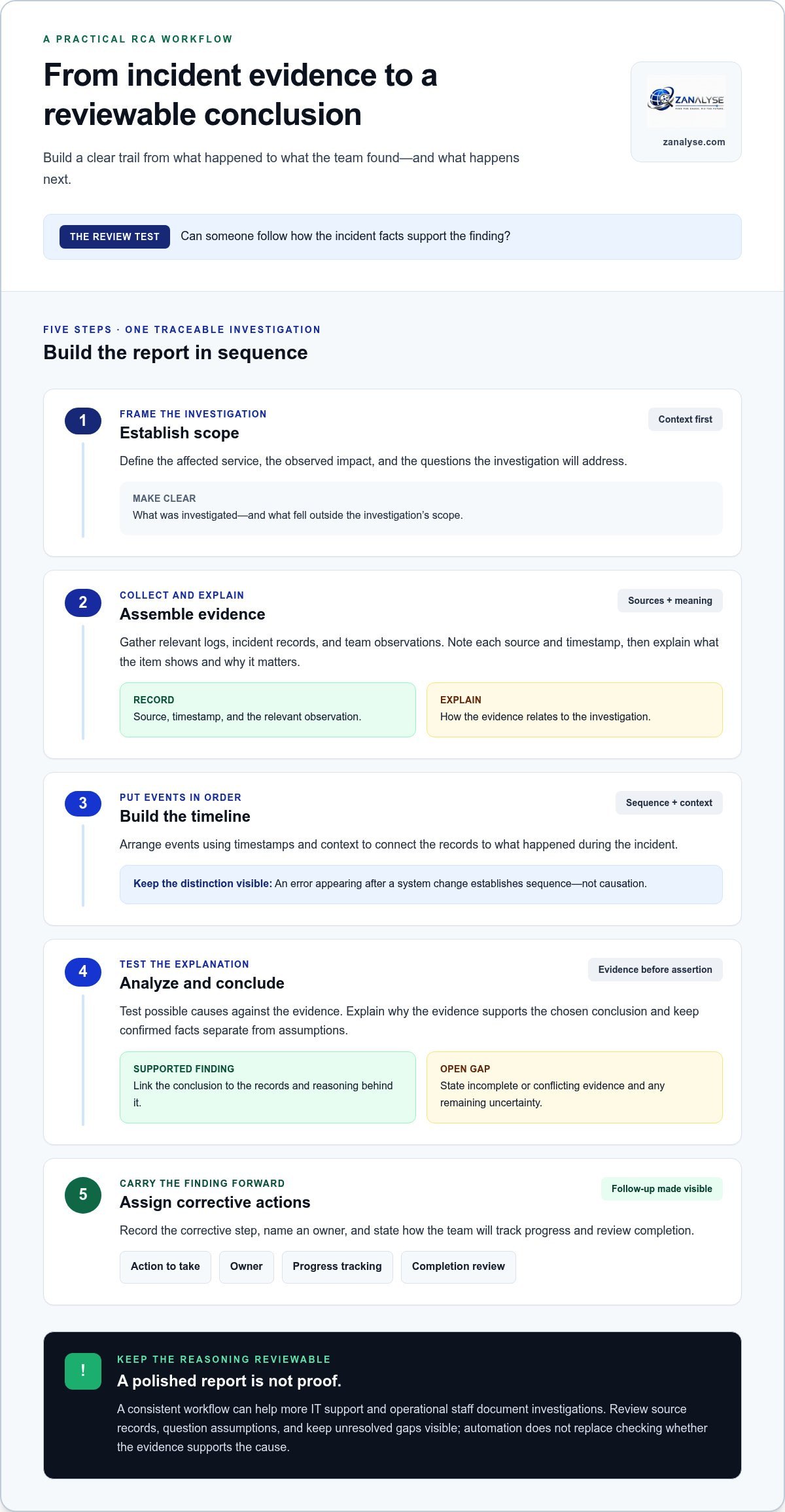
How to Build an Audit-Ready RCA Report from Incident Evidence
Use a consistent sequence to give the investigation a clear path from the incident to follow-up:
- Establish scope: Define the affected service, impact, and questions the investigation will address.
- Assemble evidence: Gather relevant logs, incident records, and team observations. Note each source and timestamp, then explain why the item matters.
- Build the timeline: Put events in sequence, using timestamps and context to connect records to what happened.
- Analyze and conclude: Test possible causes against the evidence. Separate confirmed facts from assumptions, and explain why the evidence supports the chosen conclusion.
- Assign actions: Record corrective steps with an owner and a way to track progress and review completion.
A log entry showing an error after a system change establishes sequence, not causation. Look for other evidence that supports a link, and record any gaps that remain. For a closer look at choosing an investigation technique, see these root cause analysis methods. Harvard Business School Online also outlines how to perform a root cause analysis.
How should a report show evidence, confidence, and corrective actions?
Link each major finding to the records and reasoning behind it. If evidence is incomplete or conflicting, state the gap rather than presenting an assumption as fact. A confidence score can communicate how strongly the available evidence supports a conclusion. It isn’t certainty or proof of compliance.
Make corrective actions specific enough to assign and review. Name the change to be made, its owner, and how the team will confirm it’s complete. This is the practical value of audit ready rca reports: reviewers can follow the analysis, and teams can track what happens next. To see how a guided approach can structure this work, explore ZANALYSE’s approach to RCA.
Standardize Audit-Ready RCA Reports Across Teams with a Guided Workflow
Automation can organize information into a polished report, but it doesn’t prove that the investigation’s reasoning is sound. A consistent format is useful, but it can’t replace checking whether the evidence supports the proposed cause. Teams still need to review source records, question assumptions, and keep unresolved gaps visible.
Standardize the parts that make reports easier to compare and review: incident context, scope, evidence references, analysis, findings, and corrective actions. Keep the investigation specific to the incident. A guided workflow can prompt IT support and operational teams to document their reasoning consistently, reducing dependence on a small number of specialists while leaving room for expert judgment.
What should teams standardize without losing investigative judgment?
Set shared expectations for recording evidence and explaining conclusions, rather than using a template that forces every incident into the same explanation. Confidence scores can help reviewers understand how strongly the available evidence supports a finding, but they aren’t proof. Review the underlying evidence before deciding what action to take. For related reading, see DORA incident reporting guidance and IT incident confidence scoring.
ZANALYSE provides guided RCA for IT organizations. The platform uses logs, timelines, and incident data to generate structured reports that can include evidence, confidence scores, and corrective actions. It guides users through established RCA techniques, giving teams a shared record to review and follow while leaving the investigation grounded in evidence and sound judgment. For IT teams and service providers working across Canada, Australia, and Europe, guided workflows can help more staff contribute to audit ready rca reports without treating automation as a substitute for analysis.
Make Every RCA Finding Easier to Review
Reliable RCA starts with a clear trail from incident facts to findings. A focused scope, well-contextualized evidence, and transparent reasoning help reviewers understand how the team reached its conclusion. Consistent report structure makes that trail easier to follow, but report quality alone doesn’t establish compliance.
Strong audit ready rca reports also turn findings into corrective actions that teams can assign and track. Guided workflows can help more IT staff contribute to problem management without removing the need for people to review evidence and apply judgment.
ZANALYSE is designed to support this approach. It uses logs, timelines, and incident data to create structured RCA reports that can include evidence, confidence scores, and corrective actions, helping distribute RCA across IT staff. Explore ZANALYSE’s structured root cause analysis platform to give your team a clearer path from incident evidence to meaningful follow-up.
Frequently Asked Questions
What is an audit-ready RCA report?
An audit-ready RCA report is a structured incident record that lets a reviewer trace the investigation from scope and timeline through evidence, reasoning, findings, and corrective actions. Audit readiness describes how clearly the report can be reviewed and its conclusions followed back to supporting information. It doesn’t mean the report alone guarantees compliance with any standard or regulation.
What should an audit-ready root cause analysis report include?
Include incident context, investigation scope, a clear timeline, relevant evidence, analysis, supported findings, any uncertainty or evidence gaps, and corrective actions. Audit ready rca reports should make the path from evidence to conclusion easy to follow, so reviewers can see why the team reached its findings. These elements offer a practical structure, not a universal mandatory template for every organization.
Can an automated RCA report be audit-ready?
Yes. Automation can support audit readiness by organizing relevant source data and making reporting more consistent. It can’t establish that records are complete or that a proposed cause is correct, so teams still need to review the evidence and reasoning. For IT organizations in Canada, Australia, and Europe, ZANALYSE generates structured reports with evidence, confidence scores, and corrective actions. Software alone doesn’t guarantee accuracy or compliance.
How do you make an RCA report more defensible?
Tie each major claim to supporting evidence, give timeline entries enough context, and separate confirmed facts from assumptions. State uncertainty or missing evidence rather than presenting a tentative explanation as proven. Then assign corrective actions so teams can track follow-up. Keep the report aligned with your organization’s applicable processes and requirements, since there isn’t one rule that fits every team.
Disclaimer
Some content on this website may be generated or assisted by artificial intelligence. While we strive to ensure that all information is accurate, relevant and up to date, AI-assisted content may contain errors or omissions. Content should therefore be considered informational and not as professional advice.


