


A response plan should do more than help contain an incident. It should preserve the decisions and evidence teams need to understand what happened and act on the findings. Canadian IT teams often coordinate across services, departments, and client relationships, so a shared process can prevent timelines and ownership from becoming scattered. Root cause analysis software Canada teams use can then help structure post-incident learning.
This template sets out how to define roles, record decisions and evidence, and hand off from incident response to root cause analysis. Use it to organize containment, recovery, and follow-up. For each incident, adapt the steps to your services and operating context, including work across Canada, Australia, and Europe. ZANALYSE turns logs, timelines, and incident data into structured reports to support the investigation and corrective-action stage, while your team coordinates the live response.
Key Takeaways
- Make your incident response plan a working guide to roles, communication, decisions, and evidence.
- Use a consistent sequence from preparation through review, adapting the details to your team’s operating context.
- Record incidents in a way that supports a clear handoff to root cause analysis software Canada teams use to investigate causes and organize follow-up.
- Use guided RCA workflows to help more staff contribute, then assign owners to corrective actions so findings lead to practical changes.
Why Canadian IT Teams Need an Incident Response Plan That Connects to RCA
An incident response plan should be a working guide, not a file that sits untouched until something goes wrong. It sets out who coordinates the response, how teams communicate, where decisions and evidence are recorded, and how services move toward recovery. These elements align with the broader principles of computer security incident management, while allowing each organization to shape a workflow around its operations.
Keep live response and post-incident investigation distinct. During an incident, teams focus on detection, triage, containment, and recovery. Once immediate risks are managed, a documented review can examine what caused the incident, which evidence supports that conclusion, and what corrective actions could reduce recurrence. Root cause analysis software Canada teams use can organize that follow-up, but it does not replace the people coordinating the live response.
Make the plan relevant to your sector, provincial context, and client commitments. A service provider, for example, can define responsibilities for internal responders alongside the steps for communicating with clients. Teams working across Canada, Australia, and Europe should document the context-specific obligations and commitments that apply to their operations rather than assume one workflow covers every location.
What belongs in an incident response plan before an incident occurs?
Define the incident scope and activation criteria so staff know when to start the process. Name the response lead, action owners, communication channels, escalation paths, and the person responsible for recording decisions and evidence. Specify where the incident record lives and what details it should contain, such as timestamps, affected services, observed impact, and actions taken. Then define who leads the post-incident review and how findings become assigned actions. Keep the workflow clear enough for staff beyond a small group of RCA specialists to contribute, and review it when teams, systems, or client arrangements change.
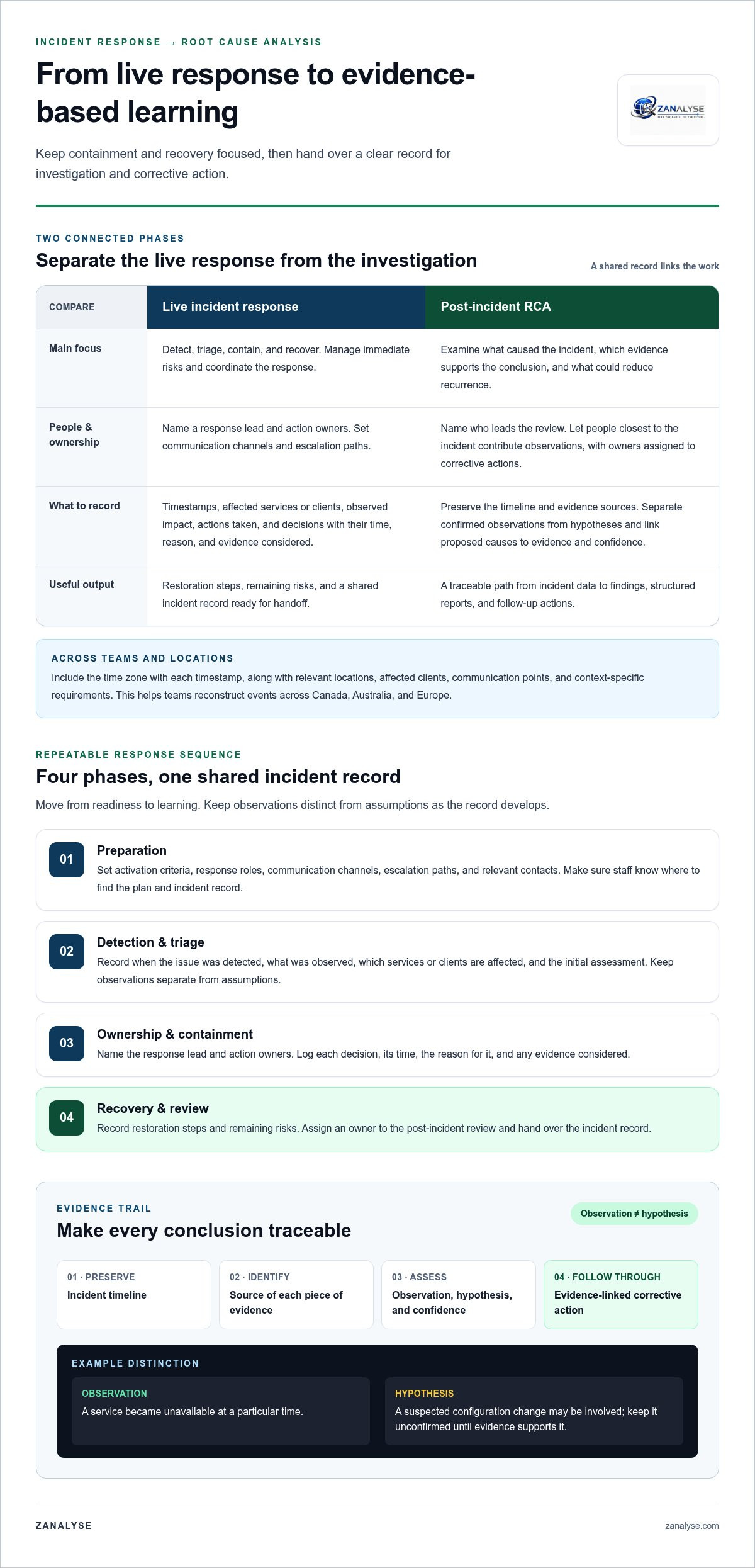
Use This IT Incident Response Plan Template to Coordinate the Work
Use a sequence that moves from readiness to learning. The Computer Security Incident Handling Guide provides a useful reference for incident-handling phases. Adapt the workflow to your organization and record the details in a shared incident record:
- Preparation: Set activation criteria, response roles, communication channels, escalation paths, and relevant contacts. Make sure staff know where to find the plan and incident record.
- Detection and triage: Record when the issue was detected, what was observed, which services or clients are affected, and the initial assessment. Keep observations separate from assumptions.
- Ownership and containment: Name the response lead and action owners. Log each decision, its time, the reason for it, and any evidence considered.
- Recovery and review: Record restoration steps, remaining risks, and any follow-up work. Assign an owner to the post-incident review and hand over the incident record.
Make the record useful across Canadian operations and international service relationships. Include the time zone with each timestamp, as well as relevant locations, affected clients, communication points, and context-specific requirements. Consistent timestamps make it easier to reconstruct the sequence of events when teams or clients work across Canada, Australia, and Europe.
How should teams move from incident timeline to evidence-based RCA?
Preserve the timeline, identify the source of each piece of evidence, and distinguish confirmed observations from hypotheses. For example, record that a service became unavailable at a particular time as an observation. Treat a suspected configuration change as a hypothesis until the evidence supports it. Link each proposed cause to its supporting evidence, confidence level, and follow-up action. This gives reviewers a traceable path from event to conclusion without presenting an early assumption as fact.
When assessing root cause analysis software Canada teams can use, look for workflows that connect incident data, evidence, confidence, and corrective actions in a structured report. Explore ZANALYSE’s guided RCA workflows to see how a consistent process can help staff across the organization contribute to investigations.
Operationalize the Template with Repeatable RCA and Corrective Actions
A response plan creates value beyond recovery when teams use its records to investigate causes and prevent repeat incidents. Guided root cause analysis (RCA) can make this work accessible to support staff, process managers, and service providers, rather than reserving every investigation for a small group of specialists. People closest to an incident can contribute observations, while a consistent workflow helps keep the investigation structured.
ZANALYSE turns logs, timelines, and incident data into structured reports featuring evidence, confidence scores, and corrective actions. Teams can use these reports to show how findings relate to the incident record and to carry proposed actions into follow-up. The Canadian Centre for Cyber Security also provides Canada-specific cyber security guidance. Software can support consistent documentation, while organizations remain responsible for decisions about applicable requirements and action ownership.
What should Canadian IT leaders evaluate in RCA software?
Assess whether the workflow is clear and usable for different contributors, from frontline support teams to decision-makers and client-facing service providers. If only specialists can navigate the process, investigations may continue to depend on the same small group. A guided workflow can help distribute problem management and make it easier for staff to contribute relevant observations.
Review a report from start to finish. Can readers trace how incident data supports the evidence, see how confidence is represented, and understand how findings lead to corrective actions with accountable owners? For root cause analysis software Canada teams evaluate, that connection matters more than a polished summary alone. It helps teams share conclusions, follow action progress, and build consistent learning across services and clients.
For license considerations, use the ZANALYSE Standard License: Buying Guide for IT Leaders as a related resource. Choose an RCA workflow that fits your incident-plan handoff and helps staff turn recorded events into structured investigations.
Turn Your Response Plan into a Repeatable Learning Process
A useful incident response plan does more than guide detection, containment, and recovery. It clarifies ownership, creates a reliable record of decisions and evidence, and sets up a clear handoff to post-incident investigation. This separation helps teams manage the immediate issue while preserving the context needed to understand why it happened.
For ongoing learning, root cause analysis software Canada teams use should make investigations easier to share, not dependent on a few specialists. ZANALYSE creates structured reports from logs, timelines, and incident data, with evidence, confidence scores, and corrective actions to help teams carry findings into follow-up. Its guided approach is designed to decentralize problem management across IT staff.
Start with a plan your teams can use, then build a consistent path from incident records to corrective action. Explore ZANALYSE’s structured approach to root cause analysis to support more accessible, evidence-led learning across your organization.
Frequently Asked Questions
What should an IT incident response plan include?
An IT incident response plan should define incident scope, activation criteria, accountable roles, communication channels, and escalation paths. It should guide teams through detection, triage, containment, recovery, and review, with a consistent place to record timestamps, impact, decisions, and evidence sources. Include a handoff to post-incident analysis, and document the organizational or regulatory obligations that apply to your situation.
How is an incident response plan different from a root cause analysis?
An incident response plan coordinates the work of managing an active incident, while root cause analysis investigates why it happened and what could prevent recurrence. During response, teams prioritize understanding impact, containing the issue, and restoring services. RCA follows, using the timeline and evidence to assess possible causes and define corrective actions. The processes connect, but they serve different purposes.
Can one incident response plan work for teams across different Canadian provinces?
Yes. Teams can use a shared core workflow, then adapt its details to local operations. Record relevant time zones, locations, team contacts, client communication points, and context-specific requirements. Organizations operating across Canada, Australia, or Europe should map the obligations and commitments that apply in each context rather than assume one version fits every team or jurisdiction.
How can RCA software help turn incident records into corrective actions?
Root cause analysis software Canada teams use can organize logs, timelines, and incident data into structured reports that connect findings to evidence and confidence scores. Guided RCA workflows can help more staff contribute to investigations, while reports capture corrective actions for follow-up. Teams still need to assess findings and assign accountable owners so proposed actions can be reviewed and progressed.
Disclaimer
Some content on this website may be generated or assisted by artificial intelligence. While we strive to ensure that all information is accurate, relevant and up to date, AI-assisted content may contain errors or omissions. Content should therefore be considered informational and not as professional advice.


