


An unexplained quota won’t tell you whether your team can keep up with root cause analysis. RCA capacity credits are easier to assess when you start with the work: how often incidents need investigation, who can contribute, and how your team handles the analysis. The terminology can be unclear when workload planning and software licensing are discussed together.
A practical capacity plan helps you scale problem management without losing consistency. This article explains how to estimate RCA capacity from incident workload, how capacity fits into an RCA workflow, and how it relates to ZANALYSE licensing. You’ll also learn when an RCA Capacity Top-up may fit your plan, so you can make a decision based on expected work rather than an arbitrary target.
Key Takeaways
- Plan rca capacity credits around your team’s incident workload, not an arbitrary quota.
- Review incident volume, recurring issues, and who will take part in RCA to build a realistic capacity plan.
- Keep operational capacity distinct from the software license that provides access to the RCA platform.
- Consider an RCA Capacity Top-up when planned analysis exceeds current capacity, but address evidence quality and ownership gaps separately.
What RCA Capacity Credits Mean for Root Cause Analysis Work
The phrase rca capacity credits can refer to two different planning questions: how much time your team can devote to root cause analysis, and what capacity is available through its software licensing. For operational planning, think of capacity as the people and time available to investigate incidents. A ZANALYSE Standard or Full License provides access to the platform, while RCA Capacity Top-ups provide additional RCA capacity. Keep these product options separate from estimates of staff hours. Don’t assume a direct conversion between hours, incidents, and product credits.
This distinction matters when problem management is shared across more people. Support staff, process managers, and other IT colleagues can contribute to investigations, but wider participation can also increase demand for analysis. Plan around the work your team expects to undertake, then consider the relevant license and capacity options separately.
How capacity fits into a structured RCA workflow
RCA begins with available incident evidence, such as logs, timelines, and other relevant data. The team reviews the information to understand what happened, follows an appropriate analysis method, and records its findings in a structured report. The report can connect evidence to confidence scores and corrective actions, documenting both the reasoning and next steps. For background on the practice and common methods, see Root Cause Analysis on Wikipedia.
Capacity supports the work of carrying out this workflow. It doesn’t improve evidence quality or guarantee a correct conclusion. Clear ownership and reliable incident information remain essential. ZANALYSE guides users through established RCA techniques, helping make structured analysis accessible to IT staff across roles.
For product-specific context on how RCA Capacity Top-ups support scaling problem management, see the RCA Capacity Top-ups guide. Keep product capacity distinct from the operational time your team needs to review evidence, discuss findings, and follow through on corrective actions.
How to Estimate RCA Capacity from Your Team’s Incident Workload
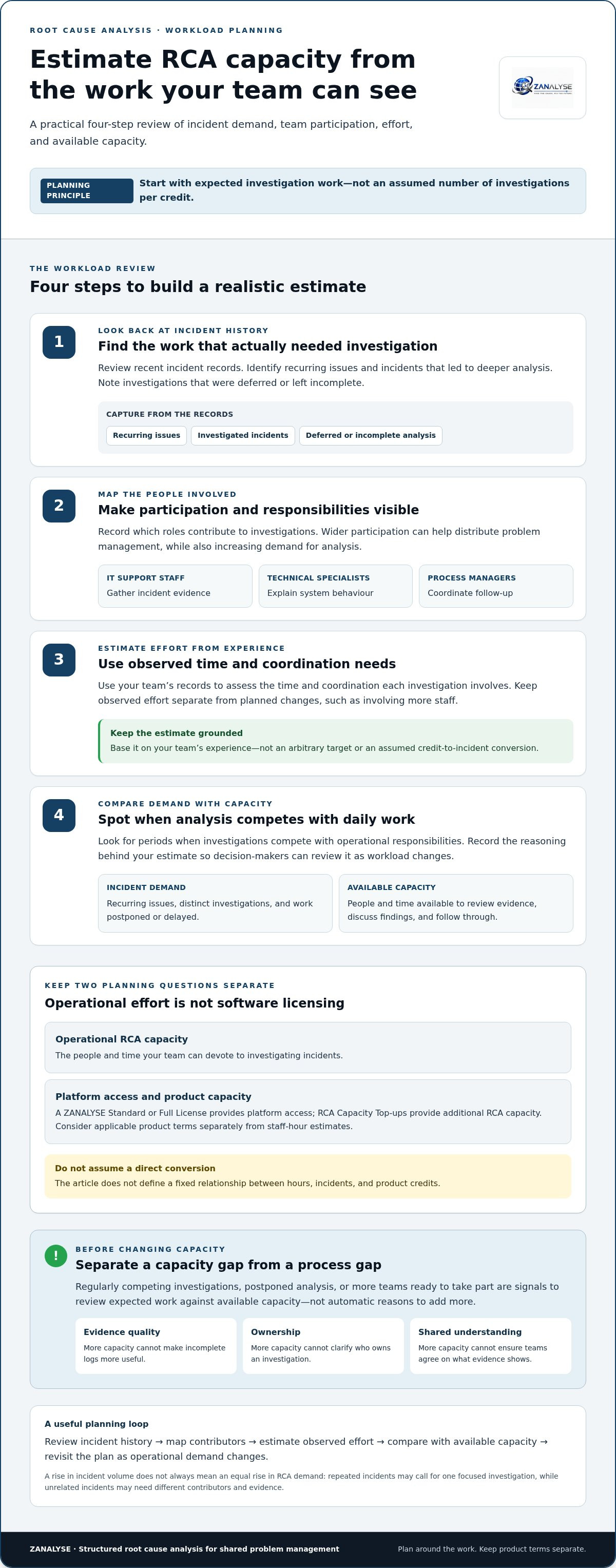
Base your plan on work the team can observe, rather than an assumed number of investigations per credit. Start with recent incident records. Note which incidents led to deeper analysis, how often similar issues returned, and whether investigations were completed or delayed. This gives you a practical view of demand and helps separate actual workload from expectations.
A practical workload review before adjusting capacity
Use this sequence to build an estimate:
- Review incident history. Identify recurring issues and incidents that required investigation. Note analysis that was deferred or left incomplete.
- Map participation. Record which roles contribute, such as IT support staff gathering evidence, technical specialists explaining system behaviour, and process managers coordinating follow-up.
- Estimate effort from experience. Use your team’s records to assess the time and coordination each investigation involves. Keep observed effort separate from planned changes, such as involving more staff.
- Compare demand with capacity. Look for periods when investigation work competes with operational responsibilities. Treat any product-specific credit calculation as a separate step, based on the applicable product terms rather than an assumed credit-to-incident conversion.
A rise in incident volume doesn’t always mean an equal rise in RCA demand. Repeated incidents may call for one focused investigation, while several unrelated incidents may need different contributors and evidence. Record the reasoning behind your estimate so IT decision-makers can review it as workload changes.
For broader workflow context, the problem management reference guide connects investigation planning to ongoing problem management. Teams assessing how a structured RCA platform can support participation across staff can also explore ZANALYSE’s RCA platform.
When RCA Capacity Top-ups May Fit Your Problem Management Plan
Review capacity when investigations regularly compete with day-to-day support, planned analyses are postponed, or more teams are ready to take part in problem management. These are signals to compare expected RCA work with available capacity, not automatic reasons to add more. If your workload review shows an ongoing gap, an RCA Capacity Top-up may be a practical next step.
Before deciding, separate a capacity constraint from a process issue. Additional capacity won’t make incomplete logs more useful, clarify who owns an investigation, or ensure that teams agree on what the evidence shows. Address those gaps directly. Otherwise, extra capacity may not help your team produce more consistent analysis.
Connect capacity decisions to consistent RCA practice
Set a repeatable approach for capturing incident evidence and recording decisions, then make participation clear across relevant IT roles. Shared, structured RCA allows support staff and specialists to contribute without making problem management the responsibility of a single team. Capacity planning supports that process, but it doesn’t guarantee a root cause, a service outcome, or compliance.
Use your workload review to define what needs to change, then consider product terms alongside your operational plan. Don’t assume that rca capacity credits translate into a fixed number of investigations. Base product decisions on the available capacity options and how your team intends to use them. If your process is clear and demand exceeds current capacity, explore ZANALYSE and its RCA capacity options.
Make RCA Capacity a Deliberate Part of Operations
Capacity decisions are most useful when they support a repeatable practice, not a one-off response to a backlog. Treat rca capacity credits as one part of a broader plan: decide which problems merit investigation, make participation workable across teams, and revisit the plan as operational demand changes. With ZANALYSE, automated reports bring incident evidence, confidence scores, and corrective actions into a structured record. The platform guides users through established RCA techniques and is designed to make problem management accessible across IT teams.
The goal isn’t simply to fit more investigations into the calendar. It’s to make room for useful analysis and follow-through without losing consistency. That gives process managers and IT leaders a clearer basis for improving how teams learn from incidents. Whether your teams operate in Canada, Australia, or Europe, use your incident workload and operating context to shape the plan. If your review points to a need for additional RCA capacity, explore ZANALYSE’s RCA capacity options and choose a structured approach to problem management.
Frequently Asked Questions
Can RCA capacity credits guarantee a root cause?
No. RCA capacity credits can support the resources allocated to investigation, but they can’t guarantee that an analysis will identify a definitive cause. The result still depends on the available information, the quality of the investigation, and how the team tests its conclusions. If evidence is incomplete, document what remains uncertain rather than presenting an assumption as a proven cause.
Do RCA capacity credits guarantee DORA compliance?
No. Capacity alone doesn’t establish compliance with DORA or any other framework. Organizations must assess their own obligations, processes, and evidence. This is especially relevant for teams operating across Europe, Canada, and Australia, where applicable requirements may differ. Treat capacity planning as an operational decision, not proof that regulatory expectations have been met.
Can RCA capacity credits improve the quality of incident reports?
They can give teams more room to carry out analysis, but they don’t automatically make reports more accurate or useful. A practical improvement is to record when events occurred, which services were affected, and what information supports each conclusion. Separating confirmed findings from open questions helps readers understand the report and decide what action to take.
Who should be involved in planning RCA capacity?
Include the people who understand the workload and those who decide how resources are assigned. IT support can describe investigation demands, technical specialists can identify the expertise involved, and process managers can coordinate consistent participation. IT directors, heads of IT, or service owners can weigh priorities against available capacity. For teams operating across Canada, Australia, and Europe, include representatives familiar with each operating context.
Disclaimer
Some content on this website may be generated or assisted by artificial intelligence. While we strive to ensure that all information is accurate, relevant and up to date, AI-assisted content may contain errors or omissions. Content should therefore be considered informational and not as professional advice.


