


Rigid software licensing shouldn't dictate your ability to resolve critical outages. When an unexpected system disruption strikes, hitting an artificial run cap brings problem investigations to a dead halt. You already know how difficult it is to predict incident volume; locking your organization into an oversized annual contract simply to survive seasonal spikes strains IT budgets. That is why flexible RCA Capacity Top-ups have become an essential safeguard for modern technical operations.
Discover how RCA Capacity Top-ups enable IT teams and service providers to absorb incident surges, decentralize problem management across staff, and maintain continuous regulatory compliance with standards like DORA and ISO. We will examine how elastic analysis pools keep your operations audit-ready and scalable without locking you into unnecessary software tiers.
Key Takeaways
- Understand how flexible RCA Capacity Top-ups allow teams to absorb unexpected incident spikes without committing to oversized annual software contracts.
- Learn an objective framework to assess when to supplement your base license with on-demand runs versus upgrading to a higher tier.
- Discover how shared capacity pools decentralize root cause analysis, empowering front-line IT support and multi-client service providers to resolve issues faster.
- Ensure your problem management workflows stay audit-ready and compliant with DORA and ISO standards, even during severe operational disruptions.
What Are RCA Capacity Top-ups in Modern IT Operations?
Traditional software models often tether technical teams to fixed monthly investigation quotas. RCA Capacity Top-ups provide an elastic solution, delivering incremental analysis volume directly on top of an existing base license. Rather than purchasing manual consulting packages or managing individual seat licenses, these top-ups supply on-demand execution credits to automated problem management platforms.
Automated platforms consume capacity whenever they ingest structured logs, reconstruct event timelines, and synthesize diagnostic evidence to complete a thorough Root Cause Analysis. When complex outages trigger cascading failures across distributed infrastructure, teams must analyze multiple interconnected services simultaneously. A rigid monthly quota quickly runs dry during such spikes. Hitting a licensing ceiling mid-investigation stalls corrective actions, leaving operations blind when stability matters most.
Managing Sudden Incident Volume and DORA Regulatory Deadlines
Major downtime rarely happens in isolation. A single infrastructure disruption often spawns a cluster of post-mortems that require rigorous, evidence-backed documentation. For regulated sectors, investigation delays carry severe legal and financial risks. European financial entities, for example, must adhere to statutory timelines mandated by strict DORA incident reporting requirements.
Adding dedicated RCA Capacity Top-ups gives operations a reliable buffer against these pressure points. Teams can continuously process system events and generate audit-ready root cause documentation on schedule, ensuring compliance obligations remain secure even through unprecedented incident spikes.
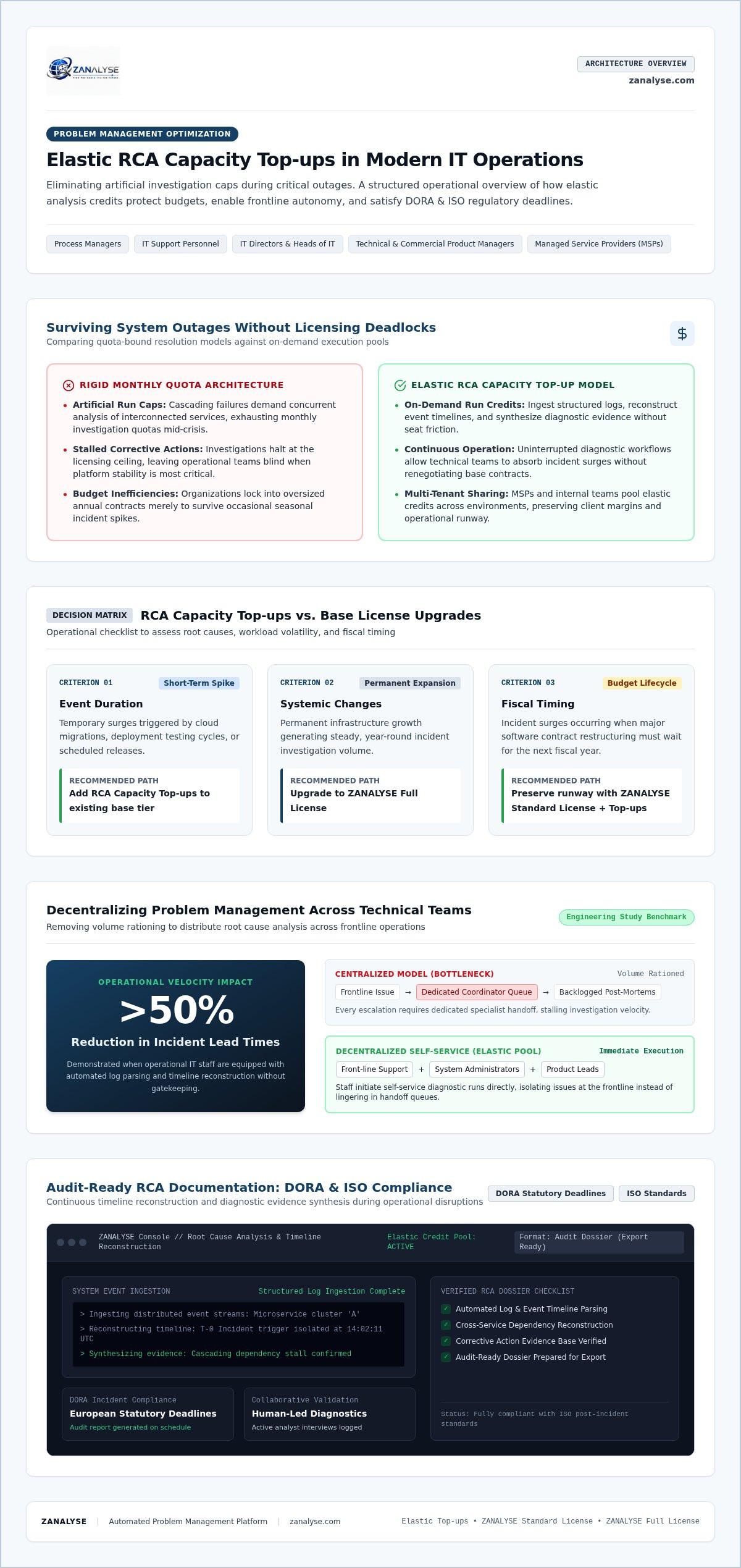
RCA Capacity Top-ups vs Base License Upgrades: Decision Framework
Committing to an enterprise software tier makes sense when your incident baseline permanently expands. However, when volume surges stem from temporary events like cloud migrations or seasonal transaction peaks, upgrading your core contract wastes operational capital. Technical teams on a ZANALYSE Standard License can utilize RCA Capacity Top-ups to navigate erratic workloads without prematurely renegotiating annual or multi-annual price plans.
This flexibility proves essential for managed service providers delivering operational support to multiple clients. Rather than purchasing rigid enterprise commitments for every tenant, service providers can share an elastic capacity pool across diverse environments. This approach supports efficient decentralized problem management while protecting client margins.
Evaluating When to Purchase Top-ups Versus Upgrading Licenses
Deciding whether to add on-demand capacity or execute a tier upgrade depends on root causes and growth patterns. IT leaders should review this operational checklist:
- Event Duration: Planned releases, testing cycles, or system migrations justify short-term top-ups rather than long-term software tier jumps.
- Systemic Changes: Permanent infrastructure expansion that generates steady investigation volume signals the need for a comprehensive ZANALYSE Full License.
- Fiscal Timing: RCA Capacity Top-ups preserve your operational runway when major contract restructuring must wait for the next fiscal year.
If your organization isn't certain which path fits your current roadmap, you can evaluate ZANALYSE platform plans to find the right balance.
Decentralizing Problem Management with Elastic Investigation Capacity
Centralized investigation groups frequently turn into operational bottlenecks. When every technical escalation requires a dedicated problem coordinator, routine incident post-mortems pile up quickly. By establishing shared pools powered by RCA Capacity Top-ups, organizations remove volume rationing. Front-line support engineers, system administrators, and product leads gain the immediate bandwidth to initiate self-service diagnostic runs without gatekeeping.
Removing these administrative barriers changes operational velocity. Recent engineering studies in decentralized root cause analysis emphasize that distributing analytical tools across operational teams prevents systemic investigation stalls. Equipping general IT staff with automated parsing of logs and timelines reduces incident lead times by over 50%. Issues get isolated right at the frontline instead of lingering in handoff queues.
Empowering Cross-Functional Teams Across Global Operations
Standardizing investigations requires methods that technical teams can execute consistently, regardless of their specialization. Applying accessible root cause analysis methods directly inside an automated interface allows diverse departments to generate reliable corrective actions without advanced training.
This decentralized structure supports distributed operations across Canada, Australia, and Europe. Rather than maintaining separate, silod investigation tools across regions, global organizations can draw from shared RCA Capacity Top-ups. Front-line personnel in different time zones analyze regional outages independently, while management preserves a unified, audit-ready record across the enterprise.
Scale Operational Stability on Your Own Terms
Unpredictable incident spikes shouldn't force your organization into restrictive, expensive software commitments. Adopting RCA Capacity Top-ups provides a practical way to manage workload surges, decentralize diagnostics across support personnel, and maintain full compliance with DORA and ISO reporting standards. By eliminating investigation bottlenecks with intuitive software workflows, engineering teams consistently reduce incident lead times by over 50%.
Whether you need to protect client service levels or support internal migrations, elastic capacity keeps your operations stable and audit-ready. Take control of your diagnostic runway today. Explore ZANALYSE License Plans and Capacity Options to equip your teams with scalable problem management built for modern technical operations.
Frequently Asked Questions
What are RCA Capacity Top-ups?
RCA Capacity Top-ups are flexible add-ons that supply incremental root cause analysis runs on top of your existing base license. Rather than forcing teams into higher software tiers, they deliver on-demand credits to process logs and incident timelines. This elastic capacity decentralizes problem management across support staff while keeping post-mortems aligned with strict regulatory standards like DORA.
When should an organization choose a capacity top-up over upgrading their license?
Choose a top-up when facing temporary incident surges from seasonal traffic, platform testing, or system migrations. If your team doesn't expect permanent volume growth, top-ups prevent premature budget commitments. A tier upgrade to a full license makes more sense when sustained baseline volume permanently outgrows your current plan across consecutive quarters.
Do RCA Capacity Top-ups expire if they are not used immediately?
Top-up runs don't expire at the end of each month; they remain active throughout your subscription term. This rolling buffer gives organizations in Canada, Australia, and Europe the flexibility to absorb sudden outages whenever they strike. IT teams can safely retain capacity for unexpected disruptions without losing unused credits to rigid calendar resets.
Can managed service providers distribute top-up capacity across multiple client accounts?
Yes, service providers can pool and distribute top-up capacity across diverse client environments. This shared model ensures operations teams don't need to purchase separate license upgrades for every individual client account. It gives technicians immediate diagnostic access to resolve client outages, cutting incident lead times by over 50% while preserving operational margins.
Disclaimer
Some content on this website may be generated or assisted by artificial intelligence. While we strive to ensure that all information is accurate, relevant and up to date, AI-assisted content may contain errors or omissions. Content should therefore be considered informational and not as professional advice.


