

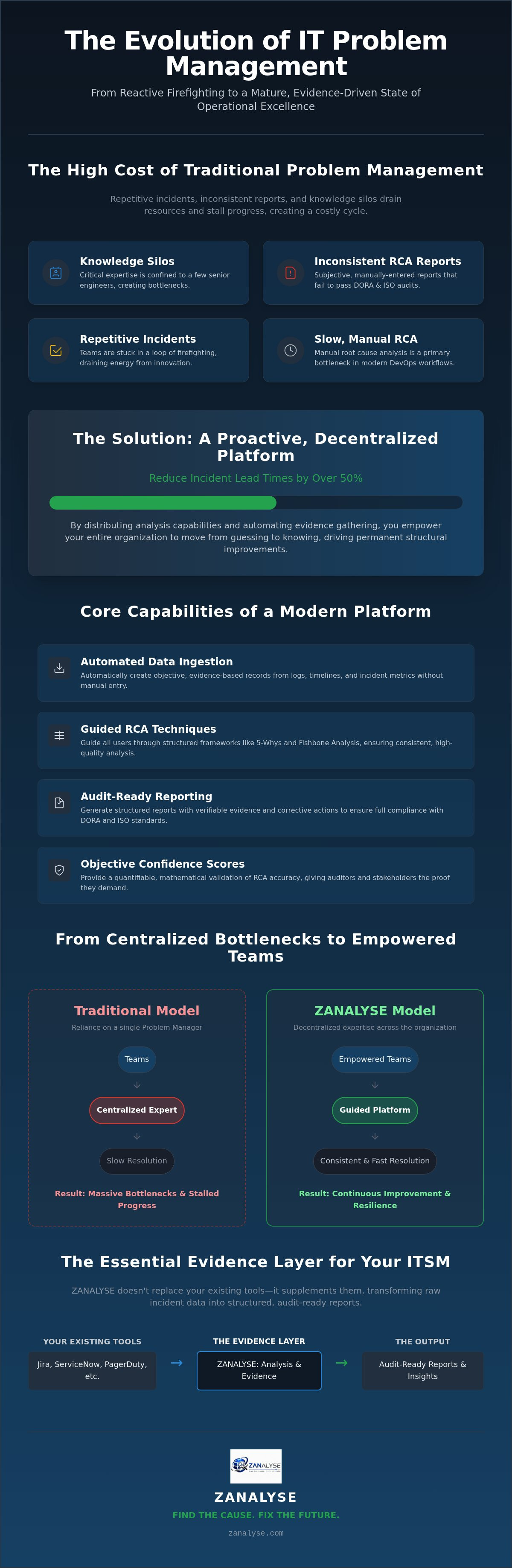
Your senior engineers shouldn't be the only people capable of solving complex problems, yet knowledge silos continue to stall operational progress. It's a costly cycle. Managing repetitive incidents drains your team's energy and produces inconsistent RCA reports that won't pass a DORA audit. Transitioning to a proactive IT problem management platform enables you to reduce incident lead times by more than 50% by distributing analysis capabilities across your entire organization.
We'll examine how to decentralize Root Cause Analysis and generate structured, audit-ready evidence that satisfies both technical requirements and commercial stakeholders. This guide provides the roadmap to move from reactive firefighting to a mature, disciplined state of operational excellence in 2026. You'll see how ZANALYSE acts as an essential evidence layer to automate techniques like the 5-Whys and protect your service integrity.
Key Takeaways
- Learn to transition from reactive firefighting to proactive structural improvement by treating problem management as an evidence-driven engine.
- Identify essential features for a modern IT problem management platform, including automated data ingestion and guided RCA techniques like Fishbone analysis.
- Empower your entire IT staff to perform high-quality analysis, effectively decentralizing expertise and ending the cycle of repetitive incidents.
- Ensure full compliance with DORA and ISO standards by generating structured reports that use objective confidence scores to validate root causes.
The Evolution of IT Problem Management Platforms in 2026
In 2026, the definition of a mature IT problem management platform has shifted significantly. It's no longer just a digital filing cabinet for linking incident tickets. Instead, it functions as a high-performance evidence engine that drives structural improvements across the entire IT Service Management (ITSM) ecosystem. Modern teams have moved past the era of reactive firefighting. They now prioritize permanent fixes over temporary patches.
Traditional tools often treat a "problem" as a static record. This approach fails because it relies on human memory and manual entry. By implementing a dedicated IT problem management platform, organizations move from guessing to knowing. Automation now plays a central role in this shift, capable of reducing incident lead times by over 50%. This efficiency allows staff to focus on innovation rather than repetitive troubleshooting.
From Reactive Ticket Tracking to Automated Root Cause Evidence
Manual RCA is the primary bottleneck in contemporary DevOps workflows. It's slow, inconsistent, and prone to error. When documentation is poor, organizations struggle to meet strict regulatory expectations like the Digital Operational Resilience Act (DORA). Failure to provide structured evidence during an audit can lead to severe consequences. ZANALYSE bridges this critical gap. It transforms raw log data into structured executive summaries that satisfy both technical leads and compliance officers. By decentralizing these capabilities, you ensure that every team member can contribute to organizational resilience without needing a decade of specialized expertise.
Key Features to Evaluate in a Modern Problem Management Solution
Selecting an IT problem management platform requires looking beyond basic ticket workflows. A modern solution must automate data ingestion from logs, timelines, and incident metrics to create objective, evidence-based records. It should guide users through structured RCA techniques like the 5-Whys or Fishbone diagrams rather than leaving them to navigate a blank text field. Without these built-in frameworks, reports remain inconsistent, subjective, and difficult to audit. High-quality output is non-negotiable. Your IT problem management platform must generate structured reports that feature verifiable evidence and specific corrective actions. This ensures that every finding is backed by data, not just intuition.
Decentralizing RCA: Empowering the Entire IT Organization
Traditional models rely on a single expert or a centralized Problem Manager to perform deep analysis. This creates massive bottlenecks and knowledge silos that stall resolution and drain senior resources. By decentralizing these capabilities, you empower the entire IT organization to contribute to the solution. A vast pool of pre-included RCAs allows junior staff to identify complex root causes that previously required years of experience to uncover. This shift builds organizational knowledge and ensures long-term stability by distributing expertise across the team. It turns every incident into a structured learning opportunity rather than a repetitive chore. Teams using ZANALYSE find that distributing these tasks is the most effective way to enhance operational maturity while reducing the burden on lead engineers. This approach doesn't just fix tickets; it creates a culture of continuous structural improvement.
Solving the Compliance Gap: Audit-Ready Reporting and DORA
Many organizations ask why they need a specialized IT problem management platform if they already use ServiceNow. The answer lies in the quality of the evidence. General ITSM tools excel at workflow, but they often lack the depth required for rigorous auditing. Auditors in 2026 don't just want to see that a ticket was closed. They demand proof. Confidence Scores solve this by providing a quantifiable measure of RCA accuracy. This mathematical validation gives regulators in Europe, Canada, and Australia the certainty they require.
Linking automated corrective action plans directly to ISO 27001 and DORA requirements is essential for modern compliance. It's a shift from manual guesswork to structured governance. By using an IT problem management platform, you ensure that every resolution step is documented with evidence that holds up under scrutiny. This level of detail is vital for financial entities facing the first full year of DORA enforcement in 2026.
Integrating ZANALYSE into Your Existing ITSM Ecosystem
ZANALYSE doesn't replace PagerDuty or Jira. It supplements them. It acts as the evidence layer that turns raw incident logs into structured reports for technical and financial stakeholders. This process transforms chaotic data into a clear narrative of resolution and prevention. For a deeper look at these evolving standards, read our Problem Management 2026: IT Operations Reference Guide. It explains how to maintain stability in increasingly complex AI-native environments.
Securing Operational Stability in 2026
The transition to evidence-driven operations is no longer optional. Implementing a modern IT problem management platform is the most effective way to eliminate repetitive incidents and satisfy the rigorous demands of DORA and ISO 27001. By decentralizing root cause analysis, you empower your entire staff to generate high-quality, structured reports that align with both technical needs and commercial goals. It's time to replace manual bottlenecks with automated precision, turning chaotic firefighting into a disciplined cycle of structural improvement.
Take the first step toward a more resilient organization. Explore the ZANALYSE Standard License for automated RCA to reduce incident lead times by more than 50% and implement automated evidence collection with confidence scoring. You can build a stable, audit-ready environment that protects your service integrity and values your team's time. Your path to operational excellence starts here.
Frequently Asked Questions
How does a problem management platform differ from incident management software?
Incident management software focuses on restoring services as quickly as possible during a disruption. In contrast, an IT problem management platform identifies the underlying cause to prevent recurrence. While incident tools track what happened, ZANALYSE provides the why by generating structured reports from logs and timelines. This distinction is critical for organizations in Canada and Europe looking to move beyond reactive firefighting.
Can ZANALYSE help our organization achieve DORA compliance?
ZANALYSE is an IT problem management platform specifically designed to help financial entities and service providers meet DORA and ISO 27001 requirements. The system transforms raw incident data into audit-ready evidence, ensuring your reporting meets the strict standards enforced across Europe and Australia in 2026. It automates the documentation process, allowing you to provide regulators with clear, evidence-based corrective action plans.
Is automated root cause analysis accurate enough for complex IT failures?
Automated analysis is highly accurate when it uses structured techniques like the 5-Whys and Fishbone diagrams combined with objective data. ZANALYSE guides users through these processes, reducing the risk of human bias or oversight. This approach has been proven to reduce incident lead times by more than 50%. It allows even junior staff to identify complex causes that once required senior specialist intervention.
How do confidence scores work in IT incident reporting?
Confidence scores provide a quantifiable metric that validates the accuracy of a root cause. The platform evaluates the strength of the evidence collected from logs and metrics to assign a score to the findings. This ensures that IT incident reporting is based on hard data rather than intuition. It gives stakeholders in Canada and beyond a reliable way to assess the integrity of their problem-solving processes.
Disclaimer
Some content on this website may be generated or assisted by artificial intelligence. While we strive to ensure that all information is accurate, relevant and up to date, AI-assisted content may contain errors or omissions. Content should therefore be considered informational and not as professional advice.


