

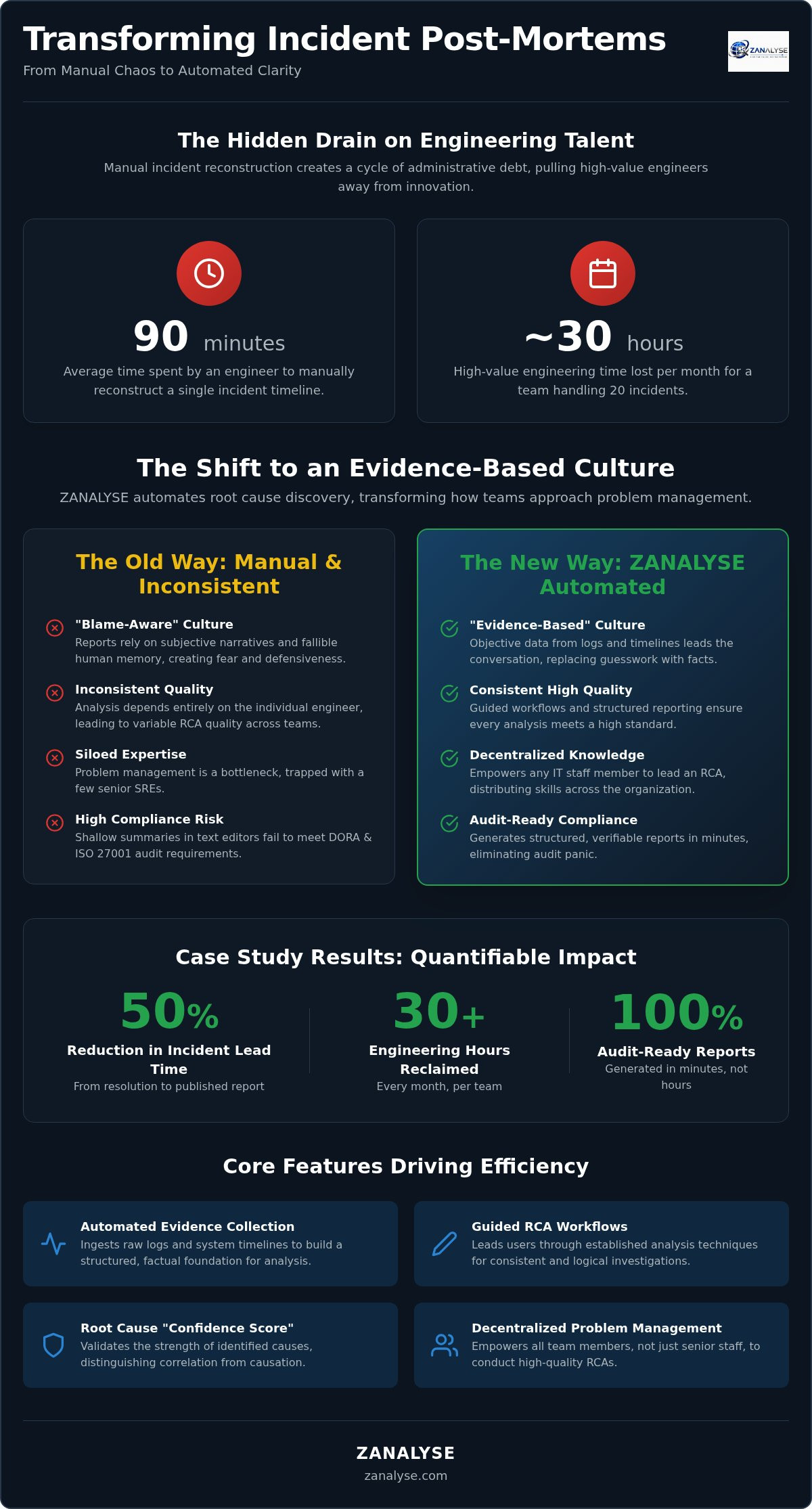
Engineers often spend up to 90 minutes manually reconstructing a single incident timeline, which can cost a team handling 20 incidents nearly 30 hours of high-value engineering time every month. It's a frustrating, repetitive cycle where technical talent is buried under administrative debt instead of solving root causes. You likely recognize the pressure of maintaining inconsistent RCA quality across teams while regulatory auditors loom with DORA and ISO 27001 requirements. Implementing specialized technical incident post-mortem software changes this dynamic by automating evidence collection and reducing incident lead times by 50%.
This case study explores how the ZANALYSE Standard License transforms chaotic reporting into a decentralized, audit-ready process. Efficiency is no longer optional. You'll see how shifting toward structured, evidence-based problem management allows any IT staff member to generate professional reports in minutes. This approach eliminates the fear of non-compliance while preventing recurring failures through permanent structural improvements.
Key Takeaways
- Learn how technical incident post-mortem software acts as an automated engine to convert raw logs and timelines into structured root cause discovery.
- Understand the process for decentralizing problem management so it's possible for any IT staff member to lead a high-quality RCA without specialized training.
- Explore how the ZANALYSE Standard License simplifies DORA and ISO 27001 compliance by generating audit-ready reports in minutes.
- Discover how to shift your team from a "blame-aware" manual culture to an "evidence-based" automated culture for long-term stability.
The Evolution of Technical Incident Post-Mortem Software
Traditional post-mortems often rely on subjective narratives stored in static text editors. This manual approach creates a "blame-aware" culture where the quality of the report depends entirely on the memory of an exhausted engineer. In contrast, modern technical incident post-mortem software functions as a high-performance engine for root cause discovery. It shifts the organizational focus toward an "evidence-based" automated culture. Text editors fail because they cannot capture the technical nuances required for sophisticated IT governance; they lack the ability to correlate disparate log files or verify system states automatically.
The regulatory environment is also evolving rapidly. Compliance frameworks like the DORA incident reporting requirements are shaping 2026 software standards. Organizations can no longer rely on shallow summaries. They need structured, verifiable data that proves exactly how a failure occurred and what was done to prevent its return. This requires a transition from simple documentation to specialized tools designed for technical precision.
Bridging the Gap Between Operational Speed and Regulatory Rigor
A natural tension exists between Site Reliability Engineers (SREs) and compliance teams. SREs prioritize restoring service and moving to the next task. Compliance officers require detailed evidence to satisfy ISO 27001 or DORA audits. Automation resolves this conflict by extracting data directly from log files and system timelines. By removing the manual burden, technical incident post-mortem software allows engineers to maintain operational speed while providing the granular evidence regulators demand. This decentralized approach empowers any IT staff member to lead a root cause analysis that is both fast and audit-ready.
Automating Root Cause Discovery with ZANALYSE
Raw logs are often the graveyard of evidence where critical details go unnoticed. ZANALYSE changes this by ingesting system timelines and automatically converting them into structured reports. Using the ZANALYSE Standard License, teams move beyond simple documentation toward rigorous investigation. The platform guides users through established RCA techniques, ensuring that every analysis follows a consistent logical path across different departments. This isn't just about recording what happened; it's about building a blameless postmortem culture where objective data leads the conversation. This technical incident post-mortem software replaces guesswork with verified facts.
One unique feature is the "Confidence Score." This metric validates the strength of identified root causes, helping teams distinguish between likely culprits and mere correlations. For organizations focused on ISO 27001 incident root cause analysis, this level of validation is critical. It provides the structured evidence auditors expect during a review. By using technical incident post-mortem software that prioritizes evidence over narrative, you ensure your operations remain stable and compliant. If you want to see how this works in practice, you can explore the ZANALYSE license options to find the right fit for your team.
Decentralizing Problem Management Across the IT Organization
Expertise shouldn't be trapped with a few senior SREs. ZANALYSE empowers junior staff and IT support personnel to perform high-level RCAs by providing access to a shared pool of historical data and guided workflows. This removes the "SRE bottleneck" that often delays critical reporting and creates operational friction. When problem management is distributed, organizational knowledge grows naturally. Every team member becomes capable of contributing to system stability, ensuring that lessons learned in one department benefit the entire enterprise. This shift transforms problem management from a specialized chore into a standard team capability.
Case Study Results: 50% Reduction in Incident Lead Times
Many organizations mistakenly believe incident management concludes the moment a service is restored. This perspective ignores the heavy administrative burden that follows every outage. By implementing technical incident post-mortem software, teams can achieve a verified 50% reduction in the lead time between incident resolution and report publication. This efficiency stems from automating the extraction of logs and system timelines, which typically consumes 60 to 90 minutes of an engineer's time per incident according to industry data. When you automate this reconstruction, you reclaim nearly 30 hours of engineering capacity every month.
The shift toward DORA compliance RCA tools effectively eliminates the "audit panic" that often characterizes regulatory reviews. When evidence is captured in real-time, the final report becomes a byproduct of the resolution process rather than a separate, manual chore. This structured approach also links corrective actions directly to the identified root causes, creating a measurable decrease in recurring incidents. To calculate ROI, compare the cost of manual documentation hours against the stability gained from an automated technical incident post-mortem software solution.
Achieving Audit Readiness for ISO 27001 and DORA
Compliance shouldn't require a frantic scramble for evidence weeks after an event occurred. The ZANALYSE Standard License generates audit-ready reports that require zero manual formatting or stylistic adjustments. By maintaining a centralized, immutable repository of all incident data, global teams can ensure consistency regardless of which staff member leads the investigation. This repository serves as a single source of truth during ISO 27001 audits, providing regulators with the transparent, evidence-based documentation they require for technical governance and long-term process integrity.
Modernize Your Incident Governance Strategy
Transitioning from manual, text-based reporting to automated workflows is no longer just an efficiency gain; it's a requirement for modern IT governance. By implementing specialized technical incident post-mortem software, you eliminate the administrative debt that follows every resolution. This approach ensures your organization remains DORA and ISO 27001 compliant while reducing incident lead times by over 50%. Decentralizing problem management empowers your entire IT staff to contribute to long-term stability, removing the bottlenecks that typically stall progress. You can move beyond temporary fixes and toward a mature, evidence-based culture that values process integrity. It's time to replace chaotic manual reporting with audit-ready consistency. Explore the ZANALYSE Standard License for automated RCA to bring order to your technical operations and secure your organizational knowledge. You've seen the data; now it's time to lead the change.
Frequently Asked Questions
How does technical incident post-mortem software differ from a standard ticketing system?
Standard ticketing systems track the status of an incident through resolution, but they don't automate the investigative phase. Technical incident post-mortem software serves as an analytical engine that reconstructs timelines and identifies root causes from system evidence. While tickets provide a record of activity, this specialized software generates structured, audit-ready reports that satisfy regulatory requirements and prevent recurring technical failures across your infrastructure.
Can ZANALYSE help with DORA compliance incident reporting?
ZANALYSE is specifically engineered to meet DORA compliance incident reporting standards for organizations in Europe and beyond. The platform converts raw log data into structured evidence, ensuring that every report meets the rigorous documentation requirements of the Digital Operational Resilience Act. By using the ZANALYSE Standard License, teams can maintain a centralized repository of immutable incident data that is ready for regulatory review.
Is it possible to decentralize problem management without losing quality?
Quality is maintained through guided RCA techniques and automated confidence scores that validate every finding. This approach allows IT staff in Canada, Australia, and Europe to lead investigations without requiring years of specialized SRE training. By distributing problem management across the organization, you remove the expertise bottleneck while ensuring that every report follows the same high standard of technical precision and governance.
Does the software integrate with existing log management tools?
ZANALYSE generates structured reports by ingesting data directly from your existing log management tools and system timelines. This technical incident post-mortem software functions as an automated discovery engine, pulling evidence without requiring manual data entry. It simplifies the transition from raw technical data to a comprehensive root cause analysis, ensuring that your existing monitoring investments contribute directly to your organizational stability.
Disclaimer
Some content on this website may be generated or assisted by artificial intelligence. While we strive to ensure that all information is accurate, relevant and up to date, AI-assisted content may contain errors or omissions. Content should therefore be considered informational and not as professional advice.


