


A major incident management process Europe teams can adapt should answer a practical question: who decides what, and how will responders share what they know? The hardest part of a major incident isn’t always restoring service. It’s coordinating decisions and communication while preserving a clear, evidence-based record of what happened.
When responsibilities are unclear and information is scattered across teams, services may be restored without a shared understanding of the incident or how to reduce the risk of recurrence. A repeatable process connects response, recovery and follow-up analysis without confusing post-incident investigation with incident leadership.
This guide shows process managers, IT support personnel, decision-makers, product managers and service providers how to structure that process. It covers roles, response decisions, communications and recovery, then explains how logs, timelines and incident data can support corrective actions. The goal is to make problem management practical and accessible to the people closest to the work.
Key Takeaways
- Set major-incident thresholds using your organization’s documented criteria for service and business impact.
- Build a major incident management process Europe teams can adapt, with clear decision-making and communications responsibilities.
- Separate operational incident handling from cybersecurity crisis coordination while defining where the work intersects.
- After recovery, use logs, timelines and incident data to distinguish evidence from assumptions and assign corrective actions with clear ownership.
What a major incident management process means for European IT operations
A major incident is an event that meets an organization’s documented criteria for material impact on a service or the business. Define those criteria around your services and priorities, rather than assuming there is one threshold for all European organizations. A critical customer service outage may qualify for one organization, while disruption to an essential internal system may be the trigger for another. Make the criteria clear enough that teams can apply them consistently during a fast-moving incident.
A major incident management process Europe organizations can use should clarify two related but distinct responsibilities. Operational incident management coordinates the people restoring service and keeping affected stakeholders informed. Cybersecurity crisis coordination addresses the wider handling of a cyber incident when its scale or impact calls for broader escalation. A technical incident may require both, but not every major IT incident becomes a cyber crisis.
For a foundation in the operational discipline, see Incident Management on Wikipedia. In practice, document the conditions that trigger each process, who can declare or escalate an incident, and how teams share updates and evidence when responsibilities overlap.
How European cyber-crisis coordination relates to an IT incident
At European level, ENISA supports cooperation through the CSIRTs Network, which connects national computer security incident response teams, and EU-CyCLONe, the European network for coordinating large-scale cybersecurity incidents and crises. These networks support coordination between relevant national and European bodies. They don’t mean every organizational incident is escalated to EU level.
Map the escalation paths relevant to your organization, including who assesses a cyber incident and who communicates with external coordination points when escalation is appropriate. Keep that map distinct from the operational roles responsible for restoring a service, while defining how the teams exchange information. Organizations operating across Europe, Canada and Australia should document the escalation routes and communication responsibilities that apply in each operating context. Regulatory reporting is a separate consideration; see the DORA incident reporting guide for that discussion.
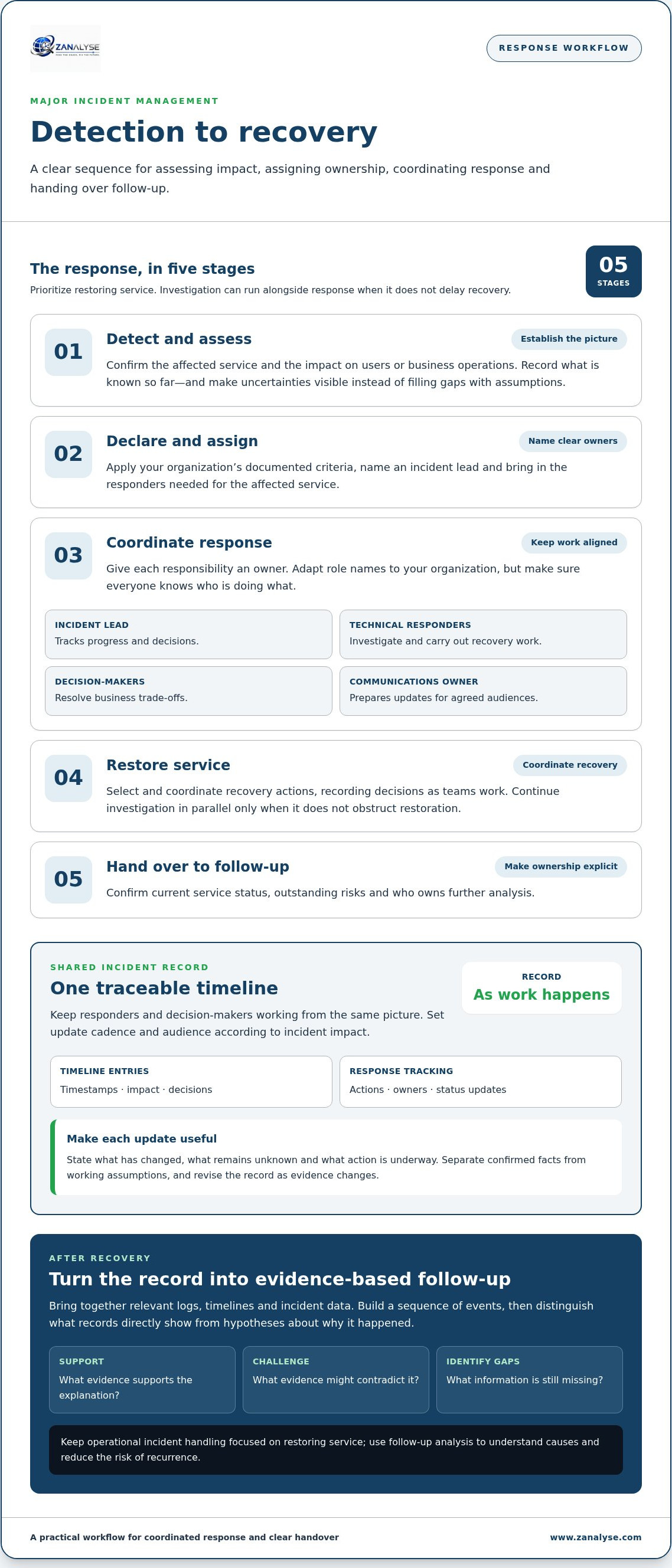
Major Incident Management: Detection to Recovery
A useful major incident management process Europe teams can adapt gives each person a clear next action without forcing every organization into identical role names. Prioritize service restoration. Investigation can run alongside response when useful, but it should not delay recovery.
- Detect and assess: Confirm which service is affected, the impact on users or business operations, and what is known so far. Record uncertainties rather than filling gaps with assumptions.
- Declare and assign: Apply your documented criteria, name an incident lead and bring in the responders needed for the affected service.
- Coordinate response: The incident lead tracks progress and decisions. Technical responders investigate and carry out recovery work. Decision-makers resolve business trade-offs, while a communications owner prepares updates for the agreed audiences.
- Restore service: Select and coordinate recovery actions, recording decisions as teams work. Continue investigation in parallel if it does not obstruct restoration.
- Hand over to follow-up: Confirm the current service status, outstanding risks and who owns further analysis.
Adapt these responsibilities to your structure, but assign each clearly. In a smaller team, one person may hold more than one role. The decision-making, response coordination and communication duties still need an owner, and everyone involved should know who that is.
What to communicate and record while the incident is active
Maintain one traceable timeline with timestamps, impact, decisions, actions, owners and status updates. Set the update cadence and audience according to the incident’s impact. For each entry, distinguish confirmed facts from working assumptions, then revise the record as evidence changes. A useful update states what has changed, what remains unknown and what action is underway. This gives responders and decision-makers a shared picture without presenting an early theory as established fact. For a deeper look at evidence quality, use this evidence-based incident confidence scoring guide.
After recovery, ZANALYSE’s root cause analysis platform can help structure the follow-up analysis. It supports that work, not incident leadership or live response coordination.
Turn incident recovery into evidence-based improvement with root cause analysis
Service restoration resolves the immediate disruption. Follow-up analysis helps teams understand the cause and reduce the risk of recurrence. Once service is stable, bring together relevant logs, timelines and incident data. Build a sequence of events, then distinguish what the records directly show from hypotheses about why it happened. For example, a service restart may be confirmed, while its relationship to an earlier change remains a theory until the evidence supports it.
Test explanations against the available information rather than treating correlation as proof. Record gaps and uncertainty, too. When reviewing a theory, ask what evidence supports it, what evidence might contradict it and what information is still missing. This creates a more reliable basis for decisions and helps colleagues who weren’t part of the response understand how the team reached its conclusions.
Where automated root cause analysis fits after a major incident
Turn findings into corrective actions with a named owner, a clear intended improvement and a follow-up to assess progress. Separate actions that address the immediate issue from changes intended to reduce the chance of recurrence. This keeps analysis practical and distributes problem-management work beyond the specialist who first investigated the incident.
For teams refining a major incident management process Europe-wide, guided root cause analysis can provide a consistent structure for examining incidents without replacing incident command or technical judgment. ZANALYSE reports bring together evidence, confidence scores and corrective actions. The ZANALYSE Standard License guides IT staff through established RCA techniques, supporting structured, decentralized problem management. Explore ZANALYSE’s root cause analysis platform.
Build a process your teams can keep improving
Check whether the process works for the people who need to use it. Choose a recurring operational problem, identify who will own follow-up, and agree how the team will judge whether corrective actions have helped. Make the review concrete: compare the action taken with the original finding, note what changed and decide whether more work is needed. The aim is to make learning part of routine operations, not a document that gets filed and forgotten.
A major incident management process Europe teams can sustain depends on clear ownership and steady improvement. ZANALYSE’s platform reduces incident lead times by over 50% and supports structured root cause analysis, helping teams turn incident records into evidence-based findings and corrective actions.
Explore ZANALYSE’s root cause analysis platform to support consistent, decentralized problem management across your team.
Frequently Asked Questions
What qualifies as a major incident?
A major incident is a disruption that meets the organization’s documented impact and escalation criteria. To make the threshold usable, specify how to assess service criticality, affected users, operational consequences and the need for senior decisions. For example, an outage affecting a key service may qualify even if only one team has reported it. Review the criteria when services or business priorities change.
Is major incident management the same as cyber-crisis management?
No. Major incident management coordinates a high-impact disruption, whatever its cause. Cyber-crisis management focuses on significant cybersecurity incidents and crises. If an outage shows signs of malicious activity, involve security leadership while service restoration continues. Organizations working across Europe, Canada or Australia should map relevant escalation routes for each operating context, rather than assume one regional pathway covers every event.
Does DORA apply to every major IT incident in Europe?
No. DORA applies to specified financial entities, and its relevance depends on the organization and incident circumstances. A major operational disruption isn’t automatically a reportable DORA incident. Keep operational handling separate from regulatory decisions, identify who assesses applicability, and consult current authoritative guidance and qualified advice before deciding whether reporting is required.
What information should an incident record preserve for follow-up?
Preserve enough context for someone outside the response team to understand what happened and why actions were taken. Alongside the timeline, retain references to source records, note the time zone used, and mark later corrections without erasing the original entry. Record open questions and who will resolve them. This helps later reviewers test explanations against source evidence rather than relying on recollection.
Disclaimer
Some content on this website may be generated or assisted by artificial intelligence. While we strive to ensure that all information is accurate, relevant and up to date, AI-assisted content may contain errors or omissions. Content should therefore be considered informational and not as professional advice.


