

System failures accounted for 51% of all major ICT incidents in 2025, yet many financial entities still struggle to document these events with the precision regulators demand. You likely know the frustration of seeing senior engineers spend hours manually piecing together logs while an audit deadline looms. It's a bottleneck that keeps your best people from high-value work and leaves your compliance status on shaky ground.
By implementing a dedicated DORA compliance RCA tool, you can transform chaotic technical data into structured, audit-ready evidence automatically. This article explores how to achieve a 50% reduction in incident lead times by decentralizing problem management across your entire IT staff. We'll examine the path from siloed expertise to a transparent, automated reporting framework that satisfies both technical teams and commercial stakeholders.
Key Takeaways
- Learn why manual post-mortems fall short of DORA’s strict harmonized governing principles and what auditors specifically look for in incident evidence.
- Identify the core capabilities of an effective DORA compliance RCA tool, from automated timeline ingestion to standardized analysis techniques like Fishbone diagrams.
- Explore methods to distribute problem management responsibilities across your organization, ensuring that RCA expertise isn't siloed within a few senior staff members.
- Discover how shifting from reactive firefighting to proactive problem management can stabilize high-pressure environments and ensure long-term operational resilience.
Bridging the Gap Between IT Incidents and DORA Regulatory Requirements
The Digital Operational Resilience Act (DORA) mandates that financial entities maintain a high level of operational resilience. It's not just a security checklist. It's a requirement to withstand, respond to, and recover from ICT disruptions. DORA demands a robust incident management framework that produces structured, evidence-based reports. Most organizations still rely on manual, unstructured post-mortems. These fail to meet the harmonized governing principles of the regulation because they lack consistent evidence and clear timelines.
Traditional RCA often relies on tribal knowledge. Senior staff hold the context in their heads, which leads to inconsistent documentation and single points of failure within the team. Regulators now demand verifiable evidence instead of an engineer's memory. If your evidence is buried in Slack threads or unorganized log files, it's not audit-ready. A DORA compliance RCA tool acts as a stabilizing bridge between technical chaos and regulatory order by automating the capture of critical data points into a standardized format.
The Cost of Non-Compliance: Beyond Regulatory Fines
ICT disruptions ripple through the financial ecosystems of Europe and Australia. Since system failures caused 51% of major incidents in 2025, poor reporting leads to repetitive, costly failures. This increases operational risk and threatens systemic stability. When you can't identify a root cause accurately, you're essentially waiting for the next outage. This cycle erodes trust with both regulators and commercial partners. Without structured evidence, you cannot prove that a problem is truly solved or that your organization is resilient. For detailed 2026 timelines and reporting requirements, see our DORA Incident Reporting: 2026 Guide for IT Operations.
Key Capabilities to Look for in a DORA-Aligned RCA Tool
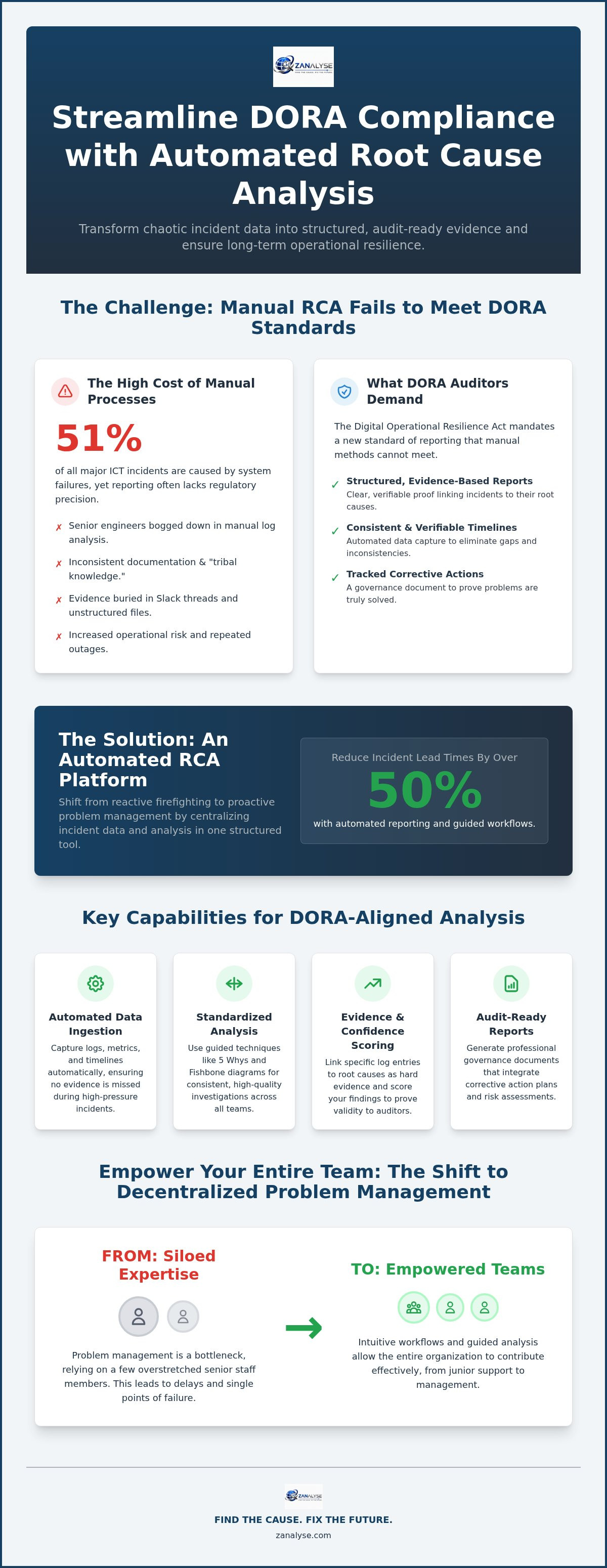
Selecting an effective DORA compliance RCA tool requires moving beyond basic ticketing systems. You need a platform that prioritizes automated log and timeline ingestion. During high-pressure outages, manual data gathering is often the first process to fail. Automation ensures no evidence is missed when it matters most. It also standardizes analysis techniques like the 5 Whys or Fishbone diagrams. This consistency prevents "investigation drift," where different IT teams produce reports of varying quality and depth.
According to the official text of the DORA Regulation, incident management must be both consistent and verifiable. For growing departments, the ZANALYSE Standard License provides these core capabilities. It allows your team to generate audit-ready reports that integrate corrective action plans and risk assessments directly into the standard workflow. If you're ready to move away from manual spreadsheets, you can explore how our automated platform structures your data.
Evidence Collection and Confidence Scoring for Audits
Auditors don't just want to know what happened; they want to know how certain you are of your findings. Confidence scores are vital for proving the validity of an RCA. Automated tools achieve this by linking specific log entries to identified root causes as hard evidence. This approach satisfies DORA Article 17, which requires tracked and verifiable corrective actions. By moving from subjective guesses toward data-backed confidence scores, you provide a level of process integrity that manual methods cannot match. It transforms a technical post-mortem into a professional governance document.
Implementing ZANALYSE to Drive Operational Resilience and Compliance
Operational maturity requires a fundamental shift from frantic firefighting to a structured, proactive stance. By automating the report generation process, ZANALYSE reduces incident lead times by over 50%. This efficiency stems from a vast pool of included RCAs that guide teams through known failure patterns rather than starting from zero during every outage. Organizations looking to secure their regulatory posture ahead of the October 2026 general availability should consider the Early-bird Pricing Plan. It's a strategic move to lock in a robust DORA compliance RCA tool before the next cycle of regulatory examinations begins.
Decentralized Problem Management: Empowering Every IT Staff Member
Problem management shouldn't be a siloed task reserved for a handful of senior experts who are already overstretched. ZANALYSE uses intuitive navigation and guided workflows to decentralize the analysis process across the entire organization. This structure allows junior support staff to contribute meaningful data and evidence immediately. It removes the technical bottlenecks that typically delay reporting. Whether your teams are distributed across Canada, Australia, or Europe, distributing these capabilities ensures that resilience is a shared responsibility rather than a localized burden.
The platform also bridges the critical communication gap between technical and business units. It simplifies complex technical logs into clear, accessible language that commercial decision-makers and product managers can understand. This transparency ensures that risk assessments and corrective actions are supported at every level of the company. By empowering the entire IT staff to participate in the compliance journey, you transform a mandatory regulatory requirement into a permanent structural improvement.
Scaling Operational Resilience for 2026 and Beyond
DORA isn't just about avoiding fines; it's about building a stable technical environment where every incident becomes an opportunity for structural improvement. Moving from tribal knowledge to decentralized, automated reporting creates a permanent record for auditors while reclaiming your team's time. Adopting a dedicated DORA compliance RCA tool ensures your organization is prepared for the first full year of active enforcement. By reducing incident lead times by over 50% and providing audit-ready structured reporting, you shift the burden from senior staff to a distributed, efficient workflow.
Secure your Early-bird Pricing Plan for ZANALYSE today and lock in your compliance strategy before the October 2026 rollout. It's time to replace technical chaos with a process that works for your engineers and your regulators alike.
Frequently Asked Questions
Does DORA require a specific root cause analysis method?
DORA does not mandate a single technique like "5 Whys" or Fishbone; it requires consistency and verifiability under its harmonized governing principles. Using a DORA compliance RCA tool allows teams across Europe and Australia to apply these methods uniformly. This ensures every investigation produces the structured evidence regulators expect, regardless of which staff member conducts the analysis.
How does an RCA tool help with DORA Pillar II (ICT Risk Management)?
Pillar II demands that organizations identify and mitigate risks to maintain operational resilience. An automated tool supports this. It transforms raw incident data into actionable intelligence. By analyzing a vast pool of previous RCAs, IT staff can identify systemic vulnerabilities. This shift from reactive response to proactive risk management helps prevent repetitive failures and strengthens the entire infrastructure.
Can ZANALYSE generate reports suitable for ISO 27001 and DORA simultaneously?
ZANALYSE generates structured reports that satisfy the documentation requirements for both ISO 27001 and DORA. The platform maps technical incident data to specific evidence fields. This dual compatibility allows organizations in Canada and Europe to maintain high operational quality. It streamlines audit preparation through a single, decentralized problem management workflow that empowers all IT staff.
What is the difference between an incident post-mortem and a DORA-compliant RCA report?
A traditional post-mortem is often a narrative summary based on engineer memory; a DORA-compliant report is a data-backed governance document. Every finding in a DORA compliance RCA tool is supported by linked log entries. It also requires verifiable corrective actions. This structured approach replaces subjective tribal knowledge with hard evidence that auditors can verify independently.
Disclaimer
Some content on this website may be generated or assisted by artificial intelligence. While we strive to ensure that all information is accurate, relevant and up to date, AI-assisted content may contain errors or omissions. Content should therefore be considered informational and not as professional advice.


