


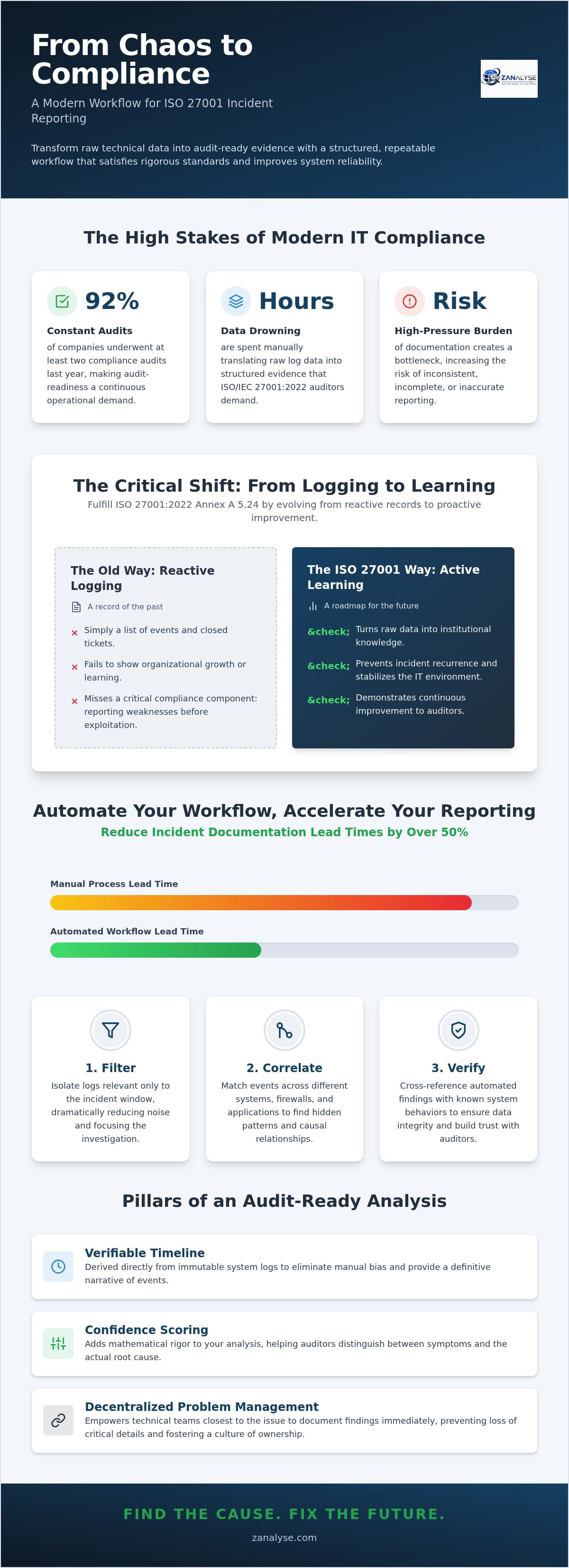
A 2025 compliance benchmark report revealed that 92% of companies underwent at least two audits in the previous year. For IT leaders, this means the pressure to produce a thorough ISO 27001 incident root cause analysis is no longer a seasonal event; it's a constant operational requirement. You likely feel the weight of this demand while drowning in raw log data. It is exhausting to spend hours manually translating technical timelines into the structured evidence that ISO/IEC 27001:2022 auditors demand.
You can stop treating documentation as a separate administrative burden. This guide shows you how to transform technical data into compliant reports that satisfy rigorous standards while improving your system reliability. We'll explore a repeatable workflow to reduce your reporting lead times by 50% and turn chaotic incident data into a clear narrative of organizational excellence through decentralized problem management.
Key Takeaways
- Understand the transition from basic event logging to active incident learning as required by the ISO 27001:2022 Annex A 5.24 controls.
- Learn how to perform a structured ISO 27001 incident root cause analysis that utilizes confidence scoring to provide auditors with verifiable evidence.
- Discover how automation can reduce incident documentation lead times by over 50% while maintaining high data integrity and consistency.
- Explore the benefits of decentralizing problem management to empower technical teams and integrate continuous improvement into daily operations.
Understanding ISO 27001:2022 Incident Reporting Requirements
Annex A 5.24 of ISO/IEC 27001:2022 mandates a comprehensive approach to information security incident management. It's no longer enough to simply acknowledge a breach. You're required to establish a process that covers the entire incident lifecycle. This includes identification, assessment, and documented response actions. Crucially, the standard requires you to report security weaknesses before they're exploited. If you only document active breaches, you're missing a critical compliance component. Auditors want to see that your team recognizes potential vulnerabilities and acts on them immediately.
Understanding these requirements is easier when you view them through the lens of the wider ISO/IEC 27000 family of standards. This framework provides the context for how incident management integrates with broader risk treatment and governance strategies. Reporting security weaknesses is mandatory. You must document suspected vulnerabilities as diligently as confirmed incidents to maintain your certification.
The Shift from Logging to Learning in ISO 27001
Auditors in 2026 have shifted their focus. They don't just want to see a closed ticket; they want evidence of organizational growth. A list of logs is a record of the past, but a structured ISO 27001 incident root cause analysis is a roadmap for the future. By moving from simple event logging to active incident learning, you demonstrate that your organization isn't just surviving threats but evolving because of them. This transition is essential for meeting the continuous improvement requirements of the standard. It turns raw technical data into institutional knowledge that prevents recurrence and stabilizes your IT environment.
Best Practices for Audit-Ready Evidence Collection
Audit readiness begins with a verifiable timeline. You must derive this chronology directly from system logs to eliminate manual bias and ensure data integrity. A precise record of events serves as the foundation for any credible Cybersecurity Incident Management and Response Guide implementation. Don't rely on memory or scattered emails. Instead, use log timestamps to build a definitive narrative of what occurred and when.
Validation requires more than just a guess. Implement a confidence scoring system to evaluate the probability of your findings. This adds mathematical rigor to your ISO 27001 incident root cause analysis, helping you distinguish between symptoms and actual triggers. Auditors value this structured approach because it demonstrates a mature, objective process. Ensure every corrective action links back to specific evidence found during the investigation. This creates an unbreakable chain of custody for your ISMS, which is particularly vital for organizations operating under strict oversight in Canada or Australia. Centralizing these reports in a single repository ensures consistency across the entire organization.
Transforming Raw Logs into Structured Evidence
Drowning in data is a common failure point. Follow this three-step framework to filter noise and highlight critical markers:
- Filter: Isolate logs relevant only to the incident window to reduce volume.
- Correlate: Match events across different systems to find hidden patterns.
- Verify: Cross-reference automated findings with known system behaviors.
Effective IT incident evidence collection builds immediate trust with external auditors. It shows you've moved beyond manual entry toward a data-driven culture. To simplify this journey, consider how the ZANALYSE Standard License can automate these complex workflows for your team.
Automating the ISO 27001 Reporting Workflow
Automation transforms documentation from a high-pressure administrative burden into a streamlined, repeatable process. By implementing a digital workflow, organizations reduce incident lead times by over 50%. This metric is a clear indicator of operational maturity that auditors prioritize during an ISO 27001 incident root cause analysis. Instead of waiting days for a manager to compile scattered notes, the system captures data as it happens. This shift ensures audit-readiness remains a permanent operational state rather than a frantic year-end scramble. It brings order to the chaos of technical recovery.
Decentralizing the reporting process allows the technical staff closest to the issue to document findings immediately. This prevents the loss of critical detail that often occurs when information passes through multiple layers of management. Utilizing a DORA compliance RCA tool offers a significant dual benefit for modern enterprises. It satisfies the strict reporting timelines of financial regulations while simultaneously building the evidence required for an ISO 27001 incident root cause analysis. This distributed model is especially valuable for service providers who manage problem management for multiple clients, as it ensures each report remains audit-ready without increasing overhead.
Empowering IT Staff with Standardized RCA
The ZANALYSE Standard License guides your team through established techniques without burying them in unnecessarily heavy IT lingo. This accessibility is vital for ensuring that both technical support staff and commercial decision-makers stay aligned. Users don't need to be governance experts to produce high-quality, structured reports. Access to a vast pool of included RCAs speeds up the documentation of common infrastructure failures, such as database latencies or cloud service disruptions. This library of organizational knowledge ensures consistency and allows your team to focus on permanent structural improvements rather than manual data entry.
Building a Resilient, Audit-Ready IT Culture
Transitioning from simple logging to a culture of incident learning is the most effective way to satisfy ISO 27001:2022 standards. By establishing a verifiable timeline and using confidence scores, you turn technical chaos into structured evidence. Decentralizing this process empowers your technical staff to contribute directly to organizational growth. This ensures that every ISO 27001 incident root cause analysis is both accurate and timely, reflecting a mature approach to security governance.
You don't have to face your next audit with fragmented logs. You can achieve a 50% reduction in incident lead times while maintaining full compliance. Automate your ISO 27001 incident reporting with ZANALYSE to generate audit-ready evidence effortlessly. It's time to replace repetitive manual tasks with an automated workflow that brings permanent stability to your operations. You're ready to turn every incident into a strategic advantage.
Frequently Asked Questions
What is the difference between an incident and a security event in ISO 27001?
A security event is an identified occurrence indicating a potential policy breach, while an incident is an event that causes actual harm. ISO 27001 requires you to monitor events but mandates a formal response for incidents. This distinction helps teams in Europe and Australia prioritize their resources. It ensures that you aren't overwhelmed by noise while still capturing critical threats to your information security management system.
How long should we retain ISO 27001 incident reports for audit purposes?
You should typically retain incident reports for at least three to five years to cover multiple audit cycles. Specific statutory requirements in Canada and Australia might mandate longer periods for certain types of data. Maintaining these records allows you to prove long-term consistency in your security posture. It's a vital part of demonstrating that your organization values permanent structural improvements over temporary fixes.
Does ISO 27001 require a root cause analysis for every minor incident?
The standard doesn't require a deep ISO 27001 incident root cause analysis for every trivial event, but it does demand that you learn from all incidents. Using a risk-based threshold helps you decide when a full investigation is necessary. Automation simplifies this process for your teams in Europe. It allows them to document smaller issues quickly so that the cumulative knowledge still supports your continuous improvement goals.
How can we automate evidence collection without compromising data privacy?
Automation preserves privacy by isolating technical metadata from sensitive user information. You should configure your tools to collect log timestamps and system identifiers while filtering out personally identifiable information. This approach ensures your ISO 27001 incident root cause analysis satisfies auditors without violating privacy regulations like GDPR. It creates a stabilizing force that brings order to your technical operations without creating new compliance risks.
Disclaimer
Some content on this website may be generated or assisted by artificial intelligence. While we strive to ensure that all information is accurate, relevant and up to date, AI-assisted content may contain errors or omissions. Content should therefore be considered informational and not as professional advice.


