

What if the value of an incident investigation depended less on who was available and more on how clearly its evidence was captured and shared? For teams working on dora operational resilience compliance, scattered logs, timelines and team messages make it harder to explain what happened and why. Findings can stay with a few experienced specialists, while corrective actions lose clear ownership once the incident is closed.
Resilience depends on more than recording an incident. Teams need a repeatable way to connect evidence, analysis, decisions and follow-up, without treating software as a substitute for regulatory interpretation or organizational accountability.
This article explains how to structure investigations, preserve supporting evidence and assign corrective actions across teams. It also explores how automated root cause analysis, including ZANALYSE reports with evidence, confidence scores and corrective actions, can support operational improvement. That improvement alone, however, is not proof of legal compliance.
Key Takeaways
- Strengthen dora operational resilience compliance by treating incident learning as part of ongoing service resilience, not a task that ends when an incident is resolved.
- Use a consistent sequence to bring records together, build a timeline, test possible causes and document supporting evidence.
- Separate evidence-backed findings from assumptions so teams can see where more investigation is needed.
- Use guided root cause analysis to make investigations accessible across IT roles and turn findings into corrective actions with clear ownership.
DORA operational resilience compliance starts with learning from incidents
Operational resilience is an organisation’s ability to keep important services working, or restore them in a controlled way when disruption occurs. It is broader than resolving one incident. A service may be restored quickly, yet the same weakness can cause another disruption if teams don’t investigate what happened and address the underlying cause. Learning from incidents is an important part of dora operational resilience compliance. For an overview of the regulation’s aims and structure, see the Digital Operational Resilience Act (DORA) Wikipedia page.
Incident learning turns an event into practical changes. If an investigation links a service interruption to an unclear handover, for example, teams can document the evidence, assign someone to improve the handover process and review whether the change helped. Evidence shows why a finding was reached; corrective actions make the response traceable after the incident review. Together, these practices build organisational knowledge instead of relying on whoever remembers the event.
How does incident learning contribute to DORA resilience work?
Investigation findings can inform improvements to operational processes, but a sound improvement process is not, by itself, proof of legal compliance. Specific obligations depend on the applicable regulation and circumstances, so teams should verify interpretations against authoritative regulatory sources. For incident reporting context, see our DORA incident reporting guidance.
Repeatable workflows and software can help teams organize records, document findings and make analysis accessible across roles. ZANALYSE guides users through root cause analysis and structures incident information into reports with evidence, confidence scores and corrective actions. These capabilities support operational learning, but they don’t replace regulatory interpretation or the organisation’s accountability for its compliance decisions.
Build a repeatable DORA incident evidence and analysis workflow
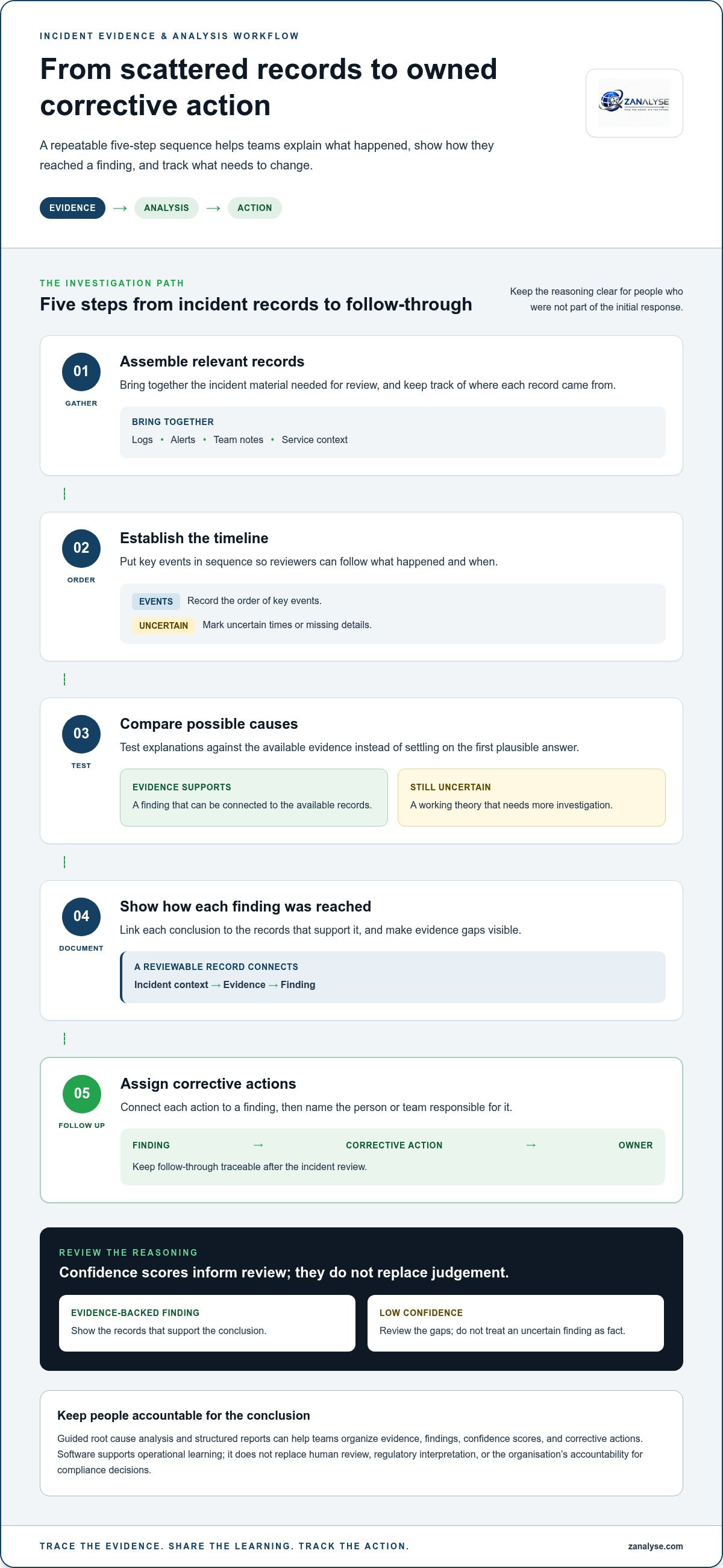
A consistent workflow helps teams move from fragmented incident records to findings they can explain and act on. For dora operational resilience compliance, the value lies in making the reasoning traceable, not simply collecting more data. A practical sequence is:
- Assemble records: Bring together relevant logs, alerts, team notes and service context. Keep track of where each record came from.
- Establish a timeline: Put key events in order and mark any uncertain times or missing details.
- Test causes: Compare possible explanations against the available evidence instead of settling on the first plausible answer.
- Document findings: Link each conclusion to the records that support it and note evidence gaps.
- Assign actions: Connect each corrective action to a finding and name the person or team responsible for it.
This structure makes the reasoning easier to review for people who weren’t part of the initial response. It also helps teams distinguish a supported cause from a working theory that needs further investigation. Confidence scores can clarify that distinction, but they don’t replace judgement. A low-confidence finding is a prompt to review the gaps, not a conclusion to treat as fact. See this IT incident confidence scoring guidance for more on evidence-based analysis.
What should a structured incident analysis record capture?
Keep the incident context, timeline, relevant logs and analysis together. Show how the evidence supports each conclusion, then record which finding each corrective action addresses and who owns it. This gives reviewers a clear path from what happened to what the team will change. For teams coordinating operations across Canada, Australia and Europe, a shared investigation structure can also make it easier to communicate findings across locations. To structure investigations across IT roles, explore ZANALYSE root cause analysis.
Use root cause analysis to turn resilience evidence into action
Evidence is useful when teams can interpret it, agree on what it supports and follow through. Guided root cause analysis (RCA) gives IT support staff, process managers and service teams a shared way to investigate problems, rather than leaving the work to a few specialists. Clear steps and established methods make structured analysis easier to use across roles, while experienced investigators can still apply their judgement to complex cases.
An investigation may show that a service issue involved several contributing factors rather than one obvious failure. A structured approach helps the team record which findings the evidence supports, where uncertainty remains and what improvement should follow. This shared record helps prevent important knowledge from staying with the person who handled the incident.
Where can automated RCA support operational resilience teams?
ZANALYSE guides users through established RCA techniques and organizes incident information into reports with evidence, confidence scores and corrective actions. Teams can review the reasoning, see which findings need more investigation and understand what actions have been identified. This supports consistent learning across internal teams and operational service providers, while keeping human review and accountability in place.
For dora operational resilience compliance, structured analysis and documentation can support an organisation’s work, but they don’t establish compliance on their own. The organisation remains responsible for interpreting applicable requirements, deciding how they apply and maintaining accountability for its compliance approach. Software can support the process, but it cannot make those decisions for the organisation.
Explore ZANALYSE to see how guided root cause analysis can help structure incident analysis and make problem-solving more accessible across IT roles.
Make incident learning part of lasting resilience
Stronger dora operational resilience compliance work starts with a repeatable way to learn from incidents. Bring records together, connect findings to evidence and assign corrective actions to clear owners so improvements don’t disappear when an investigation closes.
Guided root cause analysis can help more people across IT contribute to structured investigations. ZANALYSE reports include evidence, confidence scores and corrective actions to support clear documentation and follow-through. The platform supports analysis, while your organisation remains responsible for interpreting requirements and making compliance decisions.
Build a more consistent approach to incident learning. Explore ZANALYSE for structured root cause analysis and help your teams turn investigation findings into practical improvements.
Frequently Asked Questions
Does DORA require root cause analysis?
Interpret DORA-related incident processes against the applicable regulation and authoritative guidance. Don’t assume that a specific root cause analysis method is a standalone legal requirement. A sound investigation is a practical way to understand what happened and guide improvements, but it isn’t itself a legal conclusion. Each organization remains responsible for determining which obligations apply to its activities and circumstances.
What evidence should an organization retain after an ICT incident?
Useful investigation records connect the incident timeline with relevant logs, alerts, service context, findings and resulting actions. Link each conclusion to its supporting evidence, and give corrective actions a clear owner. This is a practical approach, not a complete legal standard. Exact recordkeeping expectations depend on applicable requirements and organizational context, including for teams working across Canada, Australia and Europe.
Can root cause analysis software make an organization DORA compliant?
No. Root cause analysis software cannot guarantee dora operational resilience compliance. It can support consistent analysis by organizing incident evidence, documenting confidence in findings and presenting corrective actions. Governance, operational controls and accountability remain the organization’s responsibility. Treat software as support for the process, not as legal advice or a substitute for interpreting applicable requirements.
How can teams make incident analysis more repeatable across an organization?
Use a shared process to collect incident records, build a timeline, test possible causes, document evidence and assign corrective actions. Guided methods can help IT support, operations and service teams contribute consistently, reducing reliance on a few specialists. Keep experienced reviewers involved in complex or high-impact cases, and make assumptions that need further investigation clear for follow-up across distributed teams.
Disclaimer
Some content on this website may be generated or assisted by artificial intelligence. While we strive to ensure that all information is accurate, relevant and up to date, AI-assisted content may contain errors or omissions. Content should therefore be considered informational and not as professional advice.


