

What if the strongest resilience setup isn’t one platform, but a connected set of tools that each do a clear job? That concern is justified. Digital operational resilience tools often overlap: observability, alert management, incident records, and root cause analysis may sit in separate systems, leaving evidence and corrective actions scattered across teams. Adding another platform won’t solve that unless it fits existing processes and helps people connect incidents to learning and follow-up.
This 2026 guide gives you a practical framework for assessing tool fit, linking incident evidence to corrective actions, and judging what a specialist capability can and can’t deliver. You’ll see how observability, alert management, and investigation tools differ, where structured root cause analysis belongs in a wider toolchain, and what to check before choosing.
Key Takeaways
- Separate resilience capabilities from monitoring, incident management, continuity, and root cause analysis so you can see what each tool is meant to support.
- Assess digital operational resilience tools in sequence: map risks, identify process gaps, define users, then compare tool fit with real needs.
- Check whether evidence handling, workflows, corrective-action tracking, usability, and reporting will help teams work consistently and share problem management.
- Consider structured root cause analysis as one specialist capability in your wider toolset. ZANALYSE supports incident analysis and follow-up, not every resilience function.
What digital operational resilience tools cover, and where their roles differ
Digital operational resilience tools are software that supports an organization in preparing for, responding to, recovering from, or learning from operational disruptions. The term describes a broad set of capabilities, not one product category. A monitoring platform may surface unusual activity, while incident management software helps teams coordinate response. Continuity tools support planning for service disruption; root cause analysis (RCA) tools help teams investigate why an incident happened and what to do next.
These roles can overlap, but they aren't interchangeable. A system that detects an issue doesn't necessarily coordinate the response or preserve the evidence needed for later analysis. Likewise, an RCA tool can structure investigation and corrective actions without replacing monitoring, continuity planning, or wider resilience governance. Software supports accountable processes; people still make decisions, maintain plans, and oversee follow-up.
Which resilience capabilities should buyers distinguish?
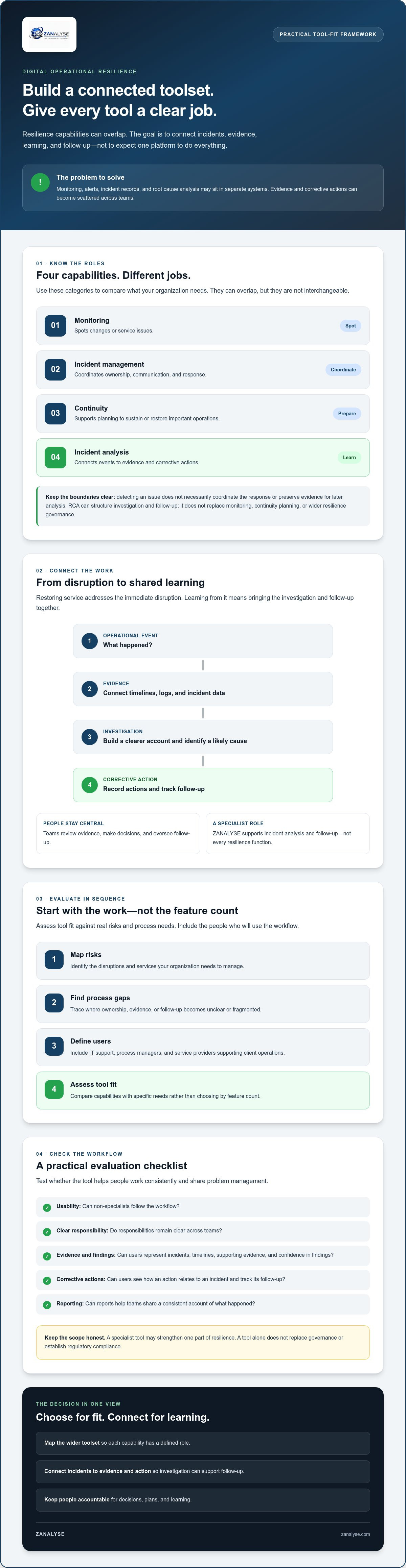
Use capability categories as a comparison framework, not a shopping list. Assess what your organization needs across areas such as:
- Monitoring: spotting changes or service issues.
- Incident management: coordinating ownership, communication, and response.
- Continuity: preparing to sustain or restore important operations.
- Incident analysis: connecting events to supporting evidence and corrective actions.
Structured incident analysis is one part of the wider picture. It can help teams turn logs, timelines, and incident data into a shared account of what happened, then assign follow-up beyond a small group of specialists. For regulatory context, see this guide to DORA incident reporting and the Digital Operational Resilience Act (DORA). Neither a single tool nor a collection of tools replaces sound governance or guarantees compliance.
How to evaluate digital operational resilience tools without buying an all-in-one promise
Start with the work that needs to improve, not a vendor’s promise to cover everything. A specialist tool may strengthen one part of your resilience process, but it shouldn’t be assumed to replace monitoring, incident coordination, continuity planning, or governance. Evaluate it as one capability in the wider toolset.
Use this sequence to keep the decision grounded:
- Map risks: Identify the disruptions and services your organization needs to manage.
- Find process gaps: Trace where ownership, evidence, or follow-up becomes unclear or fragmented.
- Define users: Include the people who will do the work, from IT support and process managers to service providers supporting client operations.
- Assess tool fit: Compare capabilities with those specific needs, rather than choosing by feature count.
What should an operational resilience tool evaluation checklist include?
Test whether non-specialists can follow the workflow, and whether responsibilities remain clear across teams. Check how the tool represents incidents, timelines, supporting evidence, confidence in findings, and corrective actions. Can users see how an action relates to an incident and track its follow-up? Can reports help teams share a consistent account of what happened? Use this problem management guidance to think through ownership and workflow design.
For DORA-related context, consult the official EU authority; a tool alone doesn’t establish compliance. If structured incident analysis is a gap in your process, you can explore ZANALYSE’s approach to root cause analysis as a specialist capability, not a full resilience stack.
Where structured root cause analysis fits in a resilience toolset
Restoring a service resolves the immediate disruption. Learning from it takes a further step: connecting the operational event to supporting evidence, identifying a likely cause, and recording corrective actions. Without a consistent investigation process, useful details can remain scattered across timelines, logs, and team notes. A structured root cause analysis (RCA) capability helps turn that material into a clearer account that teams can review and act on.
How can guided RCA support distributed problem management?
Guided RCA uses established techniques to give staff a repeatable way to investigate, rather than leaving the work to a small group of specialists. That can help more IT staff contribute to problem management while keeping findings structured. To compare approaches, see this guide to RCA methods for IT operations.
ZANALYSE is an automated RCA platform, not a complete resilience-management suite. It turns logs, timelines, and incident data into structured reports that include evidence, confidence scores, and corrective actions. Those outputs can support operational learning and follow-up, but they don’t replace monitoring, response coordination, continuity planning, or organizational governance. Nor does using an RCA platform by itself establish regulatory compliance. For regulatory context, consult the Digital Operational Resilience Act (DORA) information from EIOPA.
General availability is scheduled for October 2026. Verify current availability before making a decision. If structured incident analysis fits a gap you’ve identified, you can learn more about ZANALYSE and assess whether its specialist role suits your wider set of digital operational resilience tools.
Build resilience with tools that fit the work
Choose digital operational resilience tools by matching capabilities to real risks and process gaps, not by chasing an all-in-one promise. Clear roles matter: monitoring, response coordination, continuity planning, and incident learning support different parts of resilience. A well-fitted tool can strengthen a process, but people and governance remain essential.
Structured root cause analysis helps teams connect incident information to findings and follow-up. ZANALYSE is designed to make this work more accessible across IT staff, with reports that include evidence, confidence scores, and corrective actions. It is a specialist RCA platform, not a complete resilience-management suite.
If incident analysis is a gap in your toolset, explore ZANALYSE’s approach to structured root cause analysis. Assess how it fits your existing processes and broader capabilities, then build a resilience toolset that supports consistent learning and improvement.
Frequently Asked Questions
What are digital operational resilience tools?
Digital operational resilience tools are software that helps organizations prepare for, respond to, recover from, or learn from operational disruptions. Capabilities may include monitoring, incident coordination, continuity planning, and root cause analysis. For organizations operating in Canada, Australia, or Europe, the right mix depends on their services, risks, processes, and applicable context. Software supports the work; it doesn’t replace accountable people or sound plans.
Can one tool manage every part of digital operational resilience?
Usually, a single tool shouldn’t be assumed to cover every resilience need. A monitoring platform may detect an issue, while other capabilities help coordinate a response, plan for continuity, or investigate what caused the event. Assess the role a tool actually performs and how it fits your existing processes. Organizations in Canada, Australia, and Europe can build a connected toolset without expecting one product to replace governance or human decision-making.
How do you choose digital operational resilience tools?
Start by mapping relevant risks, then identify process gaps and the teams responsible for the work. Define who will use each capability, including support staff, process owners, and service providers. Compare tools against practical needs such as evidence handling, clear workflows, corrective-action tracking, usability, and reporting. For teams in Canada, Australia, or Europe, also check that the tool fits their operating context instead of relying on broad feature claims.
Can root cause analysis software help with DORA compliance?
Root cause analysis software can support incident learning by organizing incident information, evidence, findings, and corrective actions. It cannot, on its own, ensure DORA compliance or replace an organization’s governance and broader processes. For organizations subject to DORA, assess how investigation outputs fit into the wider compliance approach and verify requirements with authoritative sources. This distinction matters for teams across Europe and for providers supporting clients in multiple regions.
Disclaimer
Some content on this website may be generated or assisted by artificial intelligence. While we strive to ensure that all information is accurate, relevant and up to date, AI-assisted content may contain errors or omissions. Content should therefore be considered informational and not as professional advice.


