

What if different investigators reached different conclusions about the same IT incident? A structured rca framework gives teams a consistent way to define the incident, organize logs and timelines, test explanations against evidence, and turn supported findings into corrective actions with clear owners. Without that sequence, reports can sound certain while leaving gaps between what happened, what the evidence shows, and who will help prevent a repeat. The process should not depend on one specialist.
This guide explains how to build and apply a repeatable RCA process, from defining an incident to tracking actions and documenting findings. You’ll learn how to connect conclusions to evidence, communicate uncertainty, and involve more staff in investigations. These steps can help teams working across Canada, Australia, and Europe maintain a clear, reviewable record while accounting for the requirements that apply to their organization.
Key Takeaways
- A structured rca framework gives investigators a shared process without requiring the same analysis method for every incident.
- Move from a clear incident scope to a timeline, evidence review, tested explanations, documented findings, and assigned actions.
- Keep conclusions traceable by linking them to evidence and recording uncertainty when the available information does not support certainty.
- Make the process repeatable with shared report fields, clear ownership, evidence review, and action follow-up. Scale the documentation to the incident.
What a Structured RCA Framework Should Include
A structured rca framework gives teams a shared way to investigate incidents and document findings supported by evidence. It sets out a clear path from defining the incident to deciding what to change, so reports do not depend on an investigator’s preferred format or memory.
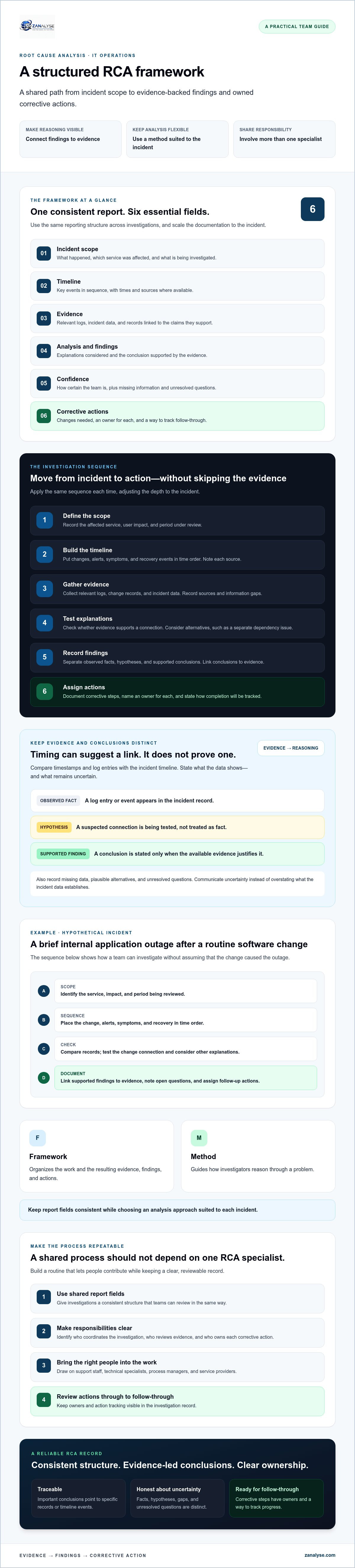
At minimum, use report fields that make the reasoning visible and the next steps clear:
- Incident scope: What happened, which service was affected, and what is being investigated.
- Timeline: Key events in sequence, with times and sources where available.
- Evidence: Relevant logs, incident data, or other records, linked to the claims they support.
- Analysis and findings: Explanations considered and the conclusion supported by the evidence.
- Confidence: How certain the team is, and what information is missing or unresolved.
- Corrective actions: The changes needed, with an owner and a way to track follow-through.
This structure helps another team member, manager, or service provider understand how the investigation reached its conclusion. To make a report easier to review, distinguish observed facts from hypotheses and link important conclusions to specific records or timeline events.
How Is a Framework Different from an RCA Method?
A method guides how investigators reason through a problem. A framework organizes the work and the resulting evidence, findings, and actions. Root-cause analysis (RCA) includes a range of principles and techniques. Teams can choose an approach suited to the incident while keeping their report fields consistent. For a closer look at technique choices, see Root Cause Analysis Methods: A 2026 Reference for IT Operations.
This distinction keeps investigations flexible without making reporting inconsistent. Guided reporting can also help more staff contribute. Tools such as ZANALYSE guide users through established RCA techniques and generate structured reports featuring evidence, confidence scores, and corrective actions.
How to Apply a Structured RCA Framework to an IT Incident
Use the same sequence for each investigation, adjusting the depth to the incident. In this hypothetical example, a team investigates a brief outage in an internal application after a routine software change.
- Define the scope. Record which service was affected, the user impact, and the period under review.
- Build a timeline. Put the change, alerts, service symptoms, and recovery events in time order. Note the source for each event.
- Gather evidence. Collect relevant logs, change records, and incident data. Record where each item came from and any gaps in the available information.
- Test explanations. Check whether the change preceded the outage and whether the logs support a connection. Consider alternatives, such as a separate dependency issue.
- Record findings. Separate observed facts from hypotheses and supported conclusions. Link each conclusion to evidence and note unresolved questions.
- Assign actions. Document corrective steps, name an owner for each, and state how the team will track completion.
This sequence helps investigators move from evidence to findings without overstating what the records establish. Other frameworks for root cause analysis can also help teams organize their reasoning. Whatever approach you use, make clear what the incident data does and does not show.
How Should Teams Connect Logs, Timelines, and Findings?
Compare timestamps and relevant log entries with the incident timeline. If an error appears after a change, the sequence may support a connection, but timing alone does not confirm causation. Label the log entry as an observed fact, the suspected link as a working hypothesis, and a conclusion as supported only when the evidence justifies it. Record missing data and plausible alternatives. For more on expressing uncertainty, see IT Incident Confidence Scoring: Why Evidence-Based RCA Matters in 2026.
Teams looking to organize logs, timelines, evidence, confidence scores, and corrective actions in a report can explore guided RCA reporting as one way to support this workflow.
How to Make Structured RCA Repeatable Across Your IT Team
A process is repeatable when people can follow it without waiting for one RCA specialist. Start with a shared report template and clear responsibilities: identify who coordinates the investigation, who reviews the evidence, and who owns each corrective action. This lets teams draw on knowledge from support staff, technical specialists, process managers, and service providers while keeping a consistent record.
- Use shared fields. Keep the core report format consistent so teams can review incidents in the same way.
- Assign ownership. Give someone responsibility for the investigation and name an owner for every action.
- Review evidence. Ask a colleague to check whether the evidence supports the finding and whether important gaps remain.
- Follow up. Track actions through to completion and revisit findings if new evidence changes the picture.
Structure does not have to mean lengthy paperwork. Scale the detail to the incident: a limited-impact event may need a brief timeline and a small set of relevant records, while a complex incident may call for deeper evidence review. Keep fields that support sound decisions, and avoid collecting information that does not help explain the incident or guide action. For teams operating across Canada, Australia, and Europe, use a consistent record while checking it against the requirements that apply to each organization. For wider process context, see Problem Management 2026: IT Operations Reference Guide. Harvard Business School Online’s Root Cause Analysis guide also offers background on applying RCA principles.
When Can RCA Software Support a Shared Framework?
Guided reporting can help staff follow shared steps and document investigations consistently, but it cannot replace human judgment about what the evidence means. ZANALYSE guides users through established RCA techniques to support problem management across IT teams. Its reports feature evidence, confidence scores, and corrective actions, helping teams capture key parts of an investigation in a structured format.
Make Your Next RCA More Consistent
A structured rca framework helps your team move from incident scope and evidence to supported findings and owned corrective actions. Shared report fields make investigations easier to review, while clear roles and proportionate documentation help more staff contribute without unnecessary overhead.
Consistency does not mean forcing every incident into the same analysis method. It means giving investigators a reliable process, recording uncertainty honestly, and following actions through. ZANALYSE helps decentralize problem management across IT staff with structured reports featuring evidence, confidence scores, and corrective actions.
Ready to see how guided reporting can support your process? Explore ZANALYSE’s approach to structured root cause analysis. Start with shared report fields, refine the process as your team learns, and build investigations people can review and act on.
Frequently Asked Questions
What is a structured RCA framework?
A structured RCA framework is a shared way to investigate an incident and record how the team reached its findings. It typically connects the incident scope, timeline, evidence, analysis, confidence, and corrective actions. The framework organizes the work, but it is not a specific RCA method. Investigators can choose an appropriate technique while keeping report fields consistent.
How do you create a structured root cause analysis report?
Start by defining the incident, its impact, and the period under investigation. Build a timeline from available records, then separate observed evidence from assumptions. Document the analysis, note alternative explanations, and state how strongly the evidence supports each finding. Finish by recording corrective actions, assigning owners, and setting follow-up criteria that fit the incident.
Which RCA method should a team use within a structured framework?
Choose a method that fits the incident, available evidence, and the team’s investigation needs. A structured RCA framework keeps reporting consistent without requiring every investigation to use the same technique. Record which method the team used, then show how evidence informed its reasoning and conclusion. This lets others review the logic and understand why the resulting actions were selected.
Can a structured RCA framework support audit-ready reporting?
A consistent structure can make incident records easier to review by organizing timelines, evidence, findings, and actions. It does not guarantee compliance with a standard or regulation by itself. Teams operating across Canada, Australia, and Europe should identify the requirements that apply to their organization and confirm that their records meet them. Treat the framework as support for clear documentation, not proof of compliance.
Disclaimer
Some content on this website may be generated or assisted by artificial intelligence. While we strive to ensure that all information is accurate, relevant and up to date, AI-assisted content may contain errors or omissions. Content should therefore be considered informational and not as professional advice.


