

What if reducing enforcement risk depends less on another policy and more on proving that your controls work and incidents lead to change? DORA has applied since January 17, 2025, but translating resilience obligations into daily practice can still be difficult. Evidence may be spread across logs, timelines, teams and tools, and recurring failures do not always lead to tracked corrective action. For organisations in Europe, and for Canadian or Australian providers serving EU financial entities, connecting those records to clear decisions and follow-up is a practical part of avoiding DORA non-compliance fines.
The challenge is to build a clear, traceable account of how your organisation manages operational risk and learns from incidents. This guide explains how to prioritise operational controls, create consistent incident evidence and turn root cause findings into actions teams can follow through. It is intended for process managers, IT support personnel, IT directors, heads of IT, decision-makers, product managers and service providers. No tool or process can guarantee protection from penalties, but a repeatable approach can make responsibilities and evidence easier to review.
Key Takeaways
- Understand why a compliance gap does not automatically mean a fine, and why penalty regimes can vary by country.
- For avoiding DORA non-compliance fines, turn relevant obligations into clear ownership and operational practices.
- Build incident records that connect evidence, timelines, analysis and follow-up actions.
- Use structured root cause analysis to support consistent learning, while keeping governance and legal review in place.
What DORA non-compliance fines depend on, and what organisations can control
A gap against a regulatory expectation creates exposure, but it does not mean a fine automatically follows. DORA sets a shared framework for digital operational resilience; it does not make every breach produce the same enforcement outcome. The Digital Operational Resilience Act (DORA) on Wikipedia provides a general overview of the regulation and its scope.
Organisations can control how clearly they understand relevant obligations and how well they show that operational risks, incidents and follow-up actions are managed. They cannot control how a competent authority assesses a specific situation or what outcome follows. Keep compliance work focused on readiness: document ownership, maintain usable incident records and track improvements. Good documentation supports review, but it does not guarantee a particular result.
Why penalty exposure cannot be reduced to one EU-wide figure
DORA requires EU Member States to provide for effective, proportionate and dissuasive penalties, while detailed penalty regimes can differ nationally. A single headline figure therefore cannot reliably describe exposure across Europe. The relevant sector, facts of the case, applicable national regime and competent authority’s assessment all matter. Organisations operating across borders should have legal specialists review the jurisdictions that apply to their activities. Operational teams should not use a generic penalty estimate as a compliance plan.
Regulatory exposure is a risk to manage, not a guaranteed penalty outcome. Start with what the organisation can evidence: who owns key controls, how incidents are recorded, and whether identified causes lead to tracked improvements. For example, when service disruptions recur, record how the organisation recognised the pattern, what evidence informed its analysis and how it followed through on corrective actions. These practices can strengthen operational readiness, but they do not determine how an authority will enforce the rules. Avoiding DORA non-compliance fines means making resilience work consistent and demonstrable while keeping legal interpretation and enforcement decisions in their proper context.
How to reduce DORA non-compliance risk through operational controls
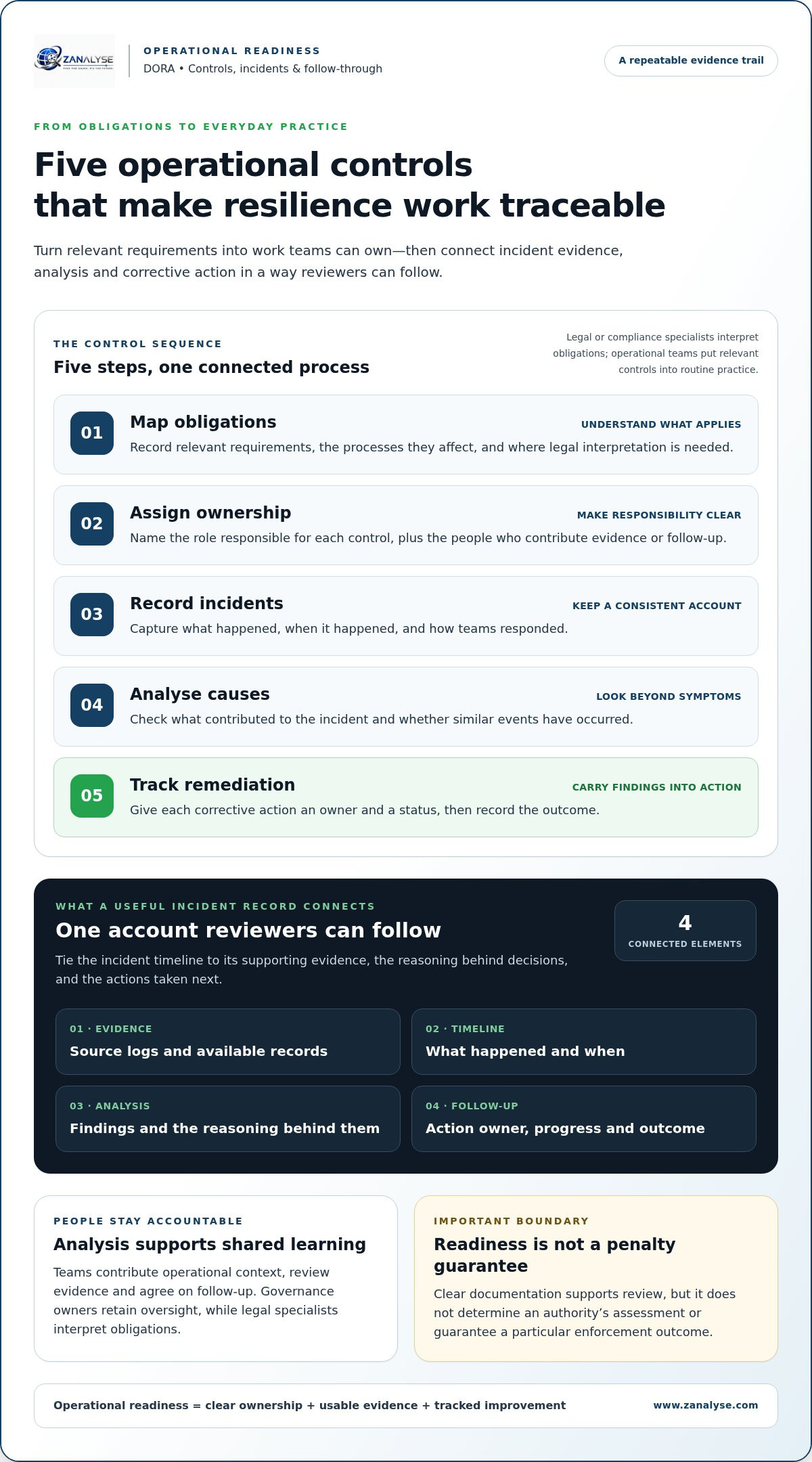
Translate applicable requirements into work teams can own. Legal or compliance specialists should interpret obligations for the organisation’s circumstances; operational teams can then make relevant controls part of routine practice. Use this sequence to establish a process that can be reviewed and improved:
- Map obligations. Record relevant requirements, the processes they affect and where legal interpretation is needed.
- Assign ownership. Name the role responsible for each control and the people who contribute evidence or follow-up.
- Record incidents. Keep a consistent account of what happened, when it happened and how teams responded. For reporting considerations, use this DORA incident reporting guide.
- Analyse causes. Look beyond immediate symptoms. Check what contributed to the incident and whether similar events have occurred.
- Track remediation. Give each corrective action an owner, a status and a recorded outcome.
This sequence supports operational readiness; it does not replace legal advice or establish new regulatory deadlines. Keep internal processes aligned with the obligations that apply to your organisation.
Turn incident handling into a repeatable evidence trail
A useful incident record connects the timeline to source logs, response decisions, analysis findings and resulting actions. For example, if a team changes a service configuration, record why the change was made and link the decision to the evidence available at the time. Include the finding, the action owner and progress against that action so a reviewer can follow what happened, how the organisation reached its conclusion and what it did next. Evidence-based incident confidence scoring offers further context on assessing the strength of findings.
Process managers and IT teams looking to make root cause analysis more accessible can explore ZANALYSE’s approach to structured RCA as part of a wider resilience programme.
How structured root cause analysis supports DORA readiness without promising fine avoidance
Incident data is most useful when it tells a coherent story. Root cause analysis (RCA) brings together logs, timelines and incident findings to explain what happened, what evidence supports the explanation and what action could address the underlying cause. A structured report lets teams review the reasoning without piecing it together from separate tools and conversations.
For example, if a recurring service failure follows a particular change, analysis can connect the event timeline with relevant logs, document the finding and show its confidence level. The team can then assign a corrective action and track its progress. A confidence score helps communicate how strongly the available evidence supports a finding; it does not replace human judgement or confirm compliance by itself.
Where automated RCA fits in a DORA-focused operating model
Accessible RCA workflows can help process managers, IT support personnel, product managers and decision-makers contribute to problem management, rather than leaving analysis with a small specialist group. Teams can share operational context, review evidence and agree on follow-up, while governance owners retain responsibility for oversight and legal specialists interpret obligations. Different root cause analysis methods can complement this process, depending on the incident and the evidence available.
Automation can make analysis more consistent, but it cannot decide whether controls are adequate, replace governance or provide legal advice. That distinction matters for avoiding DORA non-compliance fines: RCA supports operational learning and traceability, but no tool can guarantee an enforcement outcome.
ZANALYSE organises logs, timelines and incident data into structured RCA reports featuring evidence, confidence scores and corrective actions. Its guided approach helps IT staff take part in problem management and apply established RCA techniques. For teams in Europe, Canada and Australia working with EU financial entities, this can support a consistent incident analysis process alongside the organisation’s wider governance and legal responsibilities. Explore ZANALYSE’s root cause analysis platform as one operational capability within a broader resilience programme.
Make resilience improvement part of everyday operations
Reducing enforcement risk is ongoing work, not a one-time compliance exercise. Set a regular review point for operational and governance teams to check whether incident learning is influencing priorities, corrective actions are progressing, and service or process changes call for updated controls. Keep legal interpretation with the people responsible for it, and make operational responsibilities clear to the teams carrying them out.
This discipline gives process managers, IT teams and decision-makers a shared way to strengthen resilience over time. It is a practical foundation for avoiding DORA non-compliance fines, without assuming any single tool or process can determine an enforcement outcome.
ZANALYSE offers Standard and Full licenses, annual or multi-annual plans, and RCA capacity top-ups to support automated root cause analysis. Explore ZANALYSE’s platform and choose a practical incident analysis improvement your team can put into operation.
Frequently Asked Questions
Is there one EU-wide DORA fine amount?
No single figure should be treated as a universal DORA fine amount. Penalty regimes can vary between Member States, and the relevant rules depend on the organisation’s entity type and jurisdiction. If your organisation operates across Europe, map which legal entity and authority apply to each activity, then have legal advisers interpret current official requirements for that situation.
Can an organisation guarantee that it will avoid DORA non-compliance fines?
No. Controls and well-maintained records can help an organisation manage exposure, but they cannot guarantee how a regulator will decide a case. Treat prevention as ongoing risk reduction: review whether a control remains effective after a service change, and record any gaps and decisions. That discipline improves readiness without promising a penalty-free outcome.
Does using root cause analysis software make an organisation DORA compliant?
No. Software can support parts of the work, but it cannot establish that an organisation meets every applicable requirement. A report may help a team understand why a disruption recurred, while governance owners still need to decide whether the resulting control change is appropriate and addresses their obligations. Canadian or Australian providers serving EU financial entities should also assess the relevant client and contract requirements.
What incident evidence should teams retain to support DORA readiness?
Retain records that let someone unfamiliar with the incident follow the organisation’s decisions and response. For example, note who approved a service change, what information was available at the time and how the team later checked whether the change addressed the issue. Set retention and reporting practices against applicable requirements and internal policies, then have qualified legal or compliance staff validate them against current authoritative guidance.
Disclaimer
Some content on this website may be generated or assisted by artificial intelligence. While we strive to ensure that all information is accurate, relevant and up to date, AI-assisted content may contain errors or omissions. Content should therefore be considered informational and not as professional advice.


