


More resilience tools do not automatically make a fintech more resilient. A disruption can expose dependencies across systems, teams and service providers, while scattered incident records make it harder to understand what happened and prevent a repeat. This guide compares fintech operational resilience solutions Europe-based teams can assess, with a focus on turning incident evidence into useful action.
Recording an incident or meeting a process requirement is only part of the work. Teams need to understand how each solution supports their operational and regulatory priorities, without treating any single tool as a complete resilience programme. Use the criteria below to compare capabilities against real workflows.
We’ll look at how structured root cause analysis connects logs, timelines and incident data to evidence-based findings and corrective actions. We’ll also explain how ZANALYSE supports more accessible problem management, and why broader resilience governance remains essential.
Key Takeaways
- Assess resilience beyond uptime: consider whether important services can continue or recover when disruption occurs.
- Compare fintech operational resilience solutions Europe-based teams can assess against their operational and regulatory priorities.
- Look for incident analysis that links findings to traceable evidence, clear confidence scores and corrective actions.
- Guided root cause analysis can make problem management more accessible, but it does not replace governance, testing or third-party oversight.
What fintech operational resilience solutions in Europe need to address
Operational resilience is an organisation’s ability to sustain or restore important services when disruption occurs. Uptime measures system availability; resilience asks a wider question: can a service people and businesses rely on continue, or recover, when a key system, team or provider is affected? A payment service, for example, may have reliable infrastructure but still struggle if staff cannot coordinate a response or restore a critical dependency.
Resilience is the outcome; tools support the people, processes and controls that help achieve it. This distinction matters when comparing fintech operational resilience solutions in Europe. Incident-analysis software can help teams learn from disruption, but it cannot provide the full range of governance, testing and third-party oversight involved in resilience planning.
How DORA fits into European fintech resilience planning
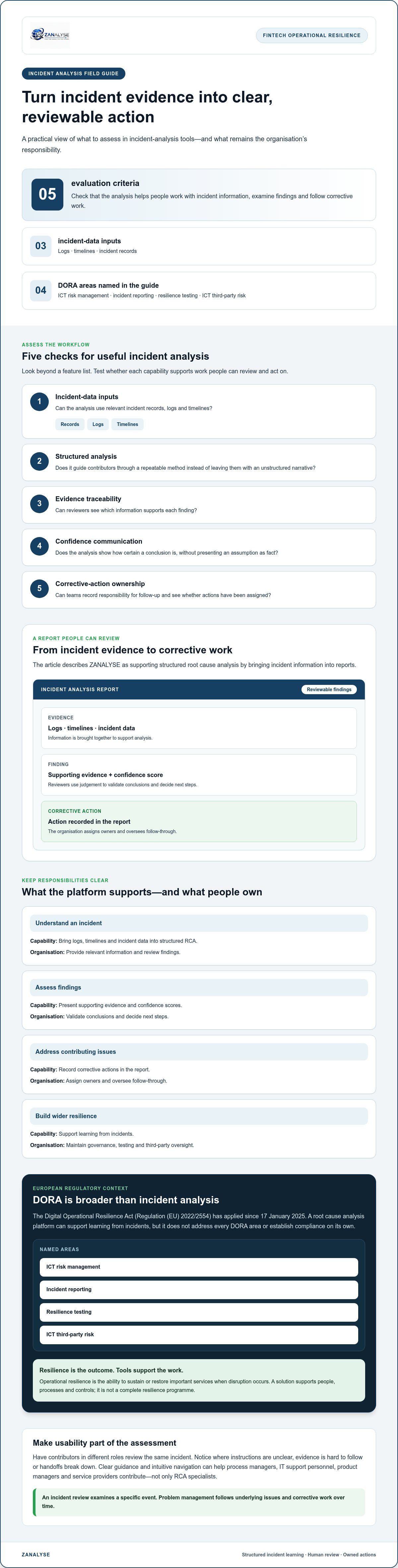
The Digital Operational Resilience Act (DORA), Regulation (EU) 2022/2554, establishes a European framework for digital operational resilience in the financial sector. It has applied since 17 January 2025. Its scope covers several areas, including ICT risk management, incident reporting, resilience testing and ICT third-party risk. A root cause analysis platform can support learning from incidents, but it does not address all these areas or establish compliance on its own.
Which requirements apply depends on the organisation and its role. Teams working across Europe, Canada or Australia should map their services, responsibilities and applicable obligations by jurisdiction rather than assume the same requirements apply everywhere. For practical reporting context, see DORA incident reporting guidance.
How to evaluate fintech operational resilience solutions without overbuying
Start with a specific resilience gap, not a feature list. When comparing fintech operational resilience solutions in Europe, consider what each capability helps people do in an actual workflow. Root cause analysis can support learning and remediation after an incident, but it does not replace governance, resilience testing or oversight of third-party providers.
Use these criteria to assess whether incident analysis will produce useful, reviewable work:
- Incident-data inputs: Can the analysis use relevant incident records, logs and timelines?
- Structured analysis: Does it guide contributors through a repeatable method, rather than leave them with an unstructured narrative?
- Evidence traceability: Can reviewers see which information supports each finding?
- Confidence communication: Does the analysis show how certain a conclusion is, without presenting an assumption as fact?
- Corrective-action ownership: Can teams record responsibility for follow-up and see whether actions have been assigned?
Assess usability alongside functionality. Clear guidance and intuitive navigation can help process managers, IT support personnel, product managers and service providers contribute, not just RCA specialists. A practical test is to have contributors in different roles review the same incident. Note where instructions are unclear, evidence is hard to follow or handoffs break down.
Match solution capabilities to resilience gaps
Connect each gap to a capability and an outcome you can observe. If incident reviews produce unclear findings, assess whether structured analysis makes the evidence and confidence behind each conclusion easier to review. If actions lack ownership, check whether responsibility can be recorded in the report. For method-selection context, explore root cause analysis methods.
An incident review examines a specific event; problem management follows underlying issues and corrective work over time. The European Banking Authority’s guidance on operational resilience provides regulatory context. Keep solution selection tied to your organisation’s actual needs, including how teams coordinate across locations and service relationships. Explore how ZANALYSE supports structured root cause analysis as one part of that work.
Where ZANALYSE fits in a European fintech resilience approach
ZANALYSE supports one part of a broader resilience approach: learning from incidents through structured root cause analysis. The platform brings logs, timelines and incident data into reports that include evidence, confidence scores and corrective actions. For teams comparing fintech operational resilience solutions Europe can use, this is an incident-analysis capability, not a complete resilience or compliance programme.
That distinction is practical. A platform can organise analysis, but the organisation still decides priorities, assigns action owners and manages its wider resilience work.
| Resilience need | Supporting capability | Organisational responsibility |
|---|---|---|
| Understand an incident | Bring logs, timelines and incident data into structured RCA | Provide relevant information and review findings |
| Assess findings | Present supporting evidence and confidence scores | Use judgement to validate conclusions and decide next steps |
| Address contributing issues | Record corrective actions in the report | Assign owners and oversee follow-through |
| Build wider resilience | Support incident learning | Maintain governance, testing and third-party oversight |
Turn incident analysis into a repeatable next step
Guided RCA makes established analysis methods more accessible beyond specialist teams. IT support personnel, process managers, IT directors, heads of IT, product managers and operational service providers can contribute to problem management using a shared approach. ZANALYSE includes a pool of RCAs to support decentralised analysis, helping teams carry reviews forward rather than relying on a small group of specialists for every incident.
Teams can use the evidence gathered to examine contributing factors, assess how well findings are supported and identify corrective actions. The report structures the analysis; people still validate conclusions, set priorities and take responsibility for changes. This keeps the tool’s role clear and the resulting work actionable.
Explore ZANALYSE as an RCA capability for operational teams that want to make incident analysis more structured and accessible.
Build resilience through consistent learning
Make your next step practical: choose a recurring incident review and agree how its findings will feed into your existing problem-management process. Give follow-up actions clear owners, then review whether they address the identified causes and reduce the chance of similar disruption. This creates a learning loop teams can improve over time, without treating software as a substitute for organisational decisions.
When assessing fintech operational resilience solutions Europe teams are considering, focus on capabilities that fit the work people need to do and make progress visible. ZANALYSE helps operational teams structure root cause analysis as part of that effort. Explore ZANALYSE for structured, evidence-based root cause analysis and take a clear next step towards more consistent incident learning.
Frequently Asked Questions
What are operational resilience solutions for fintechs?
They are the combined practices, processes and tools a fintech uses to prepare for disruption and keep important business activities working or restore them. For example, a firm might document how customer payments are handled if a service provider becomes unavailable, identify who makes response decisions and review the incident afterwards. Software can support parts of this work, but resilience also depends on clear ownership and organisation-wide planning.
Does DORA require fintechs to use operational resilience software?
No blanket requirement says fintechs must buy a particular operational resilience software product. DORA sets requirements for in-scope financial entities, while the measures relevant to an organisation depend on its classification and circumstances. A tool may help teams organise evidence or analysis, but using one does not establish compliance by itself. Consult the regulation and guidance from the relevant European or national authority for your situation.
Can root cause analysis software improve operational resilience?
It can support improvement by helping teams examine why an incident happened and identify follow-up work. For example, after a system change disrupts customer onboarding, a structured review can help distinguish the immediate trigger from contributing process issues. The organisation must still validate the findings, assign responsibility and complete agreed changes. Software supports learning; it cannot ensure that lessons are acted on.
How should European fintechs compare operational resilience solutions?
For fintech operational resilience solutions Europe-based teams are assessing, use a realistic scenario drawn from your own operations. Have intended users work through the incident information, review the resulting analysis and agree on follow-up. Note where handoffs are unclear or findings are hard to verify. Include operational staff and decision-makers in the assessment, then compare what you observe with your priorities and existing resilience processes.
Disclaimer
Some content on this website may be generated or assisted by artificial intelligence. While we strive to ensure that all information is accurate, relevant and up to date, AI-assisted content may contain errors or omissions. Content should therefore be considered informational and not as professional advice.


