


VDI login stability is not an observability challenge; it is a decentralized knowledge challenge. You likely agree that your senior engineers' time is too valuable to be spent manually sifting through thousands of log lines for every connection failure. This repetitive cycle drains resources and leaves your organization vulnerable during ISO or DORA audits when reporting is inconsistent. It's time to move beyond the senior-only bottleneck. This article explores how automated root cause analysis for vdi login issues transforms complex failures into structured, audit-ready reports while empowering your entire team to lead investigations. You'll discover how ZANALYSE, scheduled for general availability in October 2026, reduces incident lead times by over 50%. We'll preview a 2026 case study that demonstrates a decentralized problem management process that works for both technical and commercial stakeholders in Canada, Australia, and Europe.
Key Takeaways
- Break the senior engineer bottleneck by automating the correlation of data across network, profile, and storage silos.
- Discover how automated root cause analysis for vdi login issues produces structured, audit-ready reports that include specific evidence and confidence scores.
- Reduce incident lead times by over 50% while maintaining the rigorous documentation standards required for ISO and DORA compliance.
- Transition toward a decentralized support model where Level 1 and 2 personnel handle complex investigations through intuitive, guided workflows.
The Complexity Crisis: Why VDI Login Issues Paralyze Modern IT Operations
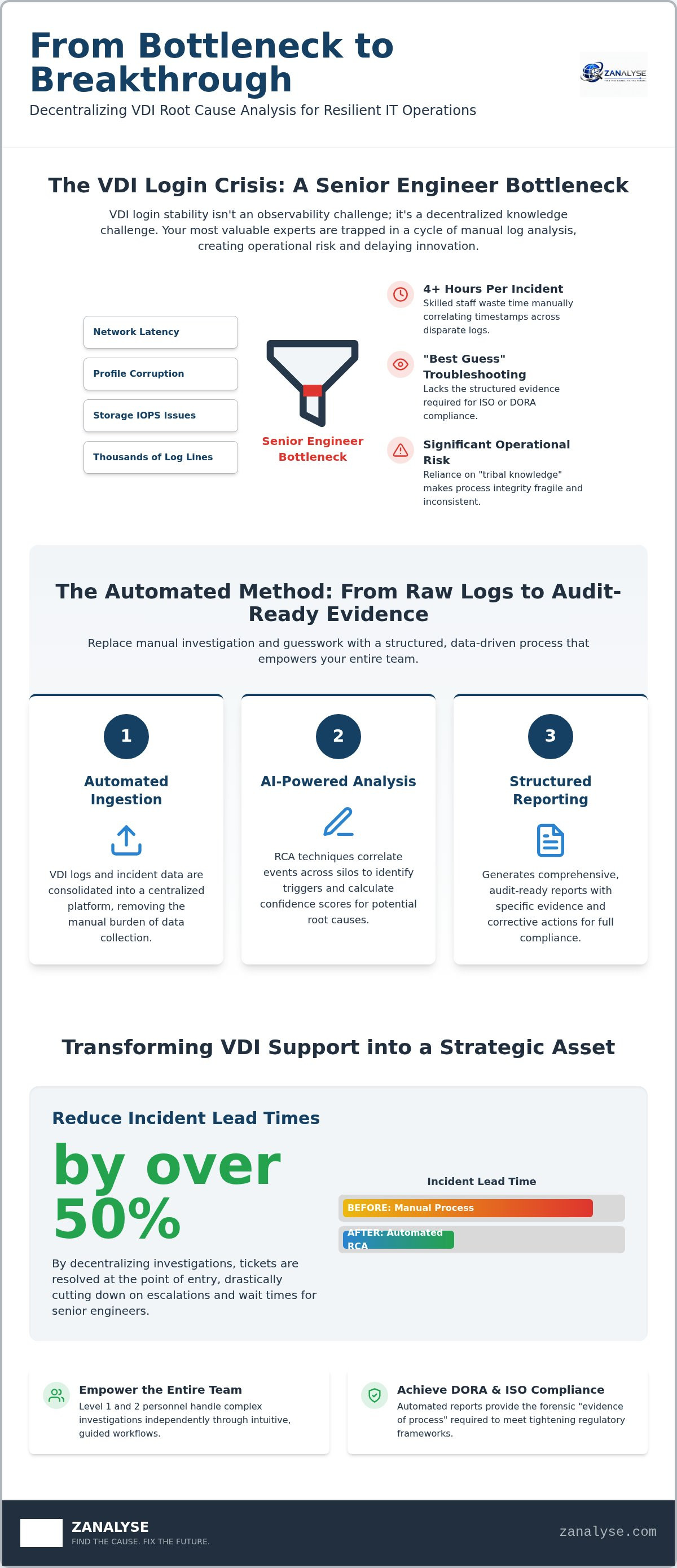
VDI login failures are rarely isolated events. They represent a collision of network latency, profile corruption, and storage IOPS bottlenecks. While traditional observability tools identify the symptom, they fail to provide the structured evidence required for a formal Root Cause Analysis (RCA). This lack of clarity forces teams into a cycle of "best guess" troubleshooting that lacks the rigor needed for ISO or DORA compliance. Without a clear path to the source, IT operations remain paralyzed by complexity, unable to move past temporary fixes.
The High Cost of Senior Staff Log-Diving
When a virtual desktop fails to connect, the clock starts ticking on productivity. Senior sysadmins often spend four hours or more on a single incident, manually correlating timestamps across disparate log files. This creates a "senior engineer bottleneck" where your most skilled staff are trapped in repetitive tasks instead of driving strategic IT projects. Relying on tribal knowledge to solve these issues is a significant operational risk. If only one person understands the nuances of your environment, your process integrity is fragile. It's a waste of specialized talent that leads to burnout and delayed innovation.
Transitioning to automated RCA for sysadmins ends this era of manual investigation. By implementing automated root cause analysis for vdi login issues, organizations can move from reactive log-diving to proactive, structured problem management. This shift ensures that every incident results in an audit-ready report with clear confidence scores. It empowers the whole team to resolve issues independently, protecting senior staff time for high-value architecture work and long-term stability.
Implementing Automated Root Cause Analysis for VDI Login Failures
Automation moves beyond the static alerts that plague traditional monitoring. Instead of simply flagging a "slow login," automated root cause analysis for vdi login issues correlates events across the network, hypervisor, and storage layers. It identifies specific triggers like GPO timeouts, authentication latency, or profile corruption instantly. This precision eliminates the guesswork that usually follows an incident. By providing a clear timeline of events, the platform shows exactly where the breakdown occurred. This isn't just about finding the fault. It's about validating the "why" behind it with absolute certainty.
From Raw Logs to Audit-Ready Evidence
The transition from chaotic logs to structured knowledge follows a methodical three-step process. First, the system performs an automated ingestion of VDI logs and incident data into a centralized platform. This removes the manual burden of data collection and ensures no evidence is lost. Second, it applies established RCA techniques to calculate confidence scores for potential causes. Modern AIOps platforms provide the analytical engine for this logic, ensuring that findings are based on empirical data rather than intuition.
Finally, the platform generates a comprehensive report that meets problem management standards. These reports are audit-ready, featuring the specific evidence and corrective actions required for regulatory compliance. By standardizing automated root cause analysis for vdi login issues, you replace temporary fixes with permanent structural improvements. If you're ready to decentralize these complex tasks, exploring a ZANALYSE Standard License is a pragmatic next step for your operation.
Strategic Decentralization: Transforming VDI Support into an Asset
Strategic decentralization shifts the burden of investigation from a few overworked experts to the broader support team. By providing intuitive navigation and guided workflows, Level 1 and 2 personnel can now handle complex investigations independently. This transition reduces incident lead times by over 50%. Instead of waiting for a senior engineer to become available, the team uses automated root cause analysis for vdi login issues to resolve tickets at the point of entry. When evaluating root cause analysis software for VDI, organizations should prioritize tools that empower every team member, not just the specialists. Standardizing these reports across Canada, Australia, and Europe ensures that operational quality remains consistent regardless of geographic location.
Achieving DORA and ISO Compliance in 2026
The shift toward automation is also a direct response to tightening regulatory frameworks. Automated reports provide the forensic "evidence of process" required for DORA incident reporting, moving beyond simple uptime metrics toward deep, verifiable proof. Utilizing a ZANALYSE Standard License allows organizations to build a permanent knowledge base that grows with every incident. These technical post-mortems are no longer opaque log dumps. They are structured briefings designed to be accessible to both technical staff and commercial decision makers. This transparency ensures that automated root cause analysis for vdi login issues serves as a bridge between operational reality and strategic governance. IT operations are transformed into a stable, predictable asset rather than a source of constant, high-pressure fire-fighting.
Securing Operational Excellence through Decentralized RCA
Transitioning from manual log-diving to a structured, evidence-based approach isn't just about speed; it's about organizational maturity. By implementing automated root cause analysis for vdi login issues, you empower your entire support team to resolve complex failures independently. This shift reduces incident lead times by over 50% while generating the audit-ready reports necessary for ISO 27001 and DORA compliance. The era of the senior engineer bottleneck is ending, replaced by a transparent process that values both technical precision and commercial clarity. With general availability scheduled for October 2026, you can now move toward a more resilient and predictable problem management model. Take the first step toward a stable and decentralized IT operation today. Request a briefing on the ZANALYSE Standard License to see how we bring order to your VDI environment.
Frequently Asked Questions
How does automated RCA improve VDI login times?
Automated RCA doesn't directly speed up the login process itself but drastically shortens the time required to identify and fix performance bottlenecks. By using automated root cause analysis for vdi login issues, IT teams can resolve underlying latency in GPOs or profile loading 50% faster. This proactive resolution prevents recurring slow logins, ensuring a consistently high-performing virtual environment for users across Canada and Europe.
Can junior IT staff use automated RCA for complex virtual desktop issues?
Yes, the platform is specifically designed to decentralize problem management. Intuitive navigation and guided workflows allow Level 1 and 2 support personnel to perform deep analysis that previously required senior engineers. This empowerment reduces the senior bottleneck and allows junior staff in regions like Australia to generate professional, accurate findings without needing decades of niche VDI expertise or manual log-diving.
What evidence is included in an automated VDI root cause report?
Every report generated by ZANALYSE includes a structured set of forensic data. This includes:
- Correlated log timelines from network and storage layers.
- Specific confidence scores for identified triggers.
- Verifiable evidence of the failure point.
- Clear corrective actions to prevent recurrence.
These details ensure that automated root cause analysis for vdi login issues results in an audit-ready document for internal and external stakeholders.
How does automated RCA support DORA compliance for financial institutions?
Automated RCA provides the rigorous documentation and evidence of process required by DORA regulations. By standardizing technical post-mortems, financial institutions can demonstrate a mature approach to operational resilience. The platform ensures that incident reporting is consistent, verifiable, and structured, which is essential for passing high-stakes audits. This level of process integrity is a core feature of the ZANALYSE Standard License.
Disclaimer
Some content on this website may be generated or assisted by artificial intelligence. While we strive to ensure that all information is accurate, relevant and up to date, AI-assisted content may contain errors or omissions. Content should therefore be considered informational and not as professional advice.


