

In 2026, the average enterprise loses $15,000 every single minute a major service remains down. While the rush to restore service is instinctive, the real pressure begins when the firefighting ends and the regulatory clocks of DORA and NIS2 start ticking. You're likely exhausted by repetitive manual reporting and the worry that an inconsistent major incident root cause analysis process will fail a critical audit. It's a common struggle to see skilled engineers trapped in spreadsheets for days just to document a single event.
This guide provides a blueprint to master a structured, audit-ready RCA process that reduces incident lead times by 50%. You'll learn how to transform compliance from a source of anxiety into a routine operational strength. We'll explore how to decentralize problem management so any staff member can generate evidence-based reports in minutes, ensuring your organization meets the highest standards of governance.
Key Takeaways
- Distinguish between immediate service restoration and deep-dive analysis to ensure your team addresses the structural vulnerabilities behind every major outage.
- Master a structured major incident root cause analysis process that uses automated timelines and proven techniques to build a consistent, evidence-based narrative.
- Reduce incident lead times by 50% by adopting an audit-ready framework that ensures seamless compliance with DORA and ISO 27001 requirements.
- Scale your problem management capabilities by decentralizing the investigation process, allowing junior staff and support teams to contribute high-quality findings.
The Major Incident RCA Framework: Beyond Firefighting
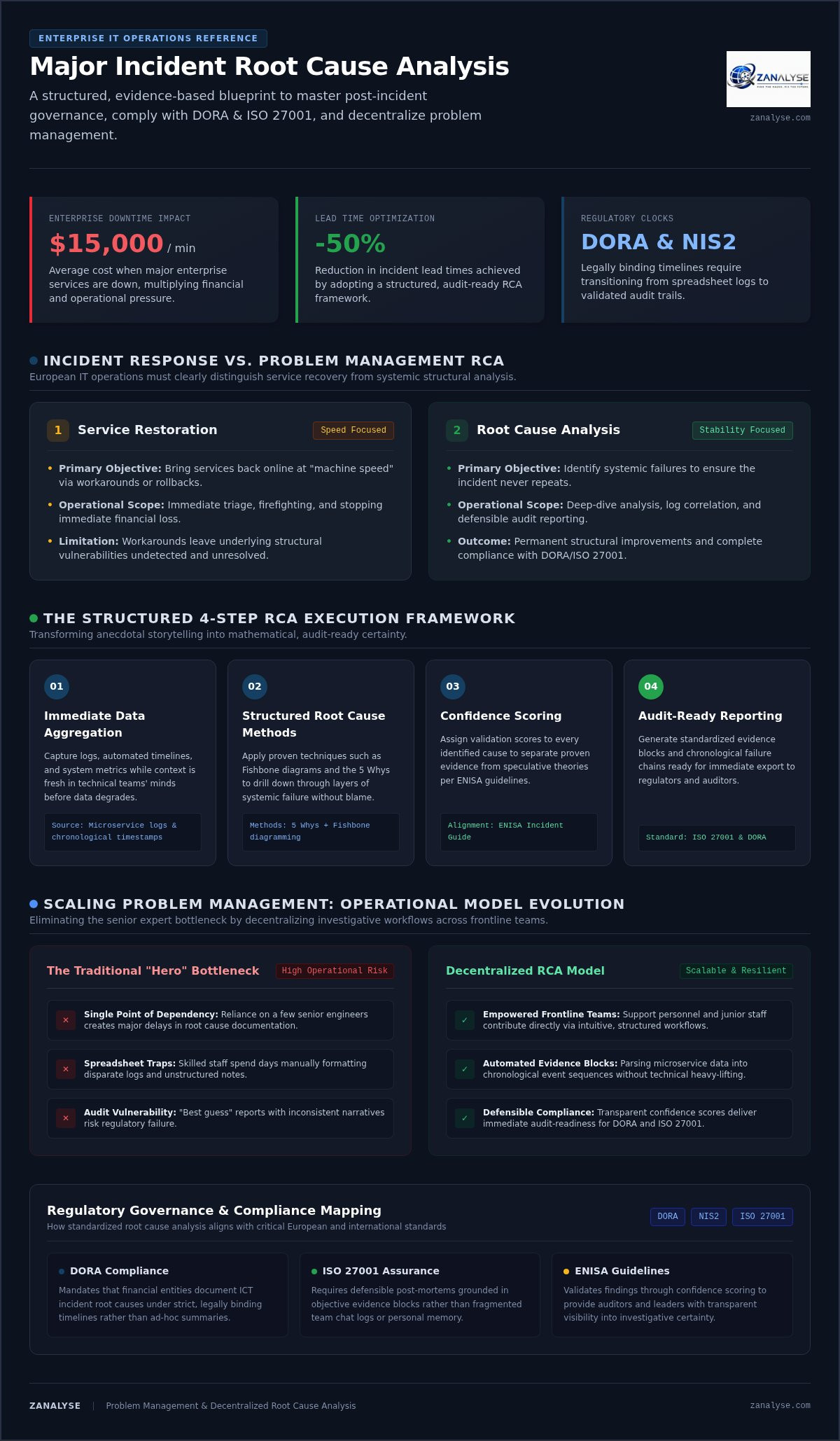
In 2026, a Major Incident (MI) is defined by more than just downtime. It's a high-impact event that triggers immediate regulatory scrutiny and carries significant financial risk, often exceeding $15,000 per minute. While incident response focuses on restoring service at "machine speed," the major incident root cause analysis process is a distinct, deliberate effort to ensure the failure never happens again. Restoration is about speed; analysis is about stability. European IT operations can't afford to treat these as the same activity. Successful teams align their RCA workflows with mature problem management frameworks. This shift moves the organization from reactive firefighting toward a culture of permanent structural improvement.
Aligning with DORA and ISO 27001 Standards
The Digital Operational Resilience Act (DORA) has fundamentally transformed how financial entities handle ICT failures. It's no longer enough to fix the bug; you must document the "why" within strict, legally binding timelines. To satisfy ISO 27001 auditors, technical post-mortems must rely on objective evidence rather than memory or fragmented chat logs. Using established root cause analysis methodologies allows teams to build a defensible audit trail that proves due diligence. Manual, unstructured reporting remains the primary risk factor for regulatory non-compliance. These "best guess" documents lack the consistency required by modern governance standards. They fail because they rely on individual writing styles rather than a repeatable process. Moving toward automated, evidence-based reports ensures every incident is handled with professional rigor.
Executing a High-Standard Major Incident RCA Process
Executing a high-standard major incident root cause analysis process requires a transition from anecdotal storytelling to rigorous, data-driven investigation. The first step involves immediate data collection; you must aggregate logs, timelines, and incident data while the technical context is still fresh in the team's mind. Once the data is secured, teams apply structured root cause analysis methods like Fishbone diagrams or the 5 Whys to peel back layers of systemic failure. This methodical approach prevents the "blame culture" that often arises during high-pressure outages. Finally, you must assign confidence scores to each identified cause. This validation step ensures report integrity by separating verified evidence from speculative theories, a practice supported by the ENISA Good Practice Guide for Incident Management. By scoring your findings, you provide auditors with a transparent view of your investigative depth and certainty.
Turning Logs into Audit-Ready Evidence
Automated tools transform raw log files into structured evidence blocks by parsing chaotic data into standardized, chronological event sequences. Correlating timestamps across disparate microservices allows you to reconstruct failure chains with mathematical certainty. Utilizing a ZANALYSE Standard License automates this synthesis, reducing reporting burdens on senior staff. If you want to standardize your major incident root cause analysis process, moving toward automated evidence generation is the most effective path toward long-term operational resilience.
Scaling Problem Management: Decentralizing the RCA Process
The traditional "hero" model of problem management is a significant operational risk. When you rely on a handful of senior experts to lead every investigation, you create a bottleneck that slows organizational learning and delays critical reporting. This centralized approach often leaves junior staff and support personnel on the sidelines, unable to contribute meaningfully to the findings. Decentralizing the major incident root cause analysis process changes this dynamic by putting structured tools into the hands of the frontline team. It's about empowering every staff member to identify causes through intuitive workflows that don't require heavy technical lingo.
Measuring the success of this shift involves tracking two primary metrics: the implementation rate of corrective actions and the reduction in incident lead times. High-performing organizations aim for a 50% reduction in lead times, proving that a distributed model is faster and more efficient than a centralized one. This evolution ensures that your problem management capability scales alongside your infrastructure, providing commercial and technical leaders with the clarity they need to make informed decisions.
Building a Culture of Permanent Corrective Action
True resilience requires moving from temporary workarounds to permanent structural improvements. While a quick fix might restore service, it leaves the underlying vulnerability intact. A mature process focuses on structural changes that prevent incident recurrence entirely. Tracking the ROI of an automated RCA program becomes straightforward when you correlate lower downtime costs with improved audit readiness. It's essential to check the latest dora incident reporting requirements to ensure your corrective actions meet 2026 standards. These regulations mandate a level of technical depth and evidence that manual, centralized processes simply cannot sustain as incident volume grows.
Securing Operational Stability Through Automated Governance
Refining your major incident root cause analysis process is no longer just an internal goal; it's a regulatory necessity. You've seen how moving beyond immediate firefighting to structured, evidence-based reporting prevents recurrence and secures your infrastructure. By decentralizing these investigations, you empower your entire team to contribute, removing the senior-level bottlenecks that stall organizational growth.
ZANALYSE simplifies this transition by automating evidence collection from logs and timelines. This approach ensures your reports are always DORA and ISO 27001 compliant while reducing incident lead times by over 50%. It's time to replace manual post-mortems with a system that brings order to technical chaos. Empower your team with the ZANALYSE Standard License today. You can build a more resilient, audit-ready operation starting now.
Frequently Asked Questions
How does the Major Incident RCA process differ for DORA compliance?
DORA mandates a rigid reporting regime for financial entities across Europe. Unlike standard internal reviews, the major incident root cause analysis process for DORA requires a final report within one month of resolution. You must provide full technical documentation, impact metrics, and long-term corrective actions. ZANALYSE automates these evidence-based reports to ensure your team meets these legal deadlines without the stress of manual drafting.
Can we automate the entire Root Cause Analysis process?
You can't automate the human judgment required for complex systems, but you can automate the most time-consuming parts. ZANALYSE automates report generation from logs and timelines, transforming raw data into structured evidence blocks. This reduces incident lead times by over 50%. It allows your staff to focus on identifying solutions rather than spending days manually correlating disparate log files across global environments.
What are the most effective RCA techniques for complex IT incidents?
The most effective techniques include the 5 Whys for deep-dive questioning and Fishbone diagrams for mapping complex dependencies. In a decentralized environment, these methods ensure consistency across different team members. ZANALYSE guides users through these established techniques to produce high-quality findings. This structured approach is essential for IT operations in Canada, Australia, and Europe to maintain stable, audit-ready service standards.
How do confidence scores improve the quality of an IT incident report?
Confidence scores improve report quality by quantifying the certainty of each identified cause. Instead of presenting theories as facts, your major incident root cause analysis process becomes transparent and defensible for ISO 27001 auditors. These scores help IT directors distinguish between verified technical failures and speculative human error. This level of precision builds trust with stakeholders and ensures that corrective actions address the actual root cause.
Disclaimer
Some content on this website may be generated or assisted by artificial intelligence. While we strive to ensure that all information is accurate, relevant and up to date, AI-assisted content may contain errors or omissions. Content should therefore be considered informational and not as professional advice.


