


A blameless post-mortem is not a get-out-of-jail-free card for performance issues; it is the most rigorous way to ensure a system never fails the same way twice. Most IT leaders know the frustration of finger-pointing during high-pressure outages. When teams lack a structured blameless post-mortem template, the primary goal often becomes finding a scapegoat. This hides actual systemic flaws and leaves your organization vulnerable to the next crisis.
This guide provides a comprehensive framework designed to shift your focus from human error to objective, evidence-based recovery. You'll learn how to automate data collection, reduce incident lead times by 50%, and produce reports that satisfy strict ISO and DORA audit requirements with minimal manual effort. We'll explore how decentralizing this process empowers every team member to contribute to organizational resilience and long-term stability.
Key Takeaways
- Adopt a structured blameless post-mortem template to shift the focus from individual error toward systemic improvement using objective data.
- Build technical timelines based on log evidence rather than manual recollection to ensure absolute accuracy in every incident report.
- Align your incident reviews with DORA and ISO compliance standards to satisfy regulatory scrutiny with minimal administrative effort.
- Learn how decentralizing problem management across your organization reduces incident lead times by 50% and fosters long-term operational stability.
Essential Components of a Blameless Post-Mortem Template
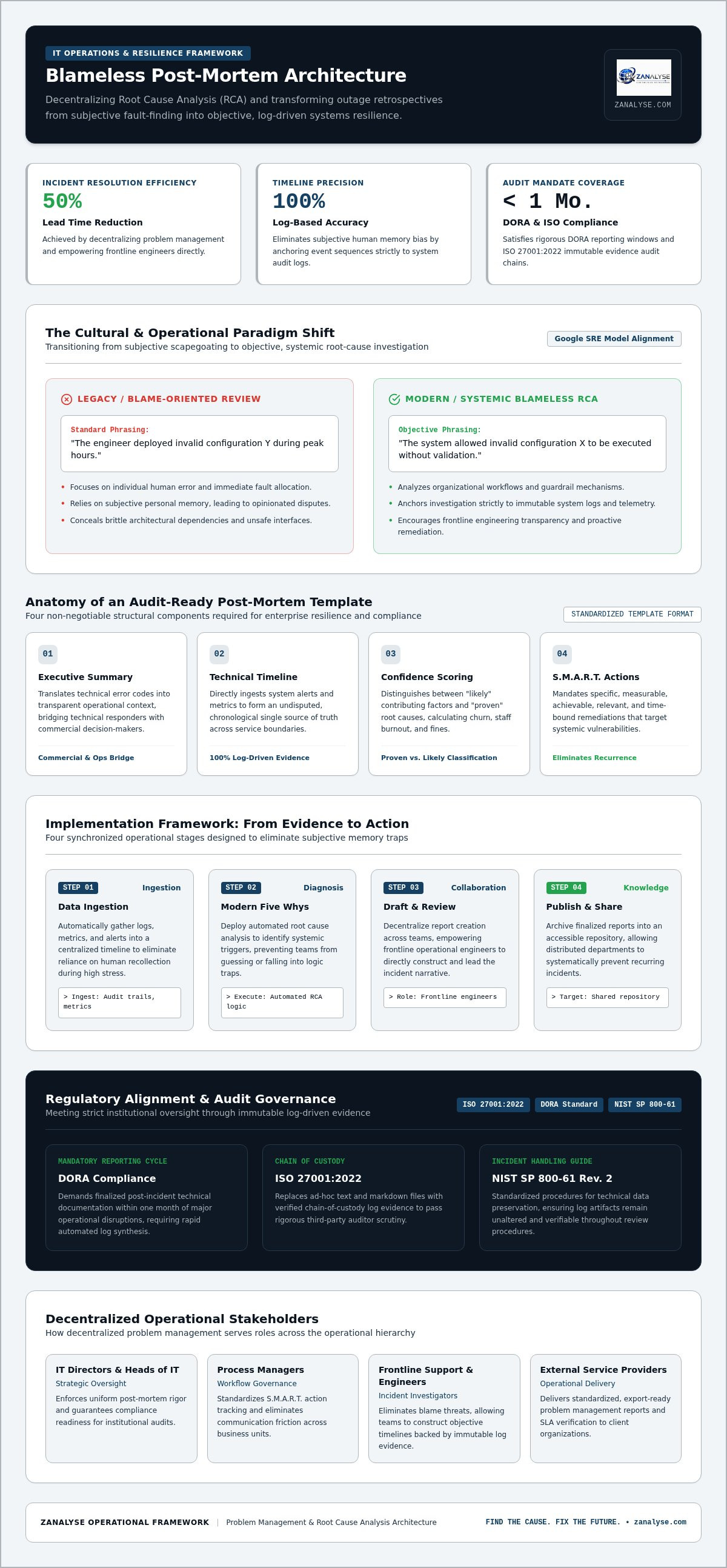
A robust blameless post-mortem template begins with an executive summary that bridges the gap between technical teams and commercial stakeholders. It's not enough to list error codes; you must articulate the operational impact in clear language. Moving beyond "human error" is mandatory for systemic health. When you blame an individual, you miss the brittle dependencies or confusing interfaces that facilitated the mistake. Focus on why the system allowed the failure to occur rather than who clicked the button.
The technical timeline is the most critical part of postmortem documentation. Manual recollection is notoriously unreliable during high-pressure outages. Shift to log-based evidence for 100% accuracy. By ingesting metrics and audit logs directly, you create a source of truth that no one can dispute. This objective data transforms the review from an opinion-based debate into a factual analysis that identifies exactly where the process broke down.
Corrective actions must follow the S.M.A.R.T. framework to ensure they actually prevent recurrence. Every task should be specific, measurable, achievable, relevant, and time-bound. Patching symptoms might stop the immediate bleeding, but only structural changes eliminate the risk. If your blameless post-mortem template doesn't produce an actionable, trackable roadmap, it has failed its primary purpose. Accountability lives in the commitment to these improvements, not in the assignment of fault.
Standardizing Incident Impact and Confidence Scoring
Quantifying the true cost of downtime involves more than calculating lost revenue per hour. You must account for staff burnout, customer churn, and potential regulatory fines. Use confidence scores to categorize findings. This helps distinguish between "likely" contributing factors and "proven" root causes. This level of precision is essential for passing rigorous audits and building internal credibility. For more on building these frameworks, see our Problem Management 2026: IT Operations Reference Guide.
Implementing the Template: From Evidence to Action
Turning an incident into a learning opportunity requires a methodical approach that prioritizes facts over feelings. You can't improve what you don't measure objectively. The implementation of a blameless post-mortem template should follow four distinct phases to ensure consistency and depth:
- Step 1: Data Ingestion. Automatically gather logs, metrics, and alerts into a centralized timeline to eliminate reliance on human memory.
- Step 2: The Five Whys (Modernized). Use automated RCA to identify systemic triggers, avoiding the logic traps that occur when teams manually guess at causes.
- Step 3: Draft and Review. Decentralize report creation by allowing the engineers on the front lines to lead the narrative.
- Step 4: Publication and Knowledge Sharing. Store the final report in a searchable repository so other departments can prevent similar failures.
This sequence mirrors the Google SRE blameless postmortem culture by focusing on transparency rather than punishment. It ensures that every outage contributes to a more resilient infrastructure.
Shifting from Who to How with Objective Evidence
Blamelessness is the practice of analyzing system behavior and organizational processes rather than individual intent or error. To maintain this focus, you must use specific phrasing in your documentation. For example, write "The system allowed X to happen" instead of "The engineer did Y." This subtle shift removes the threat of blame and encourages staff to be honest about technical gaps. The ZANALYSE Standard License automates this transition by prioritizing immutable log data over subjective recollection. By centering your blameless post-mortem template on evidence, you build a culture where engineers feel safe to innovate. You can start automating your RCA process here to ensure your reviews remain objective and actionable.
Automating Post-Mortems for DORA and ISO Compliance
Manual templates often fail during regulatory audits because they rely on subjective narratives rather than immutable evidence. In the 2026 regulatory environment, auditors expect a clear chain of custody for technical logs. Ad-hoc markdown files or static documents rarely meet the evidence-chain requirements of ISO 27001:2022 or the Digital Operational Resilience Act (DORA). Following the NIST Computer Security Incident Handling Guide is essential for preserving the technical data required to prove your findings.
A structured blameless post-mortem template maps directly to the mandatory reporting cycles defined by DORA. While the regulation requires a final report within one month of a major incident, automated root cause analysis allows teams to meet these deadlines with ease. By replacing manual reconstruction with automated data ingestion, organizations reduce incident lead times by over 50%. This speed doesn't sacrifice quality; it ensures every report is audit-ready and based on verified system behavior.
Decentralizing Problem Management via Structured Reporting
Empowering junior staff to generate high-quality post-mortems improves organizational resilience and distributes the workload. When the process is decentralized, it prevents bottlenecks in the problem management office. Structured reports are a necessity for meeting DORA Incident Reporting standards across all IT operations. ZANALYSE guides users through established RCA techniques, ensuring every blameless post-mortem template remains consistent regardless of who writes it. This approach builds a permanent repository of knowledge that demonstrates operational maturity to regulators and stakeholders alike.
Securing Long-Term Resilience Through Objective Analysis
Moving from chaotic incident response to a structured learning culture requires more than just a change in mindset. It demands a reliable blameless post-mortem template that prioritizes immutable log data over subjective memory. By automating the evidence collection process, you remove the social pressure of finger-pointing and focus entirely on system improvement. This transition ensures your reports aren't just internal documents but audit-ready assets that satisfy the rigorous demands of DORA and ISO regulations.
Decentralizing problem management empowers your entire technical staff to contribute to operational excellence. It's time to stop treating root cause analysis as a manual burden and start using it as a strategic engine for growth. You can automate your incident reports with ZANALYSE Standard License to reduce incident lead times by over 50% while generating the structured evidence your organization needs. Build a more stable future for your IT operations today.
Frequently Asked Questions
What is the difference between a post-mortem and a root cause analysis (RCA)?
A post-mortem is the comprehensive review process and resulting documentation that summarizes an incident, while root cause analysis (RCA) is the specific analytical technique used to identify the underlying failure. In a blameless post-mortem template, the RCA provides the technical evidence needed to support systemic changes. Both are essential for meeting ISO 27001:2022 standards, which require systematic learning from information security incidents.
How do you keep a post-mortem meeting blameless when a clear mistake was made?
Maintaining a blameless culture requires a shift in language from individual intent to system behavior. Instead of focusing on who made a mistake, analyze the technical environment that allowed the error to occur. By using objective log data and automated timelines, teams can remove personal bias from the discussion. This approach ensures that the review remains a constructive learning exercise rather than a finger-pointing session.
Are blameless post-mortems required for DORA compliance?
The Digital Operational Resilience Act (DORA) mandates that financial entities in Europe, Australia, and global markets provide a final report documenting verified root causes and remediation actions. While the regulation doesn't explicitly use the word "blameless," the requirement for objective, evidence-based reporting makes a blameless post-mortem template the most effective tool for compliance. These reports must be completed within one month of the incident.
How long should it take to complete a post-mortem report after an incident?
Under DORA regulations, a final incident report is due within one month of the latest intermediate report. However, high-performing IT organizations aim for much faster turnarounds to prevent recurring issues. By decentralizing problem management and using automated tools, teams can reduce incident lead times by over 50%. This efficiency allows for faster knowledge sharing across the organization while maintaining audit-ready quality.
Disclaimer
Some content on this website may be generated or assisted by artificial intelligence. While we strive to ensure that all information is accurate, relevant and up to date, AI-assisted content may contain errors or omissions. Content should therefore be considered informational and not as professional advice.


