


Mean time to resolution is not a speed metric; it's a "time-to-certainty" metric. You've likely felt the pressure of watching downtime costs mount while a single expert sifts through manual logs, all while DORA and ISO audit deadlines loom. It's a high-pressure environment where repetitive tasks create dangerous bottlenecks and knowledge silos. Understanding how to reduce mean time to resolution (MTTR) requires moving past temporary fixes toward permanent structural improvements. This guide provides the framework to slash incident lead times by over 50% through automation and decentralized problem management. We'll examine the structural changes and intuitive strategies needed to transform your incident response into a consistent, audit-ready process. You'll learn how to empower L1 and L2 staff to identify root causes independently, ensuring your organization remains resilient and compliant in an increasingly regulated landscape.
Key Takeaways
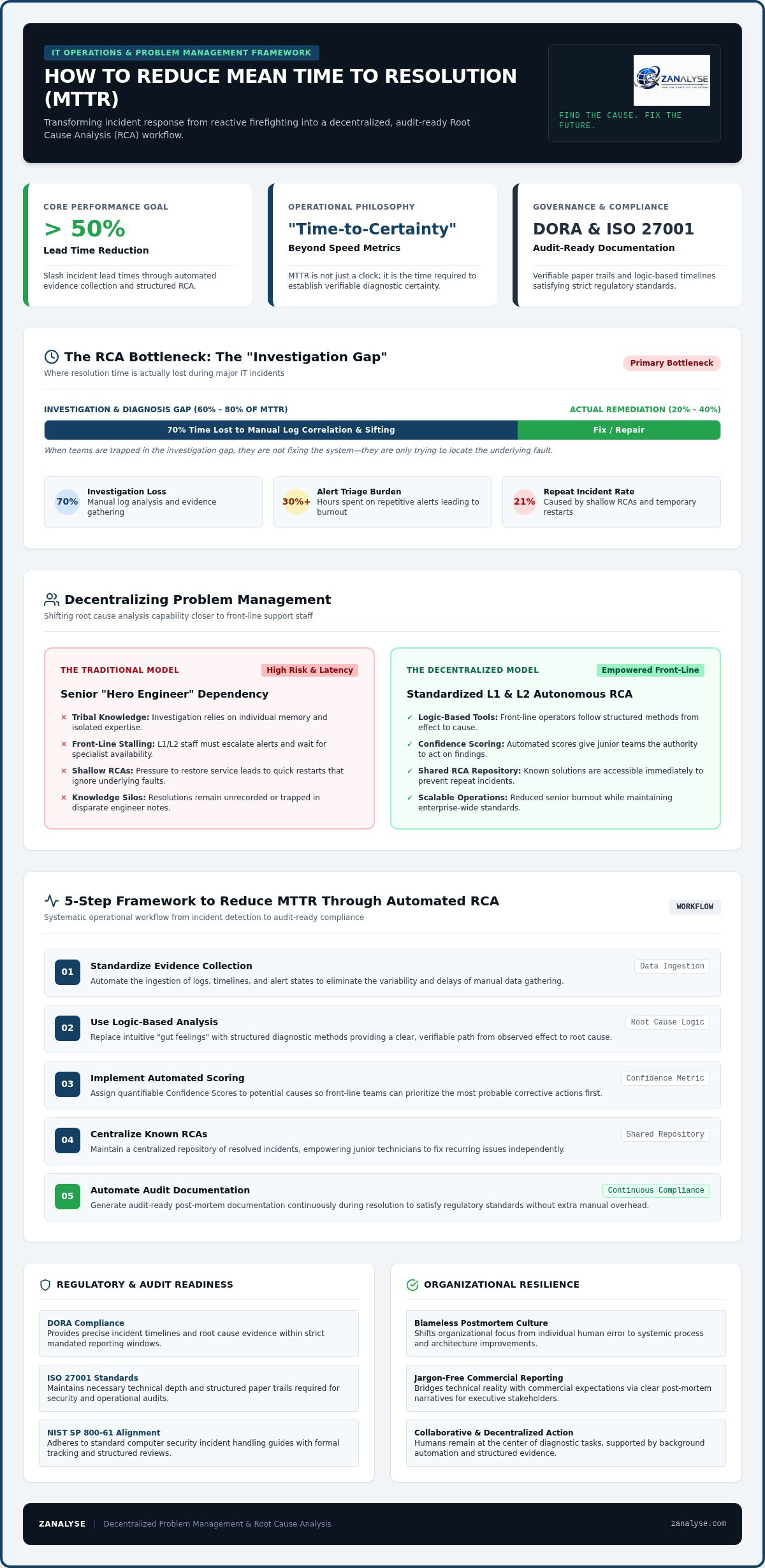
- Identify the "Investigation Gap" where 70% of your resolution time is lost to manual log correlation and learn how to automate evidence collection.
- Implement a five-step strategic framework on how to reduce mean time to resolution (MTTR) by over 50% using logic-based diagnostic methods.
- Decentralize problem management by providing front-line staff with intuitive tools that allow them to identify root causes without relying on specialized engineers.
- Transform chaotic incident data into structured, audit-ready reports that meet the strict documentation standards of DORA and ISO 27001.
Understanding the RCA Bottleneck in MTTR Reduction
MTTR isn't just a clock; it's a composite of detection, diagnosis, and repair. While many teams focus on the "repair" phase, the primary bottleneck is the "Investigation Gap." Research indicates that 60% to 80% of mean time to repair (MTTR) is consumed by manual log correlation and diagnosis. This leaves only a small window for actual remediation. When your team is trapped in this gap, they aren't fixing the problem; they're just trying to locate it.
Relying on senior "hero" engineers to perform every deep-dive analysis creates a dangerous dependency. This tribal knowledge forces L1 and L2 staff to wait for an expert, stalling the entire resolution process. Learning how to reduce mean time to resolution (MTTR) requires breaking these silos and empowering the entire team with structured, accessible data.
The Hidden Costs of Manual Incident Investigation
Repetitive manual tasks do more than slow you down; they erode team morale. High-pressure environments where staff spend 30% or more of their hours triaging alerts lead to rapid burnout. This exhaustion often results in "shallow RCAs," where teams address symptoms rather than root causes. While a quick restart might restore service, it ignores the underlying fault, contributing to a 21% repeat incident rate. Decentralized problem management serves as the antidote. By using intuitive tools that simplify complex data, you allow every team member to contribute to the resolution. This shift reduces the burden on senior staff and ensures long-term operational stability.
5 Steps to Reduce MTTR Through Automated RCA
Lowering your incident lead times requires a transition from manual investigation to a structured, automated workflow. If you're struggling with how to reduce mean time to resolution (MTTR), you must move beyond treating symptoms and address the underlying faults that drive downtime costs. Automation is the foundation for this change.
- Step 1: Standardize evidence collection. Automate the ingestion of logs and timelines to eliminate the variability of manual data gathering.
- Step 2: Use logic-based analysis. Replace "gut feelings" with structured root cause analysis methods that provide a clear path from effect to cause.
- Step 3: Implement automated scoring. Assign confidence levels to potential causes so your team can prioritize the most likely corrective actions first.
- Step 4: Centralize known RCAs. Create a shared repository of resolved issues. This allows junior staff to fix recurring problems without involving senior engineers.
- Step 5: Automate audit documentation. Ensure every resolution is documented as it happens to satisfy regulatory expectations without extra effort.
Decentralizing RCA to Empower L1 and L2 Teams
The key to how to reduce mean time to resolution (MTTR) lies in moving the diagnostic capability closer to the front line. When L1 support staff have access to structured RCA tools, they no longer need to escalate every complex alert. High "Confidence Scores" provide these team members with the authority to act on automated findings, significantly shortening the resolution window. This decentralized approach aligns with a mature problem management framework, ensuring that every technician follows the same rigorous standards. As noted in the NIST Computer Security Incident Handling Guide, a formal tracking and review process is vital for organizational resilience. Teams ready to scale this capability often find the ZANALYSE Standard License is an ideal entry point for automating these critical workflows.
Building an Audit-Ready Resolution Framework
Restoring service is only half the battle. If your resolution process doesn't leave a verifiable paper trail, you haven't truly solved the organizational risk. Mastering how to reduce mean time to resolution (MTTR) requires a shift from reactive firefighting to a proactive governance model. This transition ensures that every incident contributes to a permanent reduction in future downtime rather than just a temporary fix.
Structured resolution data serves as the backbone for modern compliance. Under the latest DORA incident reporting requirements, teams must provide precise timelines and root cause evidence within strict windows. Automated post-mortem reports bridge the gap between technical reality and commercial expectations. They provide a clear, jargon-free narrative for stakeholders while maintaining the technical depth required for ISO 27001 audits. This approach naturally fosters a blameless postmortem culture, where the focus shifts from individual error to systemic improvement.
Integrating Automated RCA for DORA and ISO Compliance
Manual reporting is a significant compliance risk in the 2026 regulatory landscape. Human error in documentation can lead to missed deadlines or incomplete evidence, inviting unnecessary regulatory scrutiny. ZANALYSE stabilizes this process by generating comprehensive reports that feature both technical evidence and specific corrective actions. This level of consistency is vital for service providers who must demonstrate how to reduce mean time to resolution (MTTR) across multiple client environments while remaining audit-ready. For teams looking to formalize their governance, the ZANALYSE Standard License provides the tools necessary to produce audit-ready documentation without increasing operational toil.
Transforming Incident Response into Strategic Governance
Reducing incident lead times isn't about working faster; it's about working with better structure. By automating log ingestion and decentralizing problem management, you remove the senior-expert bottleneck that stalls recovery. This guide has outlined the path for how to reduce mean time to resolution (MTTR) through logic-based analysis and audit-ready documentation. The transition from reactive firefighting to proactive governance ensures your team remains resilient against downtime and compliant with evolving regulations like DORA. You don't have to manage the chaos alone. Empower your team with the ZANALYSE Standard License to reduce incident lead times by over 50% and generate automated, audit-ready RCA reports for every event. It's time to distribute expertise across your entire IT staff and stabilize your operational environment. You have the framework; now take the first step toward a more mature, structured future.
Frequently Asked Questions
What is the difference between MTTR and MTTD in IT operations?
MTTD, or Mean Time to Detection, measures the interval between an incident occurring and your team becoming aware of it. In contrast, MTTR covers the entire span from that initial detection to the final resolution. While many teams in Europe and Australia focus on faster alerts, the real bottleneck usually exists in the investigation phase that follows detection.
Can automated RCA tools really work with messy, unstructured log data?
Yes, professional platforms are engineered to ingest and structure fragmented data into a cohesive timeline. Instead of requiring manual log parsing, the system standardizes evidence to identify causal patterns automatically. For IT teams in Canada and Europe, this process replaces "gut feelings" with logic-based results. It ensures that even chaotic raw data leads to structured reports with high confidence scores.
How does DORA compliance affect my MTTR reporting requirements?
The Digital Operational Resilience Act (DORA) requires financial entities in Europe to provide detailed incident reports within strict windows. This regulatory shift emphasizes how to reduce mean time to resolution (MTTR) while maintaining a verifiable audit trail. Automated platforms support this by generating reports that include specific evidence and corrective actions. This ensures your documentation meets the rigorous standards required by national competent authorities.
Is it possible to reduce MTTR without hiring more senior SREs?
You can lower incident lead times by decentralizing problem management to your existing L1 and L2 personnel. Providing junior staff with intuitive, logic-based tools removes the constant need for senior engineer escalations. By utilizing a central pool of known RCAs, your current team in Australia or Canada can resolve recurring issues independently. This approach scales your operational capacity without the high cost of specialized headcount.
Disclaimer
Some content on this website may be generated or assisted by artificial intelligence. While we strive to ensure that all information is accurate, relevant and up to date, AI-assisted content may contain errors or omissions. Content should therefore be considered informational and not as professional advice.


