


Could an incident record show not just what happened, but why it happened and what changed as a result? When evidence and decisions are scattered across tools and teams, even a sound investigation can be difficult to follow. Clear iso 27001 rca documentation connects the facts, analysis, decisions, and follow-up in one traceable account.
An audit-ready record doesn’t need to capture every conversation. It should let a reader understand the incident, see how the team reached its conclusions, and check what happened next. This guide explains what to document, how to link conclusions to corrective actions and effectiveness checks, and how to make records useful to technical teams, managers, and auditors. It also covers how structured workflows can help more people contribute to problem management while your team retains responsibility for evidence review and decisions.
Key Takeaways
- Use iso 27001 rca documentation to create a traceable account of incident facts, reasoning, decisions, and follow-up, without assuming the standard requires one universal report template.
- Structure each record so readers can follow the incident context, timeline, evidence, analysis, conclusion, decisions, actions, and review.
- Identify evidence sources and timestamps, and make confidence levels or unresolved questions clear so conclusions can be assessed in context.
- Use a shared workflow to help teams document RCA consistently, then review records for traceability, completed actions, and lessons that may help prevent future incidents.
What ISO 27001 RCA documentation should demonstrate
ISO 27001 RCA documentation should let a reader follow an incident from the available facts through the analysis, decisions, corrective actions, and follow-up. It records what the team knew, how it reached its conclusions, and whether planned actions were reviewed. A colleague who wasn’t part of the investigation should be able to understand the sequence without relying on informal explanations.
ISO/IEC 27001:2022 doesn’t prescribe one universal root cause analysis report template. Choose a format that fits your organization’s processes and captures enough context to support its conclusions. The goal isn’t to complete fields for their own sake. It’s to make the investigation and resulting decisions understandable and reviewable. Root Cause Analysis (RCA) describes the broader problem-solving approach; the record should show how your team applied its reasoning to the incident at hand.
How incident records relate to ISO 27001 controls
Clause 10.2 of ISO/IEC 27001:2022 addresses nonconformity and corrective action. For an incident that involves a nonconformity, a record can help show the organization’s analysis, response, and follow-up. This doesn’t mean every incident is automatically a nonconformity, or that the standard mandates a particular RCA form. Check the authoritative standard and your ISMS scope when mapping records to requirements.
Incident management and evidence-related controls may also be relevant, depending on the incident and which controls apply to your organization. For each important detail, record where it came from and when it was observed. Keep those verifiable facts distinct from interpretation, assumptions, and hypotheses that still need confirmation.
Documented evidence shows what was observed; assumptions and unverified hypotheses show what still needs confirmation.
For broader guidance on reporting incidents and preserving supporting details, see the ISO 27001 incident reporting guide.
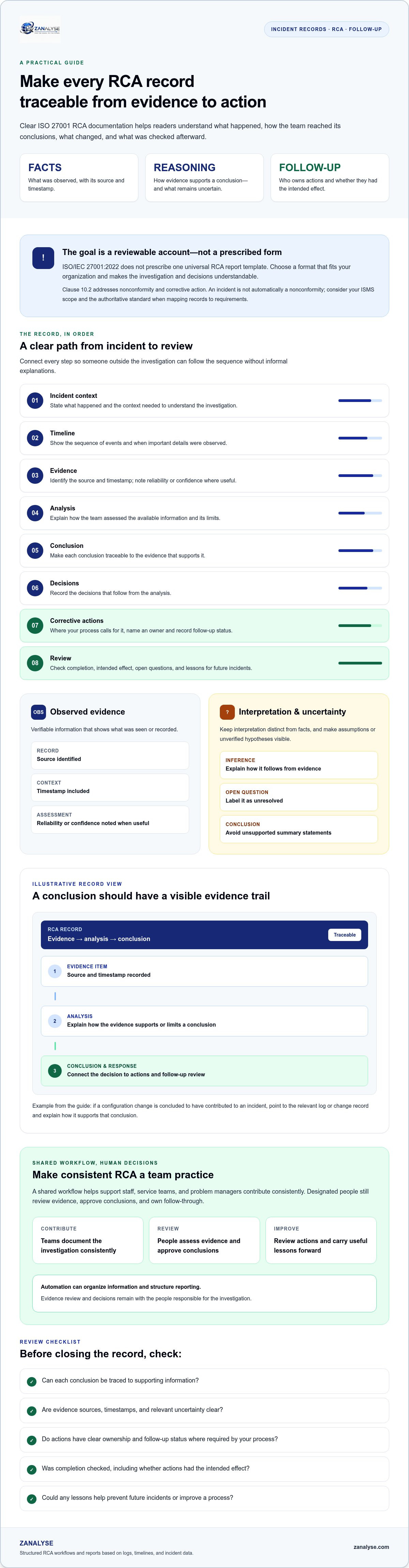
Structuring ISO 27001 RCA: From Evidence to Action
Arrange the record so readers can move from incident facts to a reasoned response: incident context, timeline, evidence, analysis, conclusion, decisions, actions, and review. Keep each step connected. For example, if the conclusion is that a configuration change contributed to the incident, point to the relevant log or change record and explain how it supports that conclusion. Avoid using a summary statement as a substitute for the evidence behind it.
What belongs in an evidence-based RCA record?
Separate what was observed from what the team inferred. For each useful evidence item, identify its source and timestamp. Note confidence or reliability where it helps explain how much weight to give the item, and label open questions as unresolved. This makes iso 27001 rca documentation easier to assess and update as new information emerges. For more on expressing confidence in incident analysis, read the guide to IT incident confidence scoring.
Every conclusion should be traceable to the evidence recorded, and any remaining uncertainty should be visible.
Next, document the decisions that follow from the analysis. Where your process calls for it, name an owner for each corrective action and record its follow-up status. A useful action addresses the identified cause; the review checks whether it was completed and whether it had the intended effect. The CISA Incident Response Playbooks provide a practical reference for organizing incident response activities. Adapt any workflow to your organization rather than treating it as an ISO-mandated form.
A shared workflow can help support staff and specialists contribute consistently, while designated people review evidence and own decisions. ZANALYSE provides structured RCA workflows and reports based on logs, timelines, and incident data. Learn more at ZANALYSE’s RCA platform.
Make ISO 27001 RCA documentation repeatable across IT teams
Consistency shouldn’t depend on one specialist remembering every step. A shared workflow gives support staff, service teams, and problem managers a common way to contribute to an investigation. Named owners should still review evidence, approve conclusions, and follow through on actions. This helps make iso 27001 rca documentation more consistent across teams without turning analysis into a box-ticking exercise.
Build a review into the process for completed records. Check whether each conclusion can be traced to supporting information, whether actions have clear ownership and follow-up status, and whether unresolved questions remain visible. Then consider whether any lessons apply to future incidents. If a recurring issue exposes a gap in a process, use that learning to improve the organization’s response, not just to close the individual record.
How automation can support consistent RCA records
Automation can help organize information and structure reporting, but it doesn’t replace human judgment. ZANALYSE turns logs, timelines, and incident data into structured reports that can include evidence, confidence scores, and corrective actions. Teams still need to check whether the evidence supports the analysis and whether proposed actions are appropriate. Used this way, structured reporting can help distribute RCA work while keeping decisions accountable.
If you’re evaluating options for structured RCA workflows, explore ZANALYSE. General availability is scheduled for October 2026, so confirm current availability before making access or purchase decisions.
Make every incident record support better decisions
Strong iso 27001 rca documentation connects incident evidence to analysis, decisions, corrective actions, and follow-up. Separate verified facts from assumptions, make conclusions traceable, and review whether actions were completed and useful. A shared workflow can make this process more consistent across IT teams without removing human review or clear ownership.
ZANALYSE is designed to decentralize problem management across IT staff. Its structured reports can include evidence, confidence scores, and corrective actions, supporting a clearer record while leaving evidence review and accountable decisions with your team. Organizations in Canada, Australia, and Europe can apply the workflow in line with their own ISMS scope and applicable requirements.
To explore whether a repeatable RCA workflow fits your team, visit ZANALYSE. Each well-documented investigation is an opportunity to strengthen organizational learning and make the next response clearer.
Frequently Asked Questions
Does ISO 27001 require a specific root cause analysis template?
No. ISO/IEC 27001:2022 doesn’t prescribe one universal root cause analysis template. Clause 10.2 addresses nonconformity and corrective action, including determining causes, but organizations can use a format suited to their processes. Keep the record clear and traceable, and check the authoritative standard and your ISMS scope rather than treating a suggested template as a formal requirement.
What should an ISO 27001 incident RCA report include?
An RCA report should provide enough information to follow the incident and understand the response. A practical record can cover context, a timeline, evidence and its sources, analysis, conclusions, decisions, corrective actions, and follow-up. Separate observed facts from assumptions, and identify unresolved questions. These are useful documentation practices, not a universal set of ISO-mandated fields.
How do you make an RCA report audit-ready?
Make the reasoning easy to trace. Link conclusions to recorded evidence, note sources and timestamps, distinguish facts from hypotheses, and document relevant decisions and action ownership. Review whether actions were completed and whether follow-up took place. Organizations operating in Canada, Australia, or Europe should also consider their own ISMS scope and applicable requirements when setting documentation practices.
Can RCA documentation be automated for ISO 27001?
Automation can help organize incident information and produce structured reports, but it shouldn’t replace evidence review or accountable decisions. ZANALYSE generates reports from logs, timelines, and incident data that can include evidence, confidence scores, and corrective actions. Its general availability is scheduled for October 2026, so confirm current availability before considering access or purchase.
Disclaimer
Some content on this website may be generated or assisted by artificial intelligence. While we strive to ensure that all information is accurate, relevant and up to date, AI-assisted content may contain errors or omissions. Content should therefore be considered informational and not as professional advice.


