


How can automation identify a likely incident cause without mistaking correlation for proof? When logs, timelines, and team knowledge sit in different places, even experienced staff can spend too long assembling the story. Automated root cause identification can narrow the search, but its conclusions are useful only when teams can inspect the evidence behind them.
Automation should guide an investigation, not replace judgment. This article explains how incident signals can point to likely causes, what evidence and confidence indicators to review, and when human expertise matters most. It also covers how structured, repeatable investigations can help more IT staff contribute, rather than leaving problem management to a few specialists.
Key Takeaways
- Use automated root cause identification to narrow plausible causes, then verify them against incident evidence.
- Check the timeline, trace findings to supporting records, test alternative explanations, and document uncertainty before accepting a conclusion.
- Use confidence scores to prioritize review, not as proof that a suggested cause is correct.
- Consistent reports help support staff, process managers, and specialists share investigations and carry corrective actions into follow-up.
What automated root cause identification does with incident evidence
Automated root cause identification uses incident evidence to rank or narrow plausible explanations. It can organize information from logs, timelines, and related incident records into findings that help teams decide what to investigate next. This supports Root-cause analysis, but a pattern is not proof. A suggested cause remains a candidate until people check whether the evidence supports it and whether another explanation fits better.
Keep correlation and causation separate. Two events happening around the same time may indicate a connection, but timing alone does not establish that one caused the other. A useful finding should identify the evidence behind the suggestion, show its confidence score, and list relevant corrective actions. Treat the score as an indicator for review, not a guarantee of correctness.
How signals become a testable cause
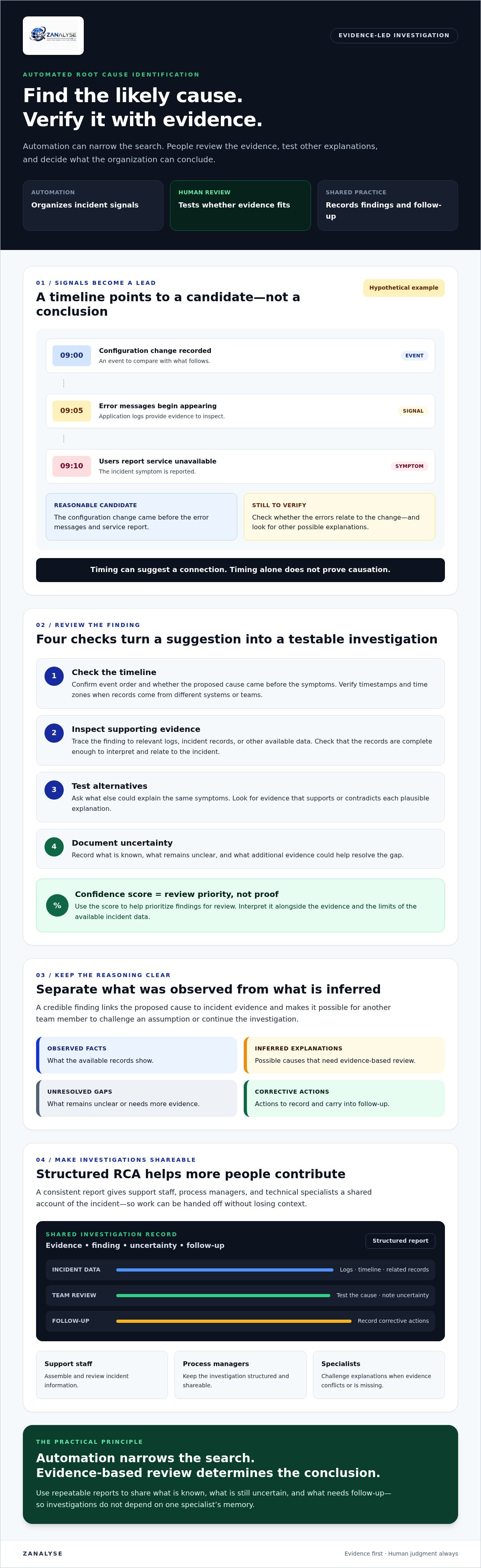
Timestamps and event sequences help establish what happened before, during, and after an incident. Related records can add context, such as whether a similar issue occurred before. For example, consider this hypothetical timeline:
- 09:00: A configuration change is recorded.
- 09:05: Error messages begin appearing in application logs.
- 09:10: Users report that a service is unavailable.
The sequence makes the configuration change a reasonable candidate to investigate. To test it, check whether the logged errors relate to that change and look for other changes or events that could explain the symptoms. The timeline points to a lead, but does not confirm causation.
Structured findings make this review easier to share. Reports that bring incident data together with evidence, confidence scores, and corrective actions give support staff and specialists a common starting point. Team members can test the proposed cause, note what remains uncertain, and carry relevant details into follow-up. Automation narrows the search; evidence-based review determines what the organization can conclude.
How to evaluate automated root cause identification findings
Treat each automated finding as a hypothesis to test, not a decision to accept. A consistent review helps teams distinguish a plausible explanation from a conclusion they can support with evidence.
- Check the timeline. Confirm the event order and whether the proposed cause came before the incident symptoms. Verify timestamps and time zones, especially when records come from different systems or teams.
- Inspect the supporting evidence. Trace the finding to relevant logs, incident records, or other available data. Check that the records are complete enough to interpret and directly relate to the incident.
- Test alternatives. Ask what else could explain the same symptoms. Look for evidence that supports or contradicts each plausible explanation.
- Document uncertainty. Record what is known, what remains unclear, and what additional evidence could help resolve the gap.
A confidence score can help prioritize which findings to review first, but it does not guarantee that a conclusion is correct. Interpret the score alongside the evidence and the limits of the available incident data.
What makes an automated finding credible?
A credible finding provides a traceable link between the proposed cause and the incident evidence. Keep four things distinct: observed facts, inferred explanations, unresolved gaps, and proposed corrective actions. This makes it easier for another team member to challenge an assumption or continue the investigation. Harvard Business School Online also describes root-cause analysis as a way to problem-solve effectively.
Bring in a qualified investigator when evidence conflicts, key records are missing, or the proposed cause could have significant consequences. They can assess the context, challenge the suggested explanation, and decide whether the evidence supports action. Structured reports can make that review easier to share across roles. For an example of guided reporting, see structured RCA reports.
How structured RCA helps teams distribute root cause identification
An investigation should not depend on one specialist remembering where to look or how to record a finding. A consistent report gives support staff, process managers, and technical specialists a shared account of the incident. Each person can contribute within their role and hand off the work without losing context.
A useful record connects incident evidence to a proposed cause, shows the confidence score, and lists corrective actions. Teams can use it to separate established facts from points that still need review, assign follow-up, and refer back to earlier investigations. Reusable records help turn individual findings into organizational knowledge instead of leaving them in scattered notes or personal memory.
From individual investigation to repeatable team practice
Guided RCA can help more staff take part by making investigation steps and report structure consistent. Support teams can assemble and review incident information, while specialists focus on complex or uncertain findings. Process managers can use the records to track corrective actions and identify where the investigation process needs attention. This distributes the work while keeping expert oversight in place.
ZANALYSE generates structured RCA reports from logs, timelines, and incident data. Its guided process presents evidence, confidence scores, and corrective actions, and its included RCAs support decentralized problem management. The ZANALYSE Standard License is the primary offering, with general availability scheduled for October 2026. ZANALYSE also offers a Full License, annual or multi-annual plans, and RCA capacity top-ups. As with any automated root cause identification process, teams should review the evidence and use their judgment before treating a suggested cause as confirmed.
To make the practice repeatable, agree on how teams will record evidence, uncertainty, decisions, and follow-up. For teams working across Canada, Australia, and Europe, consistently recording the time zone for each event can make it easier to compare timelines across systems and locations. A shared approach helps staff contribute consistently while keeping responsibility for validation clear.
Make incident investigation a repeatable team practice
Automated root cause identification is most useful when it narrows the possibilities without asking teams to treat a likely cause as proven. Check the timeline, trace findings to evidence, test alternatives, and involve a qualified investigator when information conflicts or is incomplete.
Consistent RCA reports can help support staff, process managers, and technical specialists share investigation work. Recording evidence, confidence scores, and corrective actions together creates a clearer basis for review and follow-up, rather than relying on knowledge held by a few individuals.
ZANALYSE generates structured RCA reports from logs, timelines, and incident data. Its Standard License is the primary offering, with general availability scheduled for October 2026. Explore ZANALYSE’s structured approach to root cause analysis to see how a guided process could support more consistent investigations across your organization. Keeping evidence visible and human review in place helps teams move from incident signals to informed action.
Frequently Asked Questions
What is automated root cause identification?
Automated root cause identification uses incident information, such as logs, timelines, and related incident records, to narrow possible explanations for a technical issue. It can organize evidence and surface candidate causes for investigation. A candidate is not a confirmed root cause. Review the supporting records, consider alternatives, and document uncertainty before treating a cause as established.
Can automated root cause identification replace human investigation?
No. Automation can organize incident data and suggest plausible causes, but a person should review whether the evidence supports the finding and whether alternatives remain. Check that any proposed corrective action addresses the underlying issue, not just a visible symptom. Human review is especially important when records conflict or are incomplete, or when the incident could have significant consequences.
What data is needed for automated root cause identification?
The data needed depends on the investigation and the chosen system. Logs, incident timelines, and related incident records can provide useful context. Check which inputs the tool accepts, whether timestamps and records are usable, and how findings link back to evidence. For teams handling incidents across Canada, Australia, or Europe, record the relevant time zone when comparing event sequences.
How can teams tell whether an automated root cause is reliable?
Assess reliability by tracing the proposed cause to supporting evidence and checking whether it fits the incident timeline. Interpret any confidence score alongside the underlying records, then test plausible alternatives. Document gaps and assumptions. A useful report separates observed facts from inferred explanations and makes clear what still needs validation, rather than presenting an unsupported conclusion as established fact.
Disclaimer
Some content on this website may be generated or assisted by artificial intelligence. While we strive to ensure that all information is accurate, relevant and up to date, AI-assisted content may contain errors or omissions. Content should therefore be considered informational and not as professional advice.


