

What if the incident evidence is already there, but no one can connect it into a clear, defensible cause? Logs, timelines, and reports often sit in different places, while analysis depends on a few experienced specialists. A browser based rca tool can help teams bring evidence into a structured investigation, explain how they reached a finding, and turn it into practical corrective action.
The right workflow supports IT support personnel, process managers, product teams, IT leaders, and service providers without making root cause analysis the preserve of a few specialists. It helps people assess what happened, show their reasoning, and agree on useful next steps. This article explains what capabilities to look for and how to build a repeatable path from incident evidence to action. It also shows how ZANALYSE guides users through established RCA techniques and produces structured reports with evidence, confidence scores, and corrective actions.
Key Takeaways
- Assess a browser based rca tool by how well it supports the full analysis process, not by its interface alone.
- Check whether the workflow helps teams bring incident evidence together and follow a clear analysis method.
- Look for findings that reviewers can understand, trace back to evidence, and use to agree on next steps.
- Use a consistent approach to make root cause analysis a shared practice across roles, not a task reserved for a few specialists.
What a browser-based RCA tool should do for IT incident analysis
A browser based RCA tool provides a browser-accessible workflow for carrying out structured root cause analysis. The browser is the interface, not the method. A clear screen can make a process easier to follow, but it cannot make a conclusion reliable on its own. Teams still need a disciplined way to examine what happened, test possible causes against evidence, and decide what action could help prevent recurrence. That is the purpose of Root Cause Analysis (RCA).
Useful analysis goes beyond recording an incident or restoring service. It connects incident data to a reasoned finding, shows what supports that finding, and identifies a corrective action. Without those links, a report can sound confident while leaving reviewers unable to see how the team reached its conclusion.
How structured analysis connects incident evidence to findings
Start by bringing relevant logs, timelines, and incident details into the investigation. For example, when examining a service interruption, compare the sequence of events with system records and the incident description. Separate what the evidence shows from what the team suspects. The aim is not simply to collect more data, but to identify which evidence supports a possible cause and which details remain uncertain.
Keep each finding traceable to its supporting evidence, and make confidence clear. This helps colleagues review the reasoning, challenge gaps, and distinguish a well-supported cause from a plausible theory. Avoid treating a single event that happened just before an incident as proof of its cause. For a closer look at how confidence and evidence strengthen RCA, see IT incident confidence scoring.
When the process is understandable, problem management can be shared across IT support, process managers, product teams, and service providers. Specialists still contribute their expertise, but findings do not have to depend on one person’s memory or be difficult for other roles to act on. For organizations with teams in Canada, Australia, and Europe, a consistent reporting approach also helps people in different locations review the same reasoning.
How to evaluate a browser-based RCA tool without relying on interface alone
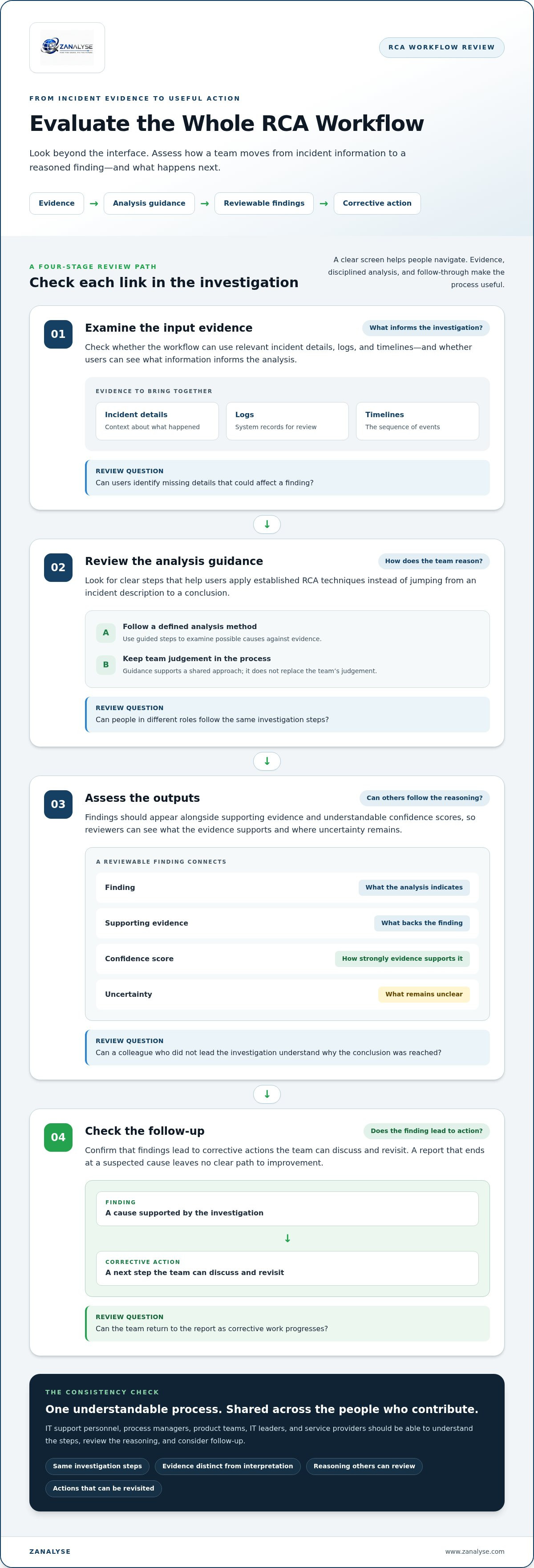
A clean interface can make a workflow easier to use, but it does not show whether the analysis will be consistent or useful. Evaluate the full process, from the evidence a team can examine to the actions it can discuss and revisit.
- Examine the input evidence. Check whether the workflow can use relevant incident details, logs, and timelines in the investigation. Consider whether users can see what information informs the analysis and identify missing details that could affect a finding.
- Review the analysis guidance. Look for clear steps that help users apply established RCA techniques rather than jump from an incident description to a conclusion. Guidance should support a shared process without replacing the team’s judgement.
- Assess the outputs. Review whether findings appear alongside supporting evidence and understandable confidence scores. A manager or colleague who did not lead the investigation should be able to follow the reasoning and see where uncertainty remains.
- Check the follow-up. Confirm that findings lead to corrective actions the team can discuss and revisit. A report that ends at the suspected cause leaves the organization without a clear path to improvement.
Questions that reveal whether an RCA workflow supports consistent decisions
Ask whether people in different roles can follow the same investigation steps and understand why a conclusion was reached. Does the process guide users through suitable methods? Does the report distinguish evidence from interpretation? A practical overview of root cause analysis methods can help teams understand the approaches a workflow may support.
Consider how the workflow serves everyone who contributes to problem management, including IT support staff, process managers, IT decision-makers, product managers, and operational service teams. Intuitive navigation and clear language can make it easier for more people to participate, reducing reliance on a small group of specialists. To see how this approach is reflected in an RCA platform, explore the ZANALYSE root cause analysis platform.
How ZANALYSE supports repeatable, evidence-led root cause analysis
ZANALYSE is an automated root cause analysis platform for IT organizations. It uses logs, timelines, and incident data to guide users through established RCA techniques and produce structured reports. The guided workflow provides a defined way to move from incident information to findings that people can review and corrective actions they can consider.
For teams assessing a browser based rca tool, the value lies in more than making an investigation easier to navigate. ZANALYSE reports bring together the finding, its supporting evidence, a confidence score, and corrective actions. This structure helps reviewers understand what the analysis indicates, how strongly the evidence supports it, and what follow-up may address the cause. Teams can also revisit the report as corrective work progresses.
From individual investigations to organization-wide problem management
Guided workflows are designed to help more IT staff contribute to RCA, rather than reserving every investigation for a small group of specialists. IT support personnel can bring operational context, while process managers, IT leaders, product managers, and service providers review findings and consider appropriate follow-up. Clear, consistent reporting makes it easier to bring those contributions together.
Over time, repeatable investigations can help an organization compare how it responds to problems, retain useful learning, and track corrective actions beyond the immediate incident. The platform supports this shared approach to problem management; people still need to assess the evidence and apply their knowledge.
The ZANALYSE Standard License gives teams a way to evaluate the platform’s guided RCA workflow and structured reports against their investigation and follow-up process. This can be useful for IT organizations and service providers working across Canada, Australia, and Europe, where clear records help teams share their analysis across locations.
Make the next incident easier to learn from
Choose a process your team can use consistently, then make it part of how you manage problems. A browser based rca tool can help turn investigation from a specialist-led task into a shared practice, giving people across IT and service teams a clearer way to contribute and act on what they learn.
As you evaluate your approach, consider whether your team can connect evidence to findings, explain uncertainty, and carry corrective actions forward. ZANALYSE combines guided RCA techniques with structured reporting to support that work.
Explore the ZANALYSE Standard License to assess how its guided RCA workflow can support more consistent incident learning.
Frequently Asked Questions
What is a browser-based RCA tool?
A browser-based RCA tool is software that lets users work through a root cause analysis process using a browser-accessible workflow. It can help organize an investigation, but the browser interface itself does not determine whether the analysis is sound. Teams in Canada, Australia, and Europe should focus on whether the workflow supports clear reasoning and useful records across their incident review practices.
Can a browser-based RCA tool help non-specialists investigate incidents?
Yes, a guided workflow can help non-specialists take part by making the investigation steps easier to understand and follow. For example, an IT support colleague can document what changed before an outage, while a process manager helps review the sequence of events. The tool supports the work, but team members still need to use their knowledge and judgement.
How does an RCA tool use logs and incident timelines?
An RCA tool can use logs and timelines as clues about what happened and when. For example, a team might compare a service error in a log with the reported start of an incident and a recent operational change. This can help investigators build a sequence of events, identify questions to resolve, and avoid treating timing alone as proof of cause.
Does a browser-based RCA tool guarantee the correct root cause?
No tool can guarantee that a proposed root cause is correct. Results depend on the quality and relevance of the information available, as well as how people interpret it. Treat a suggested cause as a finding to review: check whether the evidence supports it, consider other explanations, and revise the conclusion if new information changes the picture.
Disclaimer
Some content on this website may be generated or assisted by artificial intelligence. While we strive to ensure that all information is accurate, relevant and up to date, AI-assisted content may contain errors or omissions. Content should therefore be considered informational and not as professional advice.


