

The traditional IT war room is no longer a sign of operational urgency; it's a symptom of a failing process. You've likely spent hours in these high-pressure meetings, staring at siloed data while the clock ticks toward a DORA reporting deadline. It's frustrating when senior experts are stretched thin and junior staff feel sidelined. We all agree that relying on gut feelings instead of collaborative root cause analysis is a liability your organization cannot afford in 2026.
This article explores how a shift to decentralized, evidence-based problem management transforms operations. You'll discover how to empower your entire team while reducing incident lead times by over 50%. We will examine the transition from chaotic firefighting to generating audit-ready reports for ISO and DORA compliance. By moving toward a structured approach, you'll turn every incident into a permanent structural improvement.
Key Takeaways
- Move beyond the inefficiency of siloed war rooms toward a decentralized problem management model that reduces incident lead times by over 50%.
- Adopt a standardized framework for collaborative root cause analysis using shared digital environments to ensure consistency across technical and commercial teams.
- Integrate disparate logs and incident data into a single, evidence-based timeline to simplify complex investigations and empower staff at all levels.
- Align technical resolutions with regulatory expectations by producing the structured corrective action plans required for 2026 DORA and ISO compliance audits.
The Evolution of Collaborative Root Cause Analysis in IT Operations
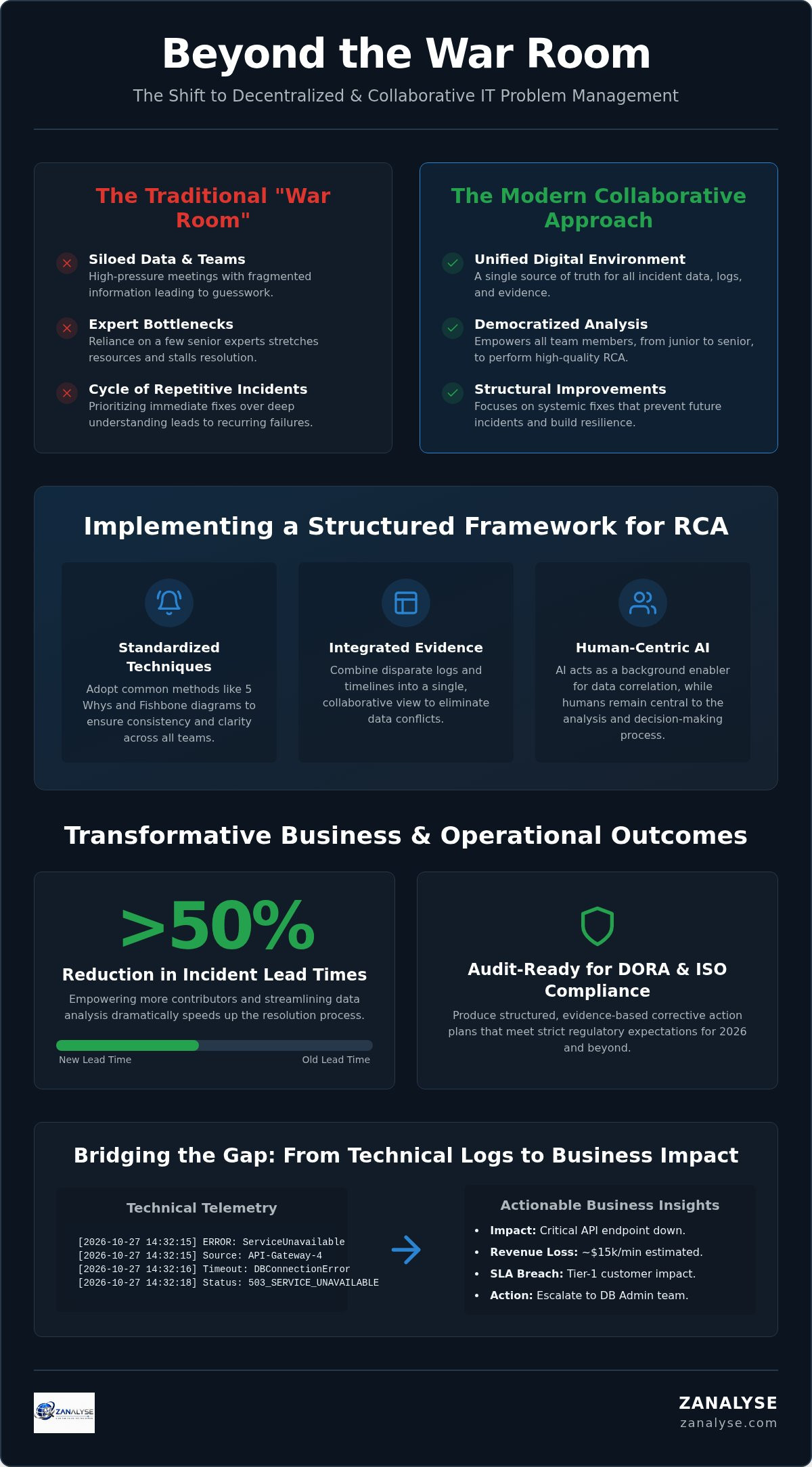
For decades, the "War Room" was the standard response to IT failure. These high-pressure environments often prioritized immediate restoration over deep understanding, leading to a cycle of repetitive incidents. In 2026, we see a definitive shift toward asynchronous, decentralized problem management. True collaborative root cause analysis is now defined as a cross-functional effort to identify systemic failures rather than human error. This transition moves teams away from subjective opinions and toward objective, structured evidence. Instead of debating theories, participants analyze verified timelines and logs to build a comprehensive incident picture that satisfies both technical requirements and regulatory audits. By adopting Root-cause analysis (RCA) as a continuous process, organizations replace chaotic firefighting with a stabilizing force that brings order to complex environments.
From Expert-Centric to Distributed Problem Management
Relying on a single "RCA Expert" creates an operational bottleneck that compromises long-term stability. When only one individual possesses the specialized knowledge to facilitate an investigation, incident resolution stalls and institutional knowledge remains trapped. Intuitive platforms now empower junior staff to perform high-quality analysis by providing structured frameworks and automated data correlation. This democratization of expertise ensures that collaborative root cause analysis isn't a specialized silo, but a shared responsibility. Decentralized RCA is the distribution of problem-solving capabilities across the entire IT organization. By empowering more contributors, organizations can reduce incident lead times by over 50% and ensure that every investigation is audit-ready for DORA or ISO standards.
Implementing a Structured Framework for Cross-Functional RCA
To achieve effective collaborative root cause analysis, teams must move beyond informal chats and adopt a common language. Using standardized techniques like the 5 Whys or Fishbone diagrams within a shared digital environment ensures that every stakeholder, from the site reliability engineer to the head of IT, understands the logic behind a finding. This structured approach is more than just a process; it's a vital organizational leadership skill that fosters clarity and accountability across the organization. It's about creating a repeatable system that doesn't rely on the intuition of a single expert.
Success depends on the integration of disparate data sources. Bringing timelines and log evidence into a single collaborative view eliminates the conflict between conflicting data interpretations. By applying objective confidence scores to evidence, teams can resolve disagreements based on metrics rather than seniority. This shift ensures that collaborative root cause analysis remains an objective exercise. It allows the group to transition quickly from investigating what happened to establishing the corrective actions that prevent recurrence. Organizations that master this transition often find they reduce incident lead times by over 50% while building a more resilient infrastructure.
Bridging the Gap Between Technical Logs and Business Context
Merging technical log data with the operational experience of process managers is often where investigations stall. Technical staff see error codes; commercial managers see lost revenue and missed SLAs. Bridging this gap requires reports that translate technical telemetry into business impact. The ZANALYSE Standard License facilitates this by guiding users through structured reporting templates that speak to both technical and commercial stakeholders. This ensures that the final analysis is not just accurate, but also actionable for decision makers. If you want to streamline this transition, consider adopting an automated RCA platform that handles the heavy lifting of data correlation.
Aligning Team Collaboration with DORA and ISO Compliance
Compliance in 2026 requires more than a simple incident log. Regulators now demand real-time evidence of resilience. A robust collaborative root cause analysis serves as the primary evidence source for ISO 27001 and DORA audits. It demonstrates that your organization doesn't just patch holes; it identifies systemic weaknesses through cross-functional validation. National Competent Authorities look for structured corrective action plans that are tracked and verified by multiple stakeholders. Automated platforms act as a guardian of process integrity, ensuring every finding is backed by objective data rather than guesswork.
By leveraging these tools, organizations can reduce incident lead times by over 50% through collaborative efficiency. This speed is critical when meeting DORA’s one-month deadline for final incident reports. It ensures your team remains productive while staying within strict legal boundaries.
Future-Proofing IT Quality with Automated Governance
Automated reporting ensures every incident has a documented root cause, leaving no room for process gaps. Having a vast pool of included RCAs speeds up the discovery process because teams don't have to start from scratch for every recurring issue. Structured evidence collection prevents "blame-storming" by focusing discussions on technical telemetry and operational quality. This objective approach protects your team's culture while satisfying the most rigorous audit requirements. It's the difference between a reactive culture and one that prioritizes long-term stability and consistent service delivery.
Building a Resilient Future Through Decentralized Analysis
The era of the isolated war room has ended. By transitioning to a decentralized model, your organization transforms problem management from a bottleneck into a scalable asset. You've seen how a structured framework and integrated evidence allow teams to meet the rigorous reporting timelines of DORA and ISO standards without sacrificing operational speed. Adopting collaborative root cause analysis ensures that every incident becomes a source of institutional knowledge rather than a repetitive failure. It's time to replace subjective guesswork with objective, audit-ready evidence that empowers every member of your IT staff.
Empower your team with the ZANALYSE Standard License today. Our platform is built for ISO 27001 and DORA compliance, helping you decentralize problem management across your IT organization and reduce incident lead times by over 50%. Start building a more stable, transparent, and resilient technical environment today.
Frequently Asked Questions
What is the primary benefit of collaborative root cause analysis?
The primary benefit is the decentralization of problem-solving capabilities, which eliminates the bottlenecks created by relying on a single expert. By moving away from siloed war rooms, teams in Europe and Australia can build a unified incident picture using verified data. This collaborative root cause analysis ensures that problem management becomes a scalable strength that empowers every staff member.
How does collaborative RCA help with DORA compliance?
DORA requires a final report within one month of a major incident, including a full collaborative root cause analysis. This team-based approach provides the structured evidence and human-verifiable corrective action plans that regulators in Canada and the EU demand. It moves your compliance strategy toward demonstrable proof of operational resilience, ensuring you're ready for active enforcement reviews.
Can junior IT staff perform root cause analysis effectively?
Junior engineers in Canada and Australia can effectively contribute to investigations when guided by platforms that structure the RCA process. By using automated tools to correlate logs and timelines, these staff members perform high-quality analysis without needing constant senior intervention. This decentralization ensures that your problem management capabilities are distributed across the entire organization, maintaining stability during high-pressure incidents.
How do confidence scores improve collaborative decision-making in RCA?
Confidence scores provide an objective metric to resolve team disagreements during an investigation. Instead of relying on seniority or gut feelings, your team uses these scores to validate findings based on technical telemetry. This evidence-based approach ensures the final analysis is accurate and audit-ready. It's a pragmatic way to maintain process integrity in complex, high-stakes technical environments across Europe and North America.
Disclaimer
Some content on this website may be generated or assisted by artificial intelligence. While we strive to ensure that all information is accurate, relevant and up to date, AI-assisted content may contain errors or omissions. Content should therefore be considered informational and not as professional advice.


