

Human error and misconfigurations will cause 95% of cloud security failures in 2026, yet many organizations still treat investigation as a manual chore. You likely feel the weight of repetitive post-mortem documentation and the growing pressure from DORA auditors for structured, immutable evidence. It's exhausting to manage inconsistent quality across different teams while incident lead times remain stagnant. This root cause analysis platform checklist provides a pragmatic framework to evaluate tools that automate evidence collection and ensure regulatory compliance. By selecting the right platform, you can reduce incident lead times by 50% and turn chaotic logs into structured organizational knowledge. We will examine the essential technical and governance features required to move from reactive firefighting to a mature, decentralized problem management strategy that satisfies both your engineers and your auditors.
Key Takeaways
- Move beyond manual post-mortems by implementing automated data ingestion that captures evidence in real-time, preventing critical knowledge from being lost.
- Evaluate your options using a comprehensive root cause analysis platform checklist that prioritizes structured techniques and automated log analysis.
- Ensure your operations remain audit-ready by selecting a platform that generates compliant reports for DORA and ISO 27001 standards.
- Decentralize your problem management process to empower technical teams, helping your organization achieve a 50% reduction in incident lead times.
Why Manual Root Cause Analysis Fails in Modern IT Ops
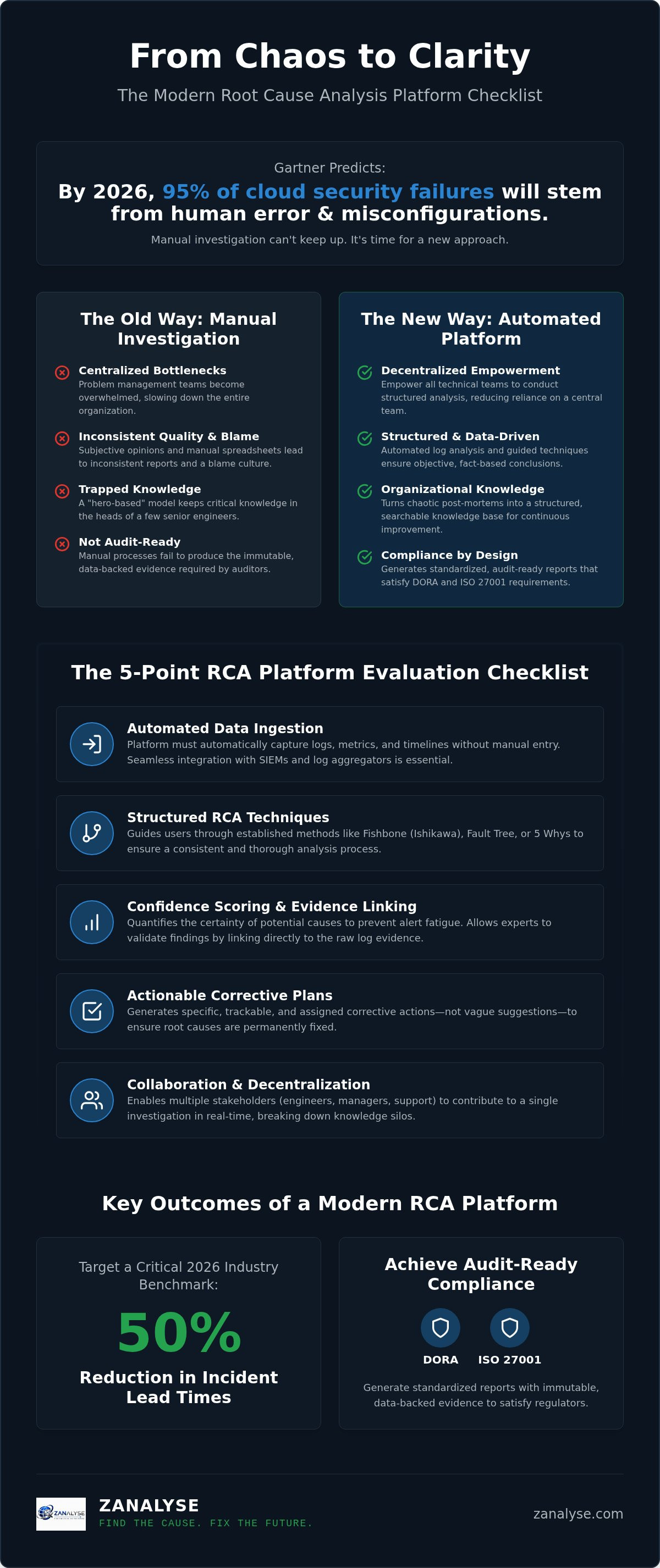
Traditional Root-cause analysis often relies on manual sessions that can't scale. In an environment of microservices and high-frequency deployments, the sheer volume of data creates a Chaos Gap. Relying on senior engineers to hold all the answers is a significant hidden cost. This hero-based model ensures knowledge stays trapped in individual heads, making it impossible to standardize quality across the organization. It's a reactive cycle that creates more noise than clarity.
The Limitations of Traditional ITIL Problem Management
Centralized problem management teams often become the ultimate operational bottleneck. They frequently focus on surface-level fixes to close tickets quickly, rather than implementing the structural improvements required for long-term stability. Manual spreadsheets and subjective opinions don't satisfy DORA or ISO 27001 auditors, who now demand immutable, data-backed evidence. Without a structured root cause analysis platform checklist, teams often default to a blame culture that obscures systemic failures instead of resolving them. This lack of structure leads to inconsistent reports and recurring incidents.
The Shift Toward Automated RCA Platforms
Modern operations require a transition from subjective guesswork to objective analysis. Automated RCA platforms act as the essential bridge between raw logs and structured reports. By adopting these tools, organizations can target a 50% reduction in incident lead times, a critical 2026 industry benchmark. Decentralization is the ultimate goal. Every sysadmin should have the power to identify root causes using confidence scores and log-based evidence. This shift moves the process from a repetitive manual chore to a reliable tool for organizational excellence, ensuring that your root cause analysis platform checklist leads to permanent improvements rather than temporary patches.
The 5-Point Root Cause Analysis Platform Checklist
Selecting an automated solution requires moving beyond generic process theory. While Harvard Business School on Root Cause Analysis emphasizes the strategic value of identifying deep-seated issues, your technical tools must handle the heavy lifting. Use this root cause analysis platform checklist to evaluate potential vendors against modern operational demands.
- Automated Data Ingestion: The platform must ingest logs and timelines without manual entry.
- Structured RCA Techniques: It should guide users through established methods like Fishbone or Fault Tree Analysis.
- Confidence Scoring: Systems must quantify the certainty of findings to prevent alert fatigue.
- Actionable Corrective Plans: Vague suggestions are useless; look for specific, trackable actions.
- Collaboration & Decentralization: Multiple stakeholders must be able to contribute to one investigation in real-time.
Evaluating Data Ingestion Capabilities
Your platform shouldn't be another data silo. It must integrate seamlessly with your existing IT stack, including SIEMs and log aggregators. The ability to correlate disparate data points into a single, unified incident timeline is non-negotiable. Log-based evidence serves as the foundation of any defensible RCA, ensuring that findings are rooted in fact rather than speculation. Tools like ZANALYSE automate this process to ensure consistency across the board.
Confidence Scores and Evidence Validation
Automated analysis can produce noise if it lacks a scoring mechanism. Confidence scores are critical for prioritizing investigations and avoiding false positives. A robust platform allows for "Evidence Linking," where experts can click any finding to inspect the underlying raw data. This supports a human-in-the-loop approach, where senior engineers validate platform-generated theories rather than spending hours digging through logs. Ensuring these features are present in your root cause analysis platform checklist guarantees that automation enhances expertise instead of replacing it.
Compliance Checklist: DORA and ISO 27001 Requirements
Regulatory oversight in 2026 is uncompromising. Financial entities and service providers must move beyond manual logs to meet the Digital Operational Resilience Act (DORA) requirements. A comprehensive root cause analysis platform checklist must prioritize audit-ready reporting. This means the platform generates standardized exports that prove a clear chain of custody for evidence. You can't just claim data wasn't tampered with; you need a system that ensures log integrity and historical retention for longitudinal reviews.
Meeting DORA Incident Management Standards
DORA mandates specific root cause identification for major ICT-related incidents. Your platform must support these core requirements to satisfy auditors during the 2026 enforcement period:
- Automated generation of corrective action plans to prevent recurrence.
- Tracking Lead Time to Resolution as a key performance indicator.
Using a structured approach to Root Cause Analysis ensures these metrics are captured accurately without the bias of manual entry, providing a transparent view of operational resilience.
ISO 27001 and Evidence-Based RCA
ISO 27001:2022 Clause 10.1 requires organizations to document lessons learned and integrate them into their Information Security Management System. Structured RCA reports serve as primary evidence during audits. It's essential to verify the platform's ability to track RCA Capacity, ensuring that all major incidents are analyzed rather than ignored due to resource constraints. This standardized taxonomy ensures every investigation follows a consistent logic, providing the process integrity that modern governance requires.
Implementation and Scaling: From Silos to Decentralization
Scaling a root cause analysis strategy requires moving beyond specialized silos where knowledge is trapped. A robust root cause analysis platform checklist should prioritize ease of integration and user accessibility. By plugging your platform into existing workflows like Slack, PagerDuty, or ServiceNow, you ensure that investigation becomes an immediate, natural response to any incident.
Decentralizing Problem Management
The goal of modern IT ops is to empower every team member to contribute to stability. Choosing between a ZANALYSE Standard License and a ZANALYSE Full License depends on your incident volume and the depth of decentralization you require. A Full License enables non-specialists to perform expert-level analysis by following structured data-driven paths. This builds a central knowledge base that prevents teams from reinventing the wheel when common bugs resurface. For peak seasons or major system migrations, RCA Capacity Top-ups allow you to maintain coverage without overcommitting to long-term costs.
Standardizing the RCA Workflow
Standardization removes the subjectivity that plagues manual post-mortems. You must define a mandatory checklist for when an automated RCA is triggered, ensuring that no major failure goes unexamined. This approach helps move the team from viewing RCA as a chore to seeing it as a tool for operational excellence. If you're hesitant to roll this out globally, use an Early-bird Pricing Plan to pilot the process in a single department first. You can then measure ROI through a 50% reduction in lead times and a significant drop in repeat incidents. To see how these licenses fit your team structure, explore ZANALYSE price plans.
Future-Proofing Your IT Ops with ZANALYSE
ZANALYSE transforms the theoretical requirements of a root cause analysis platform checklist into a functional reality. It guides technical teams through post-mortems using log-based evidence, ensuring every finding is defensible. Built-in confidence scores eliminate the guesswork that often stalls manual investigations. By automating these processes, you move from subjective opinions to a stable, evidence-based operation that respects your team's time and expertise.
Why ZANALYSE is the 2026 Market Leader
Early adopters of the platform report a 50% reduction in incident lead times. This efficiency is a critical competitive advantage as we approach the October 2026 general availability. Organizations can secure their strategy now by taking advantage of an Early-bird Pricing Plan. Shifting toward operational quality isn't just about compliance; it's about building a resilient infrastructure that supports long-term growth and minimizes the chaos of technical failures.
Getting Started: Your RCA Automation Roadmap
Implementing a new standard doesn't have to be overwhelming. Start by auditing your current manual RCA process to identify specific bottlenecks where critical knowledge is lost. Next, map your specific compliance requirements, such as DORA or ISO 27001, to ensure your reporting meets the rigorous expectations of 2026 auditors. Finally, contact ZANALYSE for a platform walkthrough to see how a ZANALYSE Standard License or ZANALYSE Full License can decentralize your problem management. This roadmap ensures your root cause analysis platform checklist leads to a measurable, permanent improvement in system stability and team confidence.
Mastering Operational Resilience in 2026
The transition from subjective, manual post-mortems to automated, data-driven investigations is no longer optional. This root cause analysis platform checklist serves as your roadmap for navigating the complexities of modern IT infrastructure and strict regulatory demands. By implementing a system that features an automated log-to-report engine, you can ensure your organization remains DORA and ISO 27001 compliant while significantly improving process integrity. Adopting these tools allows you to reduce incident lead times by over 50%, transforming repetitive chores into a strategic advantage. It's time to empower your teams with a decentralized approach to problem management that yields consistent, audit-ready results. Secure your Early-bird Pricing Plan for ZANALYSE today to stabilize your operations and lead with confidence. You've already got the expertise; let the right platform provide the evidence.
Frequently Asked Questions
What is a root cause analysis platform checklist?
A root cause analysis platform checklist is a pragmatic framework for evaluating software that automates incident investigations. It outlines essential features like automated data ingestion and structured reporting. By using this checklist, IT directors can ensure their chosen tool moves the organization from subjective guesswork to a stable, evidence-based process that meets modern governance standards.
How does an RCA platform help with DORA compliance?
Platforms help with DORA by automating the mandatory identification of root causes for major ICT-related incidents. They ensure log integrity and generate standardized reports that satisfy regulatory auditors. This automation is critical for meeting the 2026 enforcement deadlines, as it provides an immutable chain of evidence that manual spreadsheets simply cannot match.
Can an RCA platform replace my problem management team?
An RCA platform doesn't replace your team; it changes how they work. It decentralizes problem management so that individual engineers can conduct thorough investigations using automated tools. This approach removes the bottleneck of a centralized team, allowing your specialists to focus on permanent structural improvements rather than getting buried in repetitive post-mortem documentation.
What is the difference between a Standard and Full ZANALYSE license?
The ZANALYSE Standard License provides the core automated analysis features for teams with predictable incident volumes. The ZANALYSE Full License is built for organizations that want to fully decentralize their process, offering higher capacity and more collaborative seats. Both tiers are designed for intuitive navigation and help you move toward a more mature, structured investigation approach.
What are confidence scores in automated root cause analysis?
Confidence scores are numerical values that represent the platform's certainty regarding a specific finding. By correlating logs and timelines, the system identifies the most likely cause of a failure. This helps technical teams prioritize their efforts, ensuring they spend their time fixing high-confidence issues rather than chasing false positives or system noise.
How do I calculate the ROI of an RCA platform?
ROI is best measured by tracking the reduction in repeat incidents and the time saved during investigations. Most users achieve a 50% reduction in incident lead times. When you multiply those hours by the cost of senior engineering time, the financial value becomes clear. Reducing downtime also protects your organization's reputation and commercial stability.
Does ZANALYSE offer on-premise installation?
ZANALYSE is a SaaS platform and does not offer on-premise installation. This delivery model ensures that you can scale your RCA capacity without the complexity of managing local servers or hardware log collectors. It's built for speed and accessibility, allowing you to start automating your investigations as soon as you choose a license.
What data sources are required for an automated RCA platform to work?
To work effectively, the platform needs access to your system logs, incident timelines, and existing data from observability tools. It correlates these disparate data points into a single, unified timeline. This log-based evidence is the foundation of any defensible investigation, ensuring that your final reports are accurate and ready for regulatory review.
Disclaimer
Some content on this website may be generated or assisted by artificial intelligence. While we strive to ensure that all information is accurate, relevant and up to date, AI-assisted content may contain errors or omissions. Content should therefore be considered informational and not as professional advice.


