

If your incident response notes look more like a chaotic chat log than a professional document, you aren't just losing time; you're inviting regulatory scrutiny. Most IT leaders know the frustration of chasing down engineers for clear details while an ISO 27001 audit looms. It's a manual, error-prone process that frequently results in "human error" being cited as a root cause without providing a real path toward prevention. You don't have to settle for this level of operational risk.
This guide demonstrates how to implement standardized rca reporting to transform inconsistent notes into audit-ready frameworks that satisfy DORA and ISO requirements. You'll learn how to decentralize problem management across your entire organization, allowing your teams to generate high-quality reports in half the time. We'll explore the transition from ad-hoc fixes to a structured framework that ensures every incident leads to permanent structural improvement.
Key Takeaways
- Stop treating post-mortems as a bureaucratic chore; learn how a structured methodology turns technical failures into audit-ready evidence for DORA and ISO requirements.
- Move beyond the "single root cause" myth by adopting a multi-layered causal factor approach that identifies the true systemic vulnerabilities in your IT operations.
- Discover how standardized rca reporting eliminates manual data entry errors and ensures consistent quality across every team in your organization.
- Decentralize your problem management capabilities to allow junior staff to generate senior-level insights, effectively reducing incident lead times by over 50%.
The Business Case for Standardized RCA Reporting in IT Ops
Inconsistent incident notes aren't just an operational nuisance; they're a liability. Standardized rca reporting is a structured methodology for documenting IT failures to ensure every report is consistent, repeatable, and audit-ready. While a basic Root-cause analysis might identify a technical glitch, a standardized framework ensures the findings are actually useful for long-term governance. Many teams struggle with ad-hoc post-mortems that lead to compliance debt. This occurs when shallow documentation fails to prevent recurring outages, forcing teams into a cycle of reactive fire-fighting. Standardization effectively bridges the gap between raw technical logs and the executive-level risk management required for modern enterprise stability.
Meeting DORA and ISO 27001 Compliance Requirements
The regulatory environment has shifted from optional best practices to mandatory legal requirements. Under the Digital Operational Resilience Act (DORA), financial entities must follow strict incident reporting timelines and provide a specific depth of structural analysis. Failure to produce a high-maturity report can lead to significant penalties. Similarly, maintaining ISO 27001 certification depends on your ability to present standardized evidence during external audits. A key component of a mature framework is the confidence score, which quantifies the certainty of your findings. Including these scores satisfies regulatory scrutiny by demonstrating that your team isn't just guessing. Instead, it shows you're using a data-driven process to identify systemic vulnerabilities and prevent future service disruptions across the entire IT organization.
Core Components of a High-Maturity RCA Report
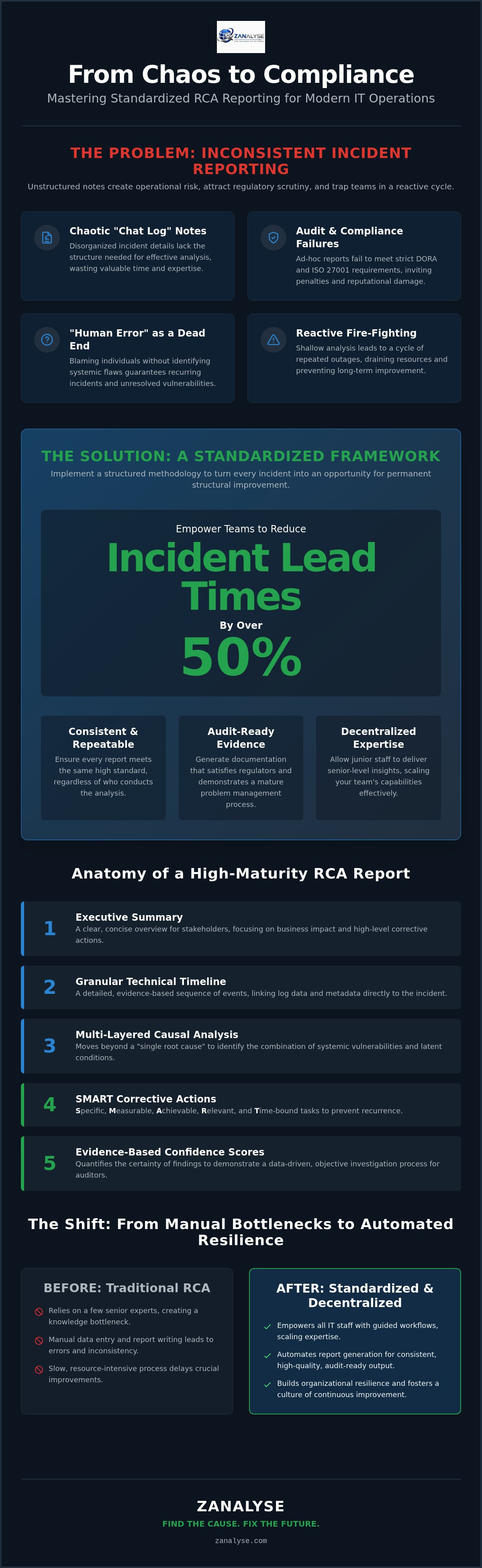
Maturity in IT operations requires moving beyond a simple "what happened" narrative. A high-maturity report includes an executive summary for stakeholders, a granular technical timeline, a multi-layered causal factor analysis, and validated corrective actions. Many teams fall into the trap of the "single root cause" myth. Real-world failures are rarely the result of one isolated mistake. Instead, they stem from a combination of systemic vulnerabilities and latent conditions. As noted in Root Cause Analysis: What It Is & How to Perform One, mastering this process is a critical leadership skill that drives organizational change and operational stability.
To ensure reports are truly audit-ready, you must integrate log data and incident metadata directly into the documentation. This creates a chain of evidence that replaces subjective opinions with verifiable facts. High-maturity standardized rca reporting also utilizes evidence-based confidence scores to communicate the certainty of each identified factor. By attaching raw logs to specific causal events, you provide the structural depth that regulators and auditors demand. This objective approach ensures that the findings remain consistent, regardless of which engineer is conducting the analysis.
The Anatomy of a Standardized Corrective Action Plan
A remediation plan is only effective if it's SMART: Specific, Measurable, Achievable, Relevant, and Time-bound. Rather than vague "improve monitoring" tasks, a standardized plan links specific evidence directly to remediation steps. If a log shows a memory leak, the action item should target that specific code block or resource limit. Using a standardized RCA platform allows organizations to track these actions across silos automatically. This ensures that corrective measures don't just sit in a forgotten PDF but are actually implemented to prevent recurrence, effectively closing the loop on problem management.
Implementing Standardization: From Manual Post-Mortems to Automation
Scaling a technical organization requires removing the "expert bottleneck." Traditional RCA often relies on a handful of senior SREs, which creates a dangerous knowledge silo. By implementing standardized rca reporting, you can empower junior IT staff to identify root causes with the same precision as your most experienced engineers. This shift isn't just about efficiency; it's about organizational resilience and ensuring consistency across diverse departments. For service providers, this decentralization allows you to deliver high-quality problem management to multiple clients without overstretching your senior talent. The ZANALYSE Standard License serves as an entry point for this transition, automating report generation and ensuring consistency across every team.
Steps to Decentralize Your Problem Management Workflow
Identify the repetitive investigation tasks that currently drain your senior resources. Log-based analysis and standardized logic can automate much of the heavy lifting, allowing your experts to focus on complex architectural improvements rather than routine data sorting. Shifting from reactive firefighting to a proactive, evidence-based problem management culture allows organizations to treat every outage as a permanent learning opportunity. Rolling out standardized rca reporting across global IT teams in Canada, Europe, and Australia requires a clear, repeatable framework:
- Unify the Template: Establish a single reporting structure that satisfies both technical depth and regional compliance mandates like DORA.
- Distribute the Capability: Deploy logic-driven tools that guide junior staff through the causal factor analysis process without constant supervision.
- Automate the Evidence: Pull incident metadata directly into reports to eliminate manual data entry and ensure audit-ready accuracy.
Achieving Long-Term Operational Stability
Transitioning from ad-hoc incident notes to a mature framework isn't just about passing the next audit; it's about building a resilient IT culture. By adopting standardized rca reporting, you move beyond the myth of the single root cause and begin identifying the systemic vulnerabilities that actually threaten your uptime. This shift allows your organization to decentralize expert knowledge, empowering junior and senior teams alike to resolve problems with consistent precision. You don't have to choose between speed and compliance.
Start standardizing your IT reports with a ZANALYSE Standard License to reduce incident lead times by over 50% through automated evidence collection. Our platform is built specifically for DORA and ISO 27001 regulatory requirements, ensuring your documentation remains audit-ready at all times. Take control of your operational data today and turn every technical failure into a strategic asset for growth.
Frequently Asked Questions
What is the difference between an incident report and a standardized RCA report?
An incident report focuses on immediate service restoration and the "what" of an event. In contrast, standardized rca reporting provides a structured analysis of the "why" to prevent recurrence. It's a shift from simple timelines to causal factor analysis, evidence-based confidence scores, and corrective actions. This ensures that IT teams in Europe and Canada maintain a consistent record for long-term operational quality.
How does standardized RCA reporting help with DORA compliance?
DORA mandates specific timelines and structural depth for incident documentation within the financial sector. Standardized reports satisfy these requirements by providing a repeatable framework for evidence collection and causal analysis. By using a platform like ZANALYSE, organizations across Australia and Europe ensure their reports are audit-ready, meeting the strict transparency and risk management standards required by modern regulatory bodies.
Can junior IT staff effectively perform root cause analysis using a standardized format?
Yes, a standardized format decentralizes problem management by providing a logical roadmap for investigation. Junior staff can identify root causes with senior-level accuracy when guided by automated templates and included RCA pools. This approach reduces the "expert bottleneck" and allows teams to decrease incident lead times by over 50%. It empowers every technician to contribute to the organization's overall stability and compliance posture.
What are the most common mistakes in IT RCA reporting?
Common mistakes include identifying a "single root cause" rather than multi-layered causal factors and citing "human error" without investigating systemic weaknesses. Many reports also lack verifiable evidence or fail to track corrective actions across silos. Moving toward standardized rca reporting solves these issues by integrating raw log data directly into a structured methodology for every technical failure.
Disclaimer
Some content on this website may be generated or assisted by artificial intelligence. While we strive to ensure that all information is accurate, relevant and up to date, AI-assisted content may contain errors or omissions. Content should therefore be considered informational and not as professional advice.


