

A critical system fails at 3:00 AM, and your most senior engineer spends the next six hours manually sifting through millions of lines of raw telemetry. It's a familiar, exhausting cycle that stalls innovation and leaves your team vulnerable to inconsistent reporting. You understand the immense pressure to meet DORA and ISO 27001 standards while managing a growing mountain of incident data. Manual log-diving simply takes too long in an era of strict 72-hour reporting windows. This article demonstrates how automated log analysis for rca transforms chaotic data into structured, decentralized insights. You'll discover how to reduce incident lead times by 50% and generate audit-ready reports automatically. We'll outline a path to move beyond temporary fixes toward permanent structural improvements that empower even your junior staff to manage complex problems with confidence.
Key Takeaways
- Eliminate operational silos by transitioning from manual log-diving to a structured system that removes the dependency on a few senior experts.
- Understand the mechanics of automated log analysis for rca and how evidence scoring provides objective confidence levels for every incident.
- Decentralize problem management by allowing junior staff to produce high-quality, evidence-based reports using guided automated logic.
- Streamline your path to compliance with DORA and ISO 27001 standards while cutting incident lead times by exactly 50%.
The Challenge of Manual Log Analysis in Modern Incident Management
Raw log files are growing in complexity at a rate that far outpaces human processing capabilities. In modern IT stacks, a single transaction might traverse dozens of microservices, each generating disparate telemetry. Traditional Log analysis performed by hand is no longer just tedious; it's unsustainable. When teams rely on manual log-diving during a crisis, they often hit the "Senior Expert Bottleneck." This operational silo occurs because only a few individuals possess the tribal knowledge to interpret cryptic raw data. This dependency creates a single point of failure that delays resolution and prevents junior staff from contributing effectively.
Manual analysis frequently results in subjective conclusions. Under intense time pressure, engineers may stop at the first plausible cause rather than digging for the actual root. This lack of structured, evidence-based reporting leads to a high frequency of repetitive incidents. Misidentifying a root cause doesn't just waste time; it incurs hidden costs by allowing systemic vulnerabilities to persist. These errors ultimately threaten your compliance with standards like DORA or ISO 27001, where precise evidence is mandatory.
Why Traditional Log Diving Fails in High-Pressure Environments
The cognitive load of correlating multiple log streams while systems are down is immense. Engineers often fall victim to confirmation bias, searching for data that supports their initial hunch rather than objectively evaluating all evidence. To break this cycle, organizations must adopt automated RCA for sysadmins. Implementing automated log analysis for rca ensures that troubleshooting is guided by logic rather than intuition. This transition from manual searching to automated evidence scoring is the only way to meet modern uptime expectations and maintain process integrity across the organization.
How Log-Based Root Cause Analysis Transforms Troubleshooting
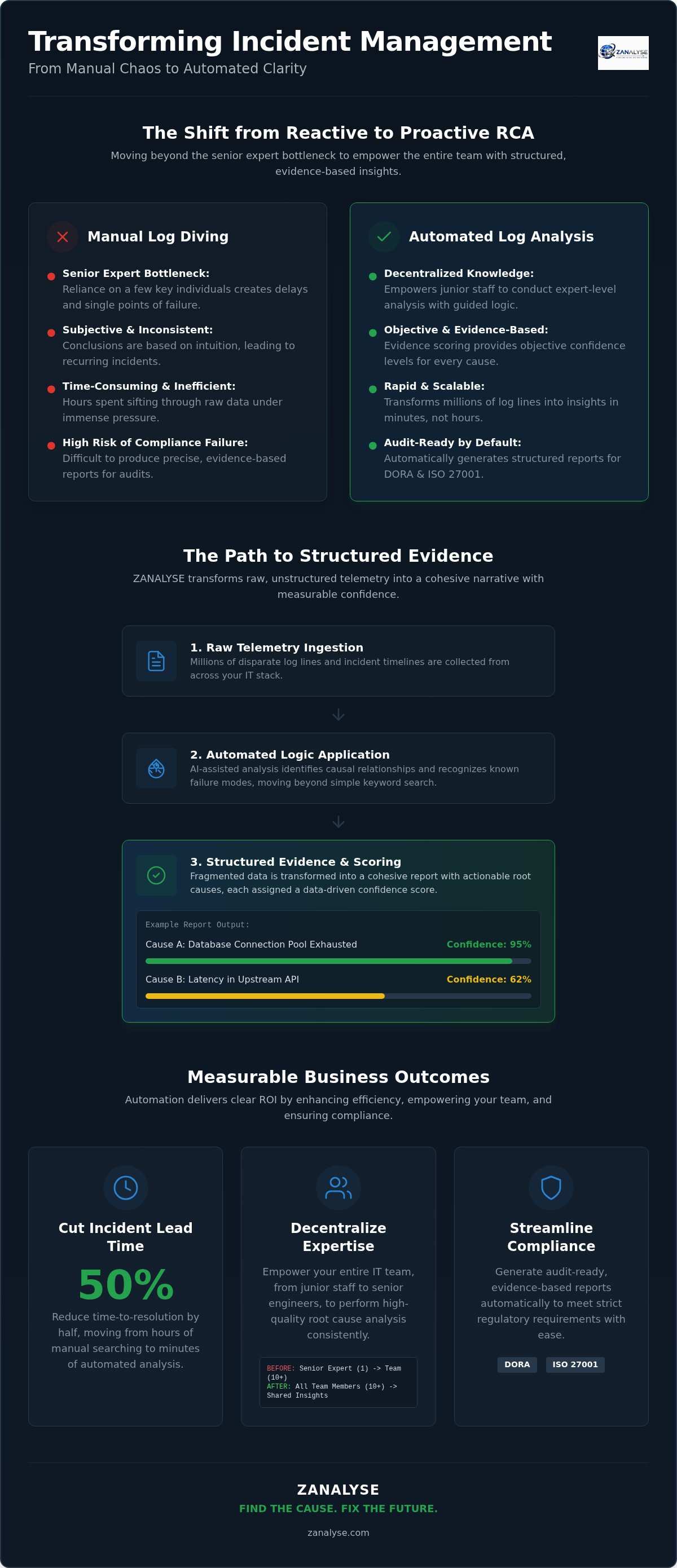
Log-based root cause analysis is the bridge between raw telemetry and structured problem management. By applying automated log analysis for rca, organizations move beyond the limitations of simple search queries. This process involves using automated logic to extract structured evidence from system logs and timelines, transforming fragmented data into a cohesive narrative. ZANALYSE facilitates this shift by moving from basic pattern recognition to sophisticated "Evidence Scoring." Every identified cause receives a confidence level based on objective data points. This ensures that decisions are based on measurable evidence rather than the intuition of an individual engineer.
Incident timelines play a vital role here. They provide the necessary context to raw log data, offering a 360-degree view of the failure sequence. This structural approach allows teams to visualize exactly when and where a system deviated from its expected state. If you are looking to mature your operations, exploring a ZANALYSE Full License can provide the deep insights needed for complex environments.
Moving from Pattern Recognition to Structural Evidence
Simple keyword searching often fails because it ignores causal relationships. In contrast, structured analysis identifies how one event triggers another. Automated systems leverage a vast pool of known RCAs to recognize familiar failure modes instantly. This is particularly effective in specific scenarios, such as resolving VDI login issue RCA, where patterns are often repetitive but difficult to correlate manually. By using these established techniques, even junior staff can produce reports that match the quality of a senior consultant's work. This transition moves the organization away from temporary fixes toward permanent, evidence-backed improvements.
Implementing Automated Log Analysis for Scalable Problem Management
Decentralizing problem management is the primary goal for organizations facing increasing operational complexity. By adopting automated log analysis for rca, you empower junior IT staff to perform high-quality investigations that previously required senior intervention. This shift doesn't just lighten the load on your experts. It ensures every incident receives a structured analysis. This approach directly results in a 50% reduction in incident lead times, providing a clear ROI for automation initiatives while distributing critical knowledge across the team.
Audit-readiness is no longer optional. Structured log analysis ensures your organization remains compliant with rigorous standards like DORA and ISO 27001. Instead of scrambling to gather evidence after a failure, you maintain a repository of structured reports ready for immediate review. These reports move beyond the "what" of a failure to provide actionable corrective action plans. This level of detail is essential for preventing recurrence and demonstrating process integrity to both commercial decision-makers and regulatory bodies.
Decentralizing RCA Capabilities Across Your IT Organization
Moving from a centralized team to a distributed model requires a fundamental shift in how knowledge is shared. Every incident becomes an opportunity for improvement when the right tools guide the user through established techniques. This framework is a core part of modernizing operations, as outlined in our Problem Management 2026 reference guide. By distributing these capabilities, you ensure that high-quality evidence scoring becomes a standard practice across the entire department, moving the organization toward long-term stability and permanent structural improvements.
Transitioning to a Mature Incident Strategy
Moving from manual log-diving to a structured approach is essential for modern IT governance. It replaces subjective hunches with objective data. This shift allows your organization to meet strict ISO 27001 and DORA requirements while empowering every team member to contribute. By decentralizing problem management, you ensure that high-quality investigations happen at every level. Implementing automated log analysis for rca is the most direct path to operational excellence. It's time to replace temporary fixes with permanent structural improvements. You can Empower your team with a ZANALYSE Standard License to reduce incident lead times by exactly 50% and secure audit-ready insights. Take the first step toward a more resilient and transparent IT environment today.
Frequently Asked Questions
How does automated log analysis differ from simple log management tools?
Simple log management tools primarily store and index data for manual searching. In contrast, automated log analysis for rca applies logic to extract structured evidence and assign objective confidence scores to potential causes. This shift transforms raw telemetry into a cohesive narrative. It allows teams in Canada, Australia, and Europe to move beyond pattern recognition toward deterministic causal analysis that supports permanent structural improvements.
Can automated RCA tools help with DORA compliance and ISO 27001 audits?
Automated RCA tools are critical for meeting the strict reporting obligations of DORA and ISO 27001. ZANALYSE generates structured reports that serve as audit-ready evidence of your investigation process. These reports document the failure timeline, identified root causes, and corrective action plans. Having this documentation ready ensures your organization can provide detailed notifications within the mandatory 72-hour windows required by modern global regulations.
Does automated log analysis require senior data science expertise to set up?
Senior data science expertise is not required to operate this platform. The system is designed for intuitive navigation, guiding users through established techniques to identify root causes. By leveraging a vast pool of included RCAs, the platform decentralizes problem management capabilities. This allows junior IT staff to handle complex investigations with the same precision as senior experts, effectively removing operational silos across the organization.
What is the impact of automated RCA on incident lead times and MTTR?
The primary impact is a reduction in incident lead times by exactly 50%. By using automated log analysis for rca, teams eliminate the hours typically spent on manual log-diving during a crisis. This efficiency directly lowers MTTR and improves service reliability. Faster resolution times allow IT directors and service providers to focus on long-term value rather than being overwhelmed by repetitive, manual troubleshooting tasks.
Disclaimer
Some content on this website may be generated or assisted by artificial intelligence. While we strive to ensure that all information is accurate, relevant and up to date, AI-assisted content may contain errors or omissions. Content should therefore be considered informational and not as professional advice.


