


A closed incident ticket can hide an unresolved problem. Restoring service matters, but it does not explain why an issue happened or how to prevent it from recurring. Teams need structured itil problem records to bring incident details, investigation evidence, workarounds, and corrective actions together. Without a repeatable format, information gets scattered, follow-up becomes harder, and useful knowledge can stay with the people who investigated the issue.
A useful problem record connects related incidents to evidence, findings, decisions, and actions with clear ownership. This guide explains what to include, how to build a record others can revisit, and how to distinguish a resolved incident from an underlying problem that still needs attention. A consistent approach also helps teams share problem management across roles and locations, including teams working across Canada, Australia, and Europe.
Key Takeaways
- Use structured itil problem records to give teams a consistent way to capture an underlying cause and its investigation.
- Start with a clear problem statement, the affected service, the observed impact, and links to related incidents.
- Separate confirmed observations from working hypotheses, and attach relevant logs and timelines to support analysis.
- Assign responsibility for investigation, corrective actions, updates, and closure so findings can be shared across IT roles.
What belongs in a structured ITIL problem record?
A problem record is the shared account of an underlying cause, the investigation, and the response needed to prevent or reduce its effects. An incident record captures a service disruption or support interaction. It may be closed once service is restored, even when the cause still needs investigation. Link related incidents to the problem record so the team can see recurring patterns, their scope, and their impact.
ITIL 4 does not prescribe one universal form. Its flexible approach lets organizations tailor their practice to their services and teams. A useful ITIL framework overview can help explain that broader context, but the record itself should make the issue understandable and actionable. Keep core fields consistent, then add details that are relevant to the specific problem.
Which fields make a problem record useful?
Use a structure that lets someone who was not part of the investigation understand what happened, what is known, and what needs to happen next. Include:
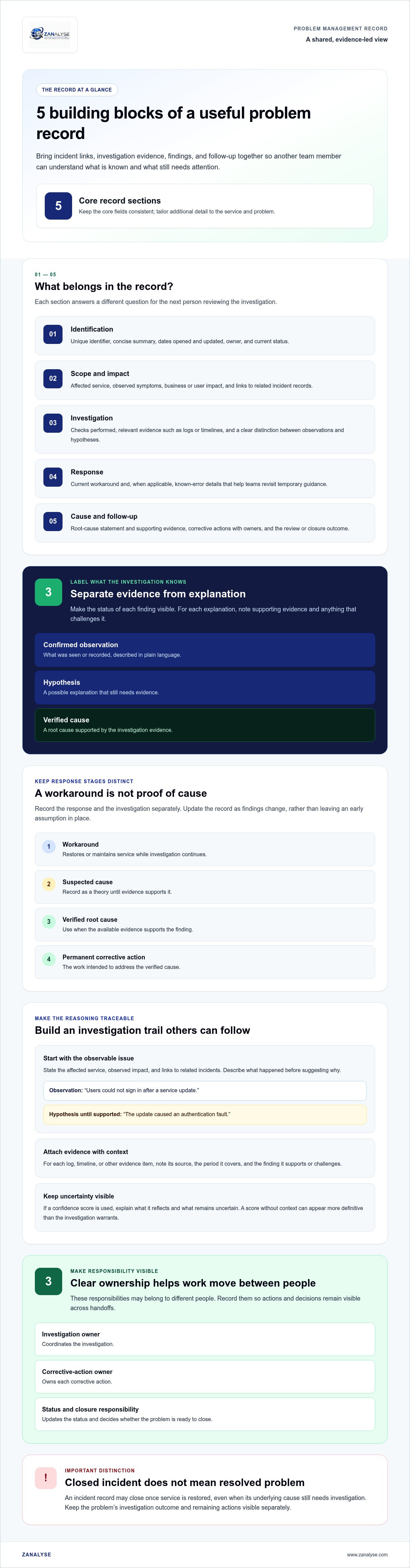
- Identification: A unique identifier, concise summary, dates opened and updated, owner, and current status.
- Scope and impact: The affected service, observed symptoms, business or user impact, and links to related incident records.
- Investigation: Checks performed, relevant evidence such as logs or timelines, and a clear distinction between confirmed observations and hypotheses.
- Response: Any current workaround and, when applicable, known-error details that help teams apply and revisit temporary guidance.
- Cause and follow-up: A root-cause statement, the evidence behind the finding, corrective actions with owners, and the review or closure outcome.
These fields make structured itil problem records useful beyond the original investigation. Support staff can find relevant history, while process managers and decision-makers can track whether corrective work is progressing. Do not mark a problem resolved just because its linked incident tickets are closed. Record the investigation outcome and any remaining actions separately.
How should teams build an evidence-led problem record?
Start with a short problem statement, the affected service, the impact observed, and links to related incidents. Describe what happened in plain language before suggesting why it happened. For example, “Users could not sign in after a service update” is an observation. “The update caused an authentication fault” is a hypothesis until evidence supports it.
Next, build a traceable investigation trail. Attach relevant logs, timelines, and other evidence. For each item, note its source, the period it covers, and the finding it supports or challenges. This helps another team member follow the reasoning without reconstructing it from scattered tickets or messages. If the investigation spans teams or locations, make handoffs and updates visible in the record.
How can a record distinguish evidence from a hypothesis?
Label findings as confirmed observations, hypotheses, or verified causes. For each explanation, record supporting evidence and anything that challenges it. If you use a confidence score, explain what it reflects, such as the amount and consistency of evidence, and note what remains uncertain. A score without context can look more definitive than the investigation warrants.
Keep response stages separate. A workaround restores or maintains service while investigation continues; it does not prove the cause. Record a suspected cause as a theory, a verified root cause only when evidence supports it, and the permanent corrective action as the work intended to address that cause. Update the record when findings change rather than leaving an early assumption in place.
This evidence trail makes structured itil problem records easier to review and update. Teams looking to organize logs, timelines, and incident data into investigation reports can explore a root cause analysis platform designed to support analysis across IT roles.
How can structured problem records support consistent problem management?
A consistent record helps teams share responsibility without losing track of decisions. Assign an owner to coordinate the investigation, name an owner for each corrective action, and identify who updates the status and decides whether the problem is ready to close. These responsibilities may belong to different people. Make each one visible so actions do not stall when work passes between IT support, process managers, service providers, or decision-makers.
Use the same core fields and review approach across teams, while allowing relevant details to vary by service. Support staff can add operational findings, process managers can check that investigations follow a shared approach, and IT leaders can review progress and unresolved impact. For teams working across Canada, Australia, and Europe, recording ownership and handoffs clearly can help colleagues follow the same investigation even when work passes between locations. A clear status and decision history give everyone a common view of what remains open.
When can automated RCA help standardize problem records?
Guided root cause analysis can help staff follow an established way of examining an issue and recording their reasoning, especially when problem management is shared across IT roles. An application built for intuitive navigation can make that guided process easier to follow. It supports consistency, but does not replace review or judgment. Treat evidence and confidence scores as information for discussion, not automatic proof that a cause is correct.
ZANALYSE is an automated root cause analysis platform that generates structured reports from incident data, timelines, and logs. Reports can include evidence, confidence scores, and corrective actions, giving teams a consistent starting point for review and follow-through. Explore ZANALYSE to see how its reporting approach can support shared analysis.
Make the next problem record a shared improvement
Choose a recurring issue and use it to test how your team works together. Agree on who will maintain the record, how progress will be reviewed, and what evidence is needed before a corrective action can be considered complete. After the review, note what made the record useful and where information was missing. Use those observations to refine the process, so structured itil problem records become part of everyday problem management rather than an extra task that depends on one person’s memory.
ZANALYSE supports a consistent RCA workflow by turning logs, timelines, and incident data into structured reports. Explore ZANALYSE's evidence-led RCA approach and see how it can help your team share investigation findings and follow through on corrective actions.
Frequently Asked Questions
Does ITIL require a specific problem-record template?
No. ITIL 4 does not require one fixed template for structured itil problem records. Teams can establish a shared baseline, then adjust it to fit their services and working practices. For example, IT teams supporting services across Canada, Australia, and Europe can use consistent core fields while recording relevant differences in service ownership or investigation handoffs.
What is the difference between an incident record and a problem record?
An incident record tracks a specific interruption or support request. A problem record helps investigate a possible shared cause behind one or more incidents. For example, several reports of slow payment processing may each have their own incident record, while a linked problem record tracks whether they point to a common issue and what follow-up is needed.
What evidence should be included in a problem record?
Include evidence that helps another person understand and assess the investigation, such as monitoring alerts, relevant change history, user reports, or service data. Identify the source and period covered for each item, and explain which finding it supports or challenges. Keep the selection relevant, and handle sensitive information according to your organization’s established practices.
Disclaimer
Some content on this website may be generated or assisted by artificial intelligence. While we strive to ensure that all information is accurate, relevant and up to date, AI-assisted content may contain errors or omissions. Content should therefore be considered informational and not as professional advice.


