


What if an incident report’s strongest conclusion is also its hardest claim to prove? Audit reviewers need more than a summary of what happened. They need to see which incident records support each finding, how the evidence supports the causal reasoning, and where uncertainty remains. When those links are missing, even a plausible root cause can be difficult to defend. Evidence based rca for audits makes those connections visible.
This article explains how to build a traceable RCA, from gathering incident records to documenting findings and assigning corrective actions. You’ll learn how to distinguish confirmed facts from assumptions, express confidence without overstating certainty, and make follow-up actions clear enough to review. A consistent, guided reporting approach can help process managers, IT support personnel, and decision-makers produce useful RCAs without relying on a small group of specialists.
Key Takeaways
- Make incident findings easier to defend by separating source facts, analysis, and unresolved assumptions.
- Use evidence based rca for audits to connect each conclusion to its source, context, and reasoning.
- Follow a repeatable workflow to define the incident, organize records, test possible causes, and document corrective actions.
- Use guided reporting to support consistent RCA across teams while keeping incident-specific judgment visible.
Evidence-Based RCA for Audits: What Makes an IT Finding Defensible?
An IT root cause analysis (RCA) is defensible when a reviewer can follow how the team moved from incident records to a conclusion, rather than being asked to accept the conclusion on trust. The Root Cause Analysis (RCA) principles provide a foundation, but an audit-ready IT report must also show how the reasoning relates to the specific incident evidence.
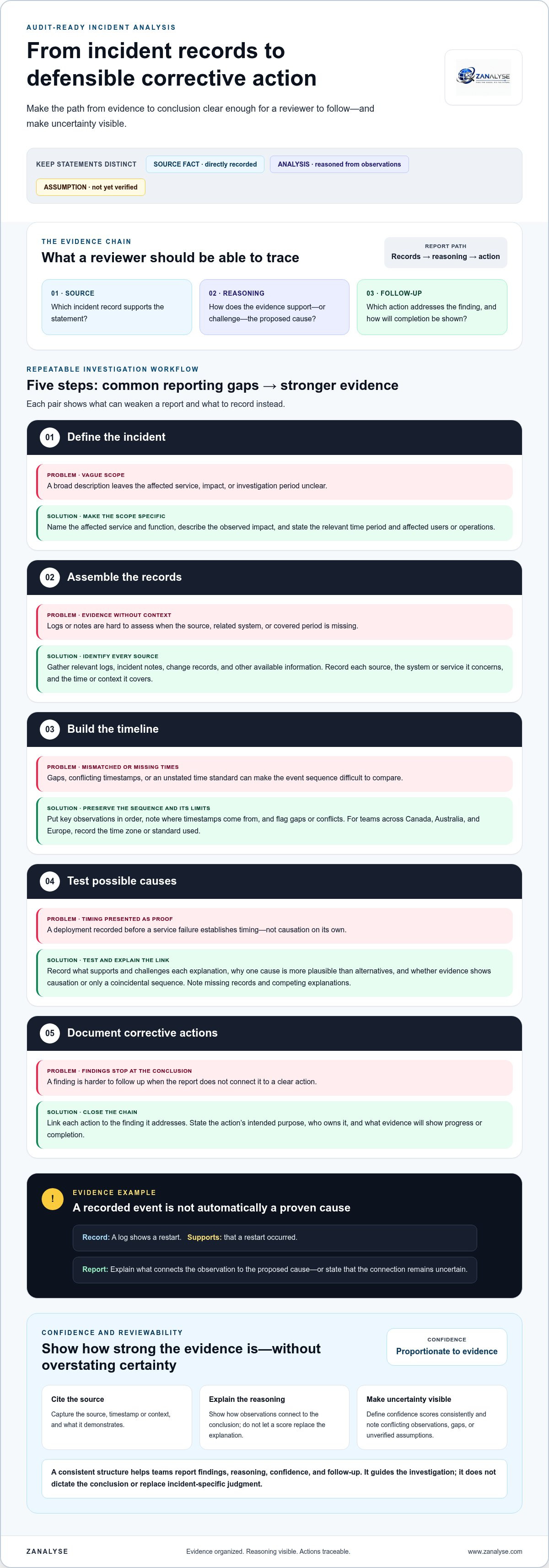
Keep three kinds of statements distinct: source facts, such as a log entry or service desk record; analysis, such as the explanation that a configuration change preceded an outage; and unresolved assumptions, such as a suspected link that available records cannot verify. For each statement, identify whether it is directly recorded, inferred from several observations, or still unverified. This prevents an interpretation from quietly becoming a stated fact.
What should an auditor be able to trace in an RCA?
A reviewer should be able to move from the incident timeline to the relevant records, then see how those records support or challenge the proposed cause. For example, a deployment recorded before a service failure establishes timing, not causation by itself. The report should explain what additional evidence connects the deployment to the failure, such as a related error or a change in service behaviour, or state that the connection remains uncertain.
Evidence based rca for audits is not a claim of certainty. Record confidence in proportion to the evidence, note conflicting observations, and make gaps visible. Guidance on reviewing financial audit quality and operational RCA for IT incidents address different contexts. In an IT report, focus on the service event, its records, the causal reasoning, and the response.
Close the chain by connecting each finding to a corrective action. State what the action is intended to address, who is responsible for it, and what evidence will show that it is complete. This gives process managers, support staff, and decision-makers a clear path from incident evidence to follow-up, without presenting assumptions as established causes.
How to Build an Evidence-Based RCA for Audits, Step by Step
A repeatable workflow gives each incident report a clear path from the event to the response. For evidence based rca for audits, keep records close to the reasoning they support, so a reviewer can follow the analysis without relying on the investigator’s memory.
- Define the incident. Describe the affected service, observed impact, and relevant time period. Keep the scope specific enough to guide the investigation, for example, by naming the service function that failed and the users or operations affected.
- Assemble the records. Gather relevant logs, incident notes, change records, and other available information. Record each source, the system or service it concerns, and the time or context it covers.
- Build the timeline. Put key observations in sequence. Note where timestamps come from and flag gaps or conflicts instead of smoothing them over. For teams working across Canada, Australia, and Europe, record the time zone or standard used so that events from different locations can be compared consistently.
- Test possible causes. Compare each explanation with the evidence. Record what supports it, what challenges it, and why one cause is more plausible than alternatives. Separate evidence that shows a cause from evidence that only shows a coincidental sequence.
- Document actions. Link each corrective action to the finding it addresses, then record who owns it and how progress or completion will be reviewed.
A causal conclusion is only as reviewable as its supporting evidence.
How should teams document evidence, reasoning, and confidence?
For every important finding, capture the source, timestamp or context, what it demonstrates, and how it relates to the conclusion. A log showing a restart confirms that a restart occurred; by itself, it may not establish why the service failed. Explain the reasoning that connects observations to a cause, and note competing explanations or missing records. This makes the report useful even when the evidence does not support certainty.
Use confidence scores consistently to communicate how strongly the available evidence supports a conclusion. Define what the scores mean in your process, and never let a score replace the explanation. Guided RCA workflows can help teams apply a consistent reporting structure while retaining judgment for each incident.
How Structured RCA Helps Teams Make Audit Evidence Repeatable
Consistency shouldn’t depend on one specialist knowing what to ask or how to write it up. Templates and guided workflows give teams a shared structure for recording findings, reasoning, confidence, and follow-up. That structure makes reports easier to compare and review, while leaving room to assess each incident on its own evidence. A template should guide the investigation, not dictate its conclusion.
When does an RCA platform support audit readiness?
A platform can help when staff across support, operations, and problem management can follow the same process and produce reports a reviewer can understand. Guided RCA can also distribute problem-solving across IT staff, rather than concentrating it in a small specialist group. Broader participation works best when contributors can see how their observations fit into the analysis and where human judgment is still needed.
ZANALYSE brings logs, timelines, and incident data into structured reports that include evidence, confidence scores, and corrective actions. Its guided approach helps teams use a consistent reporting structure while leaving incident-specific findings open to review. The platform supports evidence organization; it doesn’t guarantee compliance or replace review of the findings. The ZANALYSE Standard License provides teams with access to its automated RCA capabilities.
For teams building a repeatable approach to evidence based rca for audits, the practical test is whether reports stay clear across different contributors and incidents, while showing the basis for each finding. Explore ZANALYSE to see how guided, distributed RCA can support that process.
Make Your Next RCA Easier to Review
Use your next incident as an opportunity to make evidence based rca for audits part of everyday problem management, not a task reserved for audit preparation. Agree on a shared reporting approach, then let contributors apply it to real cases while keeping uncertainty and human judgment visible. Over time, this helps process owners and IT teams build a clearer record of how operational learning leads to follow-through.
ZANALYSE supports this approach with structured reports that bring evidence, confidence scores, and corrective actions together. The platform is designed to decentralize problem management across IT staff, while teams remain responsible for reviewing findings and deciding what action fits. Explore how ZANALYSE structures root cause analysis and see how guided RCA can fit your team’s work.
Frequently Asked Questions
What evidence should an RCA report include for an audit?
Include records that let a reviewer understand the incident’s operational context, such as the incident ticket, service health alerts, relevant change records, and communications about impact or recovery. Identify which service or system each record concerns, its source, and the time period it covers. For teams operating in Canada, Australia, or Europe, recording the time zone or standard used can help reviewers compare records across locations.
How do you show that a root cause is supported by evidence?
Show that the proposed cause fits the event sequence and is corroborated by relevant records, rather than relying on a single coincidental signal. For example, compare the affected service’s change history with records from an unaffected service. Explain why the evidence supports one explanation, address credible alternatives, and narrow the conclusion if important information is missing. This makes evidence based rca for audits more transparent.
Can automated RCA create audit-ready reports?
Automated RCA can help organize incident information into a consistent report, but automation alone can’t establish that a conclusion is correct or make a report audit-ready. A reviewer still needs to confirm that the inputs are relevant, the interpretation fits the incident, and the proposed actions make sense. This distinction matters for teams in Canada, Australia, and Europe using automation to support operational analysis.
Disclaimer
Some content on this website may be generated or assisted by artificial intelligence. While we strive to ensure that all information is accurate, relevant and up to date, AI-assisted content may contain errors or omissions. Content should therefore be considered informational and not as professional advice.


