


What good is a high confidence score if you can’t see the evidence behind it? Incident findings are hard to compare when teams document them differently, and a score without clear support can seem more certain than the investigation warrants. That’s the central test for rca confidence score software: can people trace the finding back to the information that supports it?
A confidence score can help communicate how well a finding is supported, but it doesn’t prove that a root cause is correct. In this article, you’ll learn what a score can and can’t tell you, how to review the evidence behind an RCA, and what to look for in software. We’ll also consider how structured reports and intuitive navigation can help more IT staff contribute to problem management, rather than relying on a small group of specialists. ZANALYSE brings evidence, confidence scores, and corrective actions together in structured RCA reports.
Key Takeaways
- A confidence score communicates how strongly an RCA finding is supported; it doesn’t prove the root cause is correct.
- Evaluate rca confidence score software by checking whether its evidence, reasoning, and report are clear to both technical and non-technical stakeholders.
- Use a practical review sequence: inspect the evidence, understand the finding, review the report, then consider the next action.
- See how ZANALYSE brings incident data into structured RCA reports to help more staff take part in problem management.
What an RCA confidence score means, and what it cannot prove
An RCA confidence score communicates how strongly an incident finding is supported. It’s a signal to consider alongside the investigation, not proof that the proposed root cause is correct. The score is useful when reviewers can understand the finding, see the evidence behind it, and follow how the investigation reached its conclusion.
A confidence score is not a verified probability that the proposed cause is correct. Don’t treat a high score as permission to skip review, or a lower one as evidence that the investigation has failed. Use it to prompt practical questions: Does the incident timeline fit the explanation? Do the available records support the sequence of events? Are there other plausible causes?
These checks reflect Root Cause Analysis (RCA) principles: a finding needs a reasoned connection between the incident and its proposed cause. A score alone can’t show whether that connection is sound. Review the reasoning and evidence together, particularly when the finding will inform corrective actions or be shared with people who weren’t part of the investigation.
How evidence supports an incident finding
Logs can show recorded events, timelines can put them in sequence, and incident data can add operational context. Together, they may support a proposed explanation. For example, if a service disruption began soon after a change, the timing is relevant, but it doesn’t establish that the change caused the disruption. Review the surrounding evidence and reasoning before accepting the conclusion. Well-designed rca confidence score software should make that review practical, rather than asking readers to rely on a number without context.
Make gaps visible. Missing records may limit what the team can conclude; conflicting details may point to more than one explanation. Note these uncertainties in the investigation and report instead of letting a confident-looking score obscure them. Clear evidence gives IT support personnel, process managers, and decision-makers a shared basis for reviewing a finding and deciding what to investigate next.
How to evaluate RCA confidence score software in practice
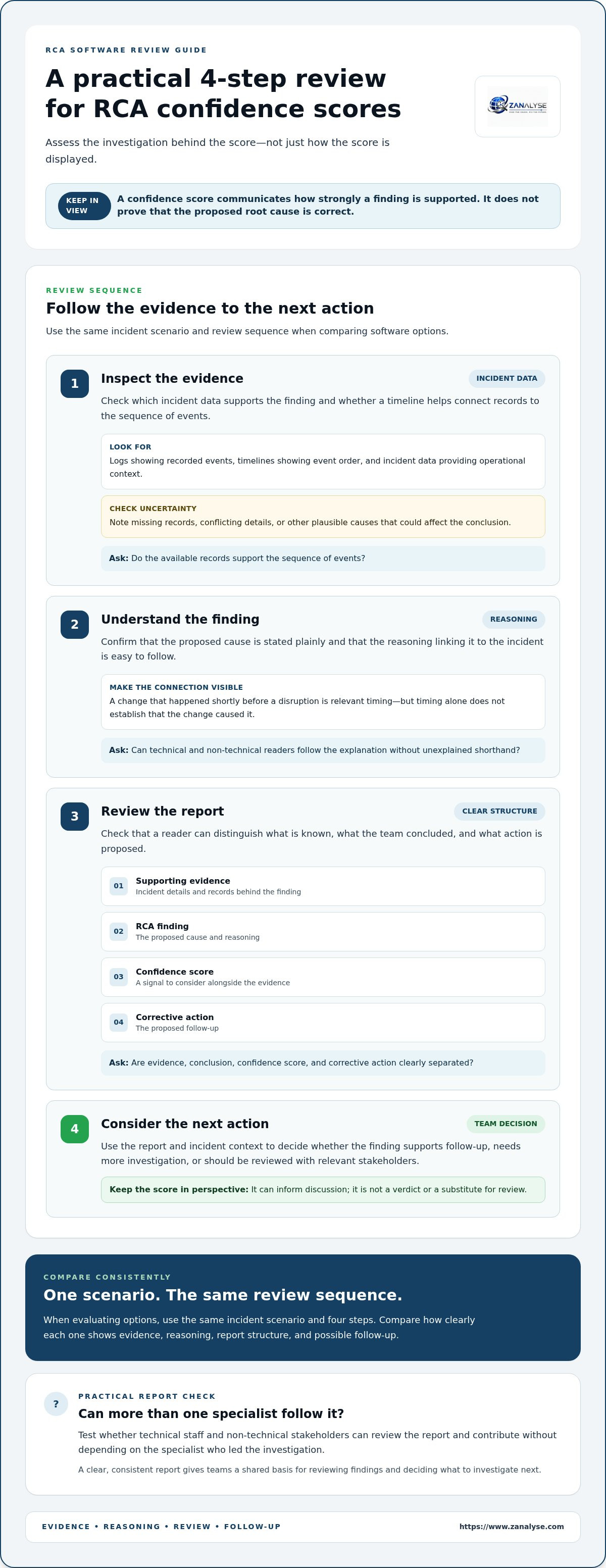
Assess the investigation behind the score, not just how the score is displayed. A practical review helps IT teams, process managers, and decision-makers judge whether a finding is clear enough to discuss and act on. When comparing software, use the same incident scenario and review sequence for each option. This makes differences in evidence visibility, report structure, and ease of use easier to spot.
1. Inspect the evidence. Check whether the report identifies relevant incident data and shows how it supports the finding. Look for a timeline that helps you connect records to the sequence of events. Note gaps or conflicting details that could affect the conclusion.
2. Understand the finding. Confirm that the proposed cause is stated plainly and that the reasoning connecting it to the incident is easy to follow. A conclusion that depends on unexplained technical shorthand may be difficult for service managers or product managers to review.
3. Review the report. Look for a clear distinction between supporting evidence, the RCA finding, its confidence score, and any suggested corrective action. A reader should be able to tell what is known, what the team has concluded, and what action is proposed.
4. Consider the next action. Decide whether the finding supports a practical follow-up, needs further investigation, or should be reviewed with relevant stakeholders. A score can inform the discussion, but the team should base its decision on the report and the incident context.
Useful RCA software makes findings reviewable, not merely scoreable. Test whether technical staff and non-technical stakeholders can follow the report without relying on an explanation from the one specialist who led the investigation. For IT directors and service providers, also consider whether the same reporting approach will be understandable to different teams and clients.
Questions to ask when reviewing an RCA report
- Can the team identify the incident data and timeline that support the finding?
- Does the report clearly separate evidence, conclusion, confidence score, and corrective action?
- Can staff follow the report and contribute to the review without every investigation depending on one specialist?
Consistent answers help teams assess a report’s practical value and identify where investigation or documentation needs attention. Explore structured RCA software as one way to guide more staff through a consistent review process.
How ZANALYSE connects confidence scores to structured RCA work
ZANALYSE uses logs, timelines, and incident data to generate structured root cause analysis reports. The reports bring key parts of an investigation together: supporting evidence, a confidence score, and corrective actions. This gives reviewers a clearer way to move from incident information to a documented finding and possible follow-up, without treating the score as a verdict.
The report structure helps keep investigation outputs consistent. IT support personnel can review incident details, while process managers, IT leaders, product managers, and service providers can see how the finding and proposed actions are presented. The confidence score is one report element to consider alongside the evidence and reasoning.
From individual investigation to shared problem management
Root cause analysis can become dependent on a few specialists if the process is difficult for others to follow. ZANALYSE guides users through established RCA techniques with intuitive navigation, helping make structured analysis more accessible to a wider range of IT staff. This supports a more shared approach, so support and operations teams can contribute to investigations instead of leaving the full process to one experienced person.
Consistent reports also support knowledge sharing. Teams can review how incidents were assessed, what evidence informed the finding, and which corrective actions were proposed. This gives colleagues a common record to discuss recurring issues and carry investigation learning between support, process, and operations teams. For organizations with teams or clients across Canada, Australia, and Europe, a structured report can also give people in different locations a consistent basis for review.
If you’re assessing rca confidence score software, explore ZANALYSE’s approach to structured RCA and consider how guided analysis and consistent reporting could fit your team’s problem management work.
Make evidence review part of everyday problem management
Make evidence-based review a repeatable team habit, not an exercise reserved for major incidents or a few specialists. Choose a current investigation and ask a colleague who wasn’t involved to follow the report from incident data to finding and proposed action. Where they need extra explanation, improve the report or identify what evidence is missing. This simple review can help teams make investigation findings easier to share and build on.
For teams assessing rca confidence score software, ZANALYSE brings evidence, confidence scores, and corrective actions into structured reports, while guiding users through established RCA techniques. Its intuitive navigation is designed to make participation in root cause analysis more accessible across IT staff.
Explore how ZANALYSE structures root cause analysis and consider how a more shared, consistent approach could support your team’s next investigation.
Frequently Asked Questions
What does a confidence score mean in root cause analysis software?
It indicates how strongly an RCA finding is presented as supported by the investigation. Treat it as a prompt for review, not a stand-alone decision. For example, a team might use a score to identify a finding for discussion, then check whether the available records and incident context give reviewers enough grounds to accept or question it.
Can an RCA confidence score guarantee that the identified root cause is correct?
No. A score can’t guarantee that a proposed cause is correct, because an investigation may rely on incomplete records or miss another contributing factor. Before acting, consider whether the explanation fits the known incident details and whether further checks could change the conclusion. Keep the distinction clear in team discussions: a score supports review, while validation depends on the evidence and investigation.
What evidence should RCA software show alongside a confidence score?
Look for traceable information that lets a reviewer understand why a finding was raised, such as relevant event records, the order of key incident events, and supporting incident notes. The report should also make uncertainties or gaps apparent. This helps a colleague who wasn’t involved in the investigation assess the reasoning without relying only on the original investigator’s explanation.
How do teams compare RCA confidence score software?
Compare tools using the same incident scenario and review whether staff can follow each report from source information to finding and proposed follow-up. Consider readability, consistency, and whether non-specialists can take part in reviewing the result. For teams working across Canada, Australia, and Europe, a shared review process can help colleagues use a common approach across different locations.
Disclaimer
Some content on this website may be generated or assisted by artificial intelligence. While we strive to ensure that all information is accurate, relevant and up to date, AI-assisted content may contain errors or omissions. Content should therefore be considered informational and not as professional advice.


