


A review that leaves people afraid to speak has failed, even if its report is complete. After an incident, teams need to understand what happened, not search for someone to blame. The right post incident review tools can make evidence easier to examine and lessons easier to share, but a fair, constructive process still matters.
Reviews can feel like another burden when teams are already handling repeated documentation and follow-up. A clear process helps: organize the available evidence, build a shared timeline, distinguish facts from hypotheses, and turn supported findings into practical improvements with owners. Structured reports and automation can reduce repetitive preparation and make it easier for more people to contribute, while keeping human judgment at the centre of the discussion.
Key Takeaways
- Frame reviews around the conditions that shaped an incident, not personal fault, to encourage open and useful discussion.
- Use a clear sequence: prepare evidence, build a shared timeline, examine contributing conditions, assign actions, and track progress.
- Involve support, engineering, operations, and relevant commercial stakeholders so learning isn’t limited to a small group.
- Evaluate post incident review tools for intuitive navigation and reports that connect timelines, evidence, findings, and corrective actions.
Why post-incident reviews affect IT team morale
A post-incident review is a structured opportunity to understand what happened and improve the systems and processes involved. Its purpose is learning, not assigning personal blame. When people can discuss events openly, teams are better placed to identify contributing conditions and make useful changes.
Reviews can feel punitive when expectations are unclear, people must retell the same events in different forums, or conclusions go beyond the available evidence. A rushed discussion might treat one person’s action as the explanation while overlooking unclear procedures, missing information, or system design that shaped the response. That can discourage honest participation and leave the underlying problem unresolved.
Accountability means owning the improvements a system needs, not assigning individual fault for an incident.
What makes an incident review feel fair to the people involved?
Set a learning-focused purpose before the discussion and invite the technical and operational perspectives needed to understand the event. Support staff may know what users reported; engineers may explain system behavior; operations may add context about response processes. Include the relevant voices without turning the meeting into a search for someone to blame.
Keep observations, hypotheses, and conclusions distinct. For example, a timeline entry can record when an alert appeared, while a proposed explanation for a delay remains a hypothesis until supported by evidence. This makes uncertainty visible instead of presenting an early assumption as fact. Post incident review tools can organize timelines and evidence into a shared account, reducing reliance on individual recollection alone.
Recognize that incidents create real workload and pressure. Keep the review focused, avoid asking people to repeat details already documented, and give participants a clear way to correct or add context. A fair process respects the people involved while still examining what needs to change.
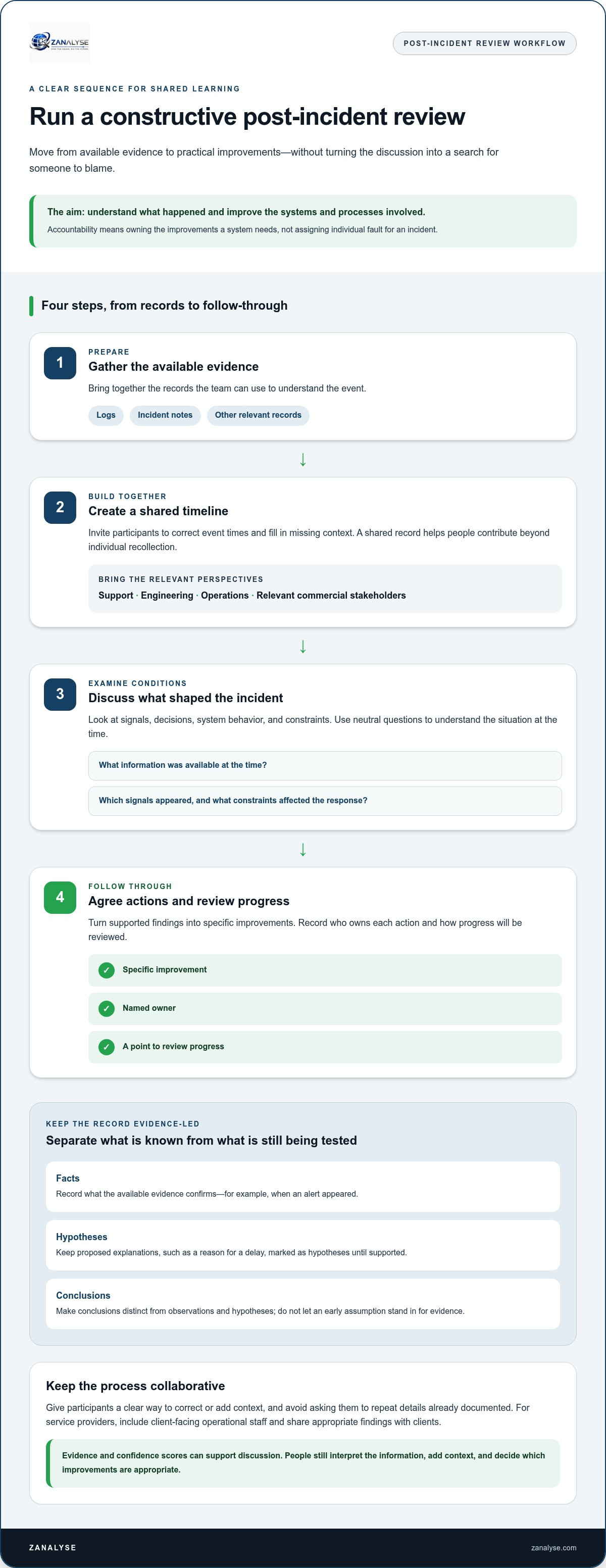
How to run a constructive post-incident review
A clear sequence keeps the review focused and reduces repeated retelling. Prepare relevant records, then build a shared timeline with participants. Discuss the conditions that contributed to the incident, agree on corrective actions, and set a point to review progress. Keep the record accessible so people who weren’t in the meeting can understand the findings.
Evidence-led reviews distinguish what the records confirm from what the team still needs to test. Marking facts, hypotheses, and conclusions separately helps prevent an early explanation from becoming an unsupported verdict.
- Prepare evidence: Gather available logs, incident notes, and other relevant records.
- Build a timeline: Invite participants to correct event times and fill in missing context.
- Discuss contributing conditions: Examine signals, decisions, system behavior, and constraints.
- Agree actions: Record specific improvements, an owner, and how progress will be reviewed.
How can teams discuss causes without turning the review into blame?
Ask neutral questions: What information was available at the time? Which signals appeared, and what constraints affected the response? Invite support, engineering, operations, and relevant commercial stakeholders to add context. Service providers should include client-facing operational staff and share appropriate findings with their clients. Before drawing conclusions, let participants correct the timeline and identify gaps. Turn supported findings into owned improvements, not judgments about individuals.
Structured post incident review tools can help teams organize evidence and share findings beyond a small group of specialists. ZANALYSE uses logs, timelines, and incident data to generate structured root cause analysis reports. Explore ZANALYSE root cause analysis for more on this approach.
What to look for in post-incident review tools
Choose post incident review tools that make the review record clear and useful to people beyond the specialists who led the investigation. A structured report should bring together the timeline, supporting evidence, confidence in findings, and corrective actions. This helps readers follow how the team reached its conclusions and see what needs to happen next.
Check whether the tool is intuitive enough for support, engineering, operations, and relevant business stakeholders to contribute. If only a few specialists can navigate the process, problem management stays centralized and useful context may be missed. Consider how well the tool fits your review process, keeps people involved in decisions, and helps teams track actions after the report is written. Automation can reduce repetitive preparation, but it can’t create a fair review culture on its own.
How can structured RCA support shared learning?
ZANALYSE uses logs, timelines, and incident data to generate structured root cause analysis reports featuring evidence, confidence scores, and corrective actions. Bringing these elements together can help participants follow the reasoning, question gaps, and share learning across teams.
Evidence and confidence scores are aids to discussion, not substitutes for team judgment. Participants still need to interpret the information, add context, and decide which improvements are appropriate. A well-designed process makes shared review easier without treating an automated output as the final word. For more on interpreting confidence scores, see IT Incident Confidence Scoring: Why Evidence-Based RCA Matters in 2026.
Make every review a step toward stronger systems
Constructive reviews help teams learn from incidents without turning the discussion into personal blame. A shared timeline, clearly distinguished evidence and hypotheses, and practical actions with owners make findings easier to trust and follow through. The right post incident review tools can also make that learning accessible beyond a small group of specialists.
ZANALYSE supports this approach with structured reports featuring evidence, confidence scores, and corrective actions, while helping decentralize problem management across IT staff. Automation can reduce repetitive report preparation, but people remain responsible for interpreting findings and choosing improvements.
For IT teams and operational service providers in Canada, Australia, and Europe, a structured approach can make incident learning easier to share across roles and client teams. Explore the ZANALYSE Standard License to support evidence-led root cause analysis and more distributed problem management.
Frequently Asked Questions
Can post-incident reviews improve IT team morale?
Yes, constructive reviews can support morale by helping teams focus on learning and system improvements rather than personal blame. Set a clear purpose, invite relevant perspectives, and distinguish evidence from assumptions. For IT teams in Canada, Australia, and Europe, a consistent, transparent process can make it easier to share lessons across roles and keep corrective actions visible.
How do you run a blameless post-incident review?
Start by gathering relevant records and building a shared timeline with participants. Discuss the conditions, signals, and constraints that shaped events, using neutral questions rather than personal judgments. Give people a chance to correct gaps before reaching conclusions. Then document specific improvement actions, assign owners, and review progress so the discussion leads to practical change.
What should post-incident review tools include?
Useful post incident review tools should organize timelines, evidence, findings, confidence scores, and corrective actions in a clear report. Look for intuitive navigation that lets technical and operational contributors participate, rather than restricting problem management to specialists. Automation can reduce repetitive report preparation, while people remain responsible for interpreting findings and deciding which improvements to make.
Disclaimer
Some content on this website may be generated or assisted by artificial intelligence. While we strive to ensure that all information is accurate, relevant and up to date, AI-assisted content may contain errors or omissions. Content should therefore be considered informational and not as professional advice.


