


Strict reporting deadlines don't protect critical systems when senior engineers spend hours piecing together fragmented spreadsheets instead of resolving technical failures. Managing financial services IT incident reporting Australia requires balancing tight statutory windows, such as APRA's 72-hour CPS 230 mandate, against the demanding reality of live production outages. You already know the operational drag of manual documentation, siloed problem management, and the persistent risk that incomplete records will fail an external audit.
Compliance doesn't have to paralyze your technical operations. In this guide, you'll learn how to master Australian reporting requirements, empower all IT support staff to execute rigorous root cause analysis, and cut incident lead times by over 50% using structured evidence workflows. Here is your complete operational blueprint for turning complex regulatory obligations into a fast, audit-ready investigation routine.
Key Takeaways
- Understand how overlapping APRA, SOCI, and ASIC notification deadlines demand immediate operational alignment rather than delayed, manual log gathering.
- Master financial services IT incident reporting Australia by establishing standardized, contemporaneous timelines directly from incident logs and monitoring alerts.
- Decentralize root cause analysis across frontline IT staff and process managers to eliminate investigation bottlenecks for senior engineering teams.
- Reduce incident lead times by over 50% using structured evidence workflows that produce defensible, audit-ready reports with clear confidence scores.
Navigating Regulatory Mandates for Australian Financial Services IT Incident Reporting
An unexpected core banking outage isn't just an internal engineering fire drill. It triggers mandatory statutory disclosures that require strict procedural discipline. Internal post-mortems prioritize service restoration and team learning, but formal financial services IT incident reporting Australia requires defensible, timestamped records for external oversight. Regulators won't accept vague post-incident guesswork when critical retail payment rails or customer accounts face disruption.
Key Regulatory Obligations Across APRA and Australian Financial Frameworks
Entities regulated by the Australian Prudential Regulation Authority must systematically document incident severity against defined operational thresholds. Understanding these distinct triggers prevents severe non-compliance penalties:
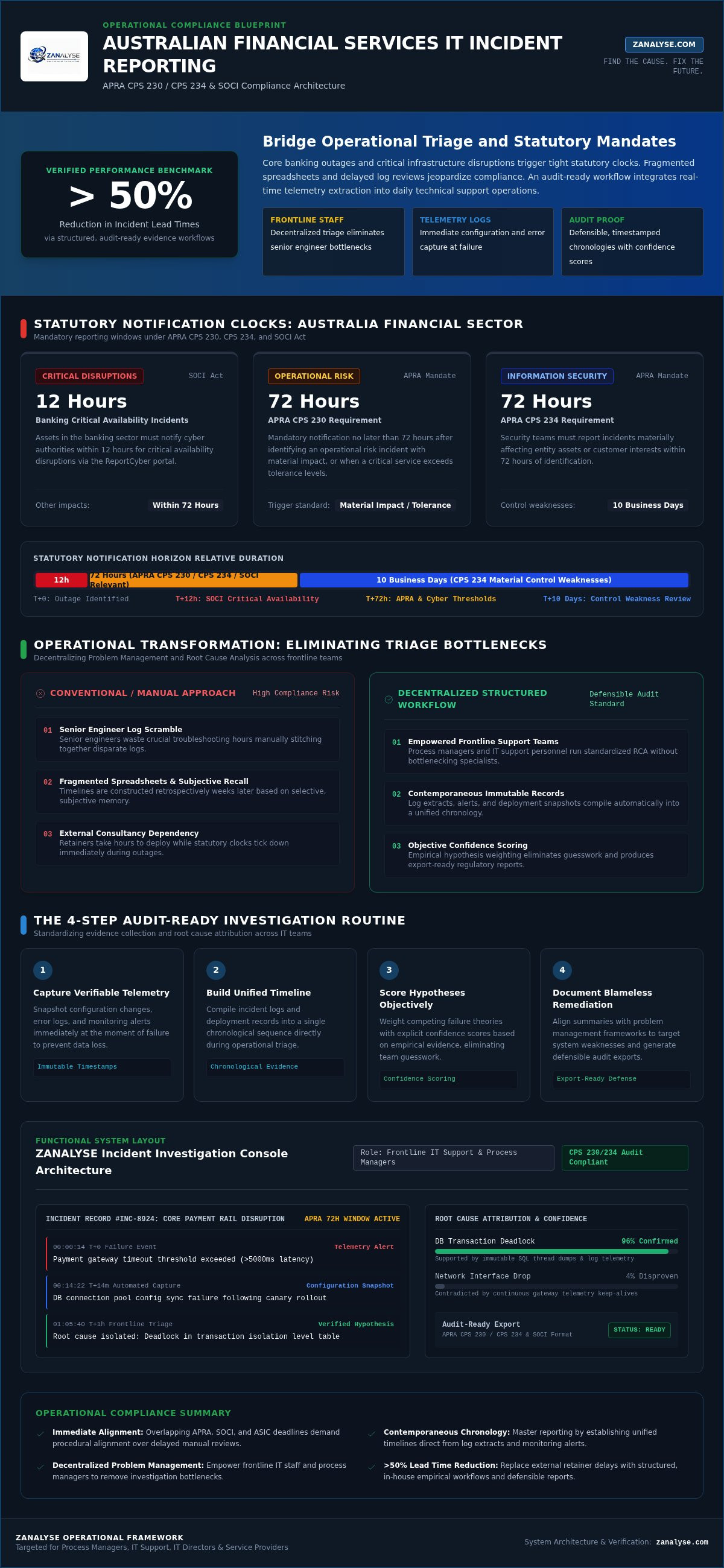
- APRA CPS 230: Entities must notify the regulator no later than 72 hours after identifying an operational risk incident with material impact, or when a critical service exceeds tolerance levels.
- APRA CPS 234: Security teams must report incidents materially affecting entity assets or customer interests within 72 hours. Material control weaknesses require notification within 10 business days.
- SOCI Act Mandates: Assets in the banking sector must notify cyber authorities within 12 hours for critical availability disruptions, and 72 hours for other relevant impacts.
Maintaining a disciplined, contemporaneous evidence trail protects institutions during external audits and supervisory inquiries. A structured root cause workflow ensures frontline support teams capture verifiable facts during early triage stages. This operational rigor satisfies domestic prudential supervisors while seamlessly aligning cross-border operations with international standards like DORA incident reporting requirements.
How to Build an Audit-Ready IT Incident Investigation Workflow
Bridging the gap between active troubleshooting and regulatory compliance requires operational discipline. Most organizations scramble to reconstruct facts weeks after an outage occurs. An audit-ready workflow integrates evidence gathering directly into daily technical operations. By automatically compiling log extracts, monitoring alerts, and deployment records into a single chronological timeline, teams eliminate the friction of preparing compliance disclosures for financial services IT incident reporting Australia. Applying structured root cause analysis methods allows engineers and operational leads to isolate failure triggers without delaying technical triage.
Standardizing Evidence Collection and Root Cause Attribution Across IT Teams
Audit defense succeeds or fails on contemporaneous proof. When incidents threaten critical infrastructure or involve external disclosures via the ReportCyber portal, investigators demand immutable system timestamps rather than subjective recollections. Standardizing this process across support staff ensures consistent record quality across every shift:
- Capture verifiable telemetry: Snapshot configuration changes and error logs at the moment of failure to prevent data loss.
- Score hypotheses objectively: Weight competing failure theories with explicit confidence scores based on empirical evidence, eliminating guesswork.
- Document corrective actions: Align post-incident summaries with established problem management frameworks that target system weaknesses without fostering personal blame.
Adopting an intuitive platform like ZANALYSE simplifies this entire lifecycle, empowering frontline support personnel to build defensible incident records without administrative delays.
Selecting the Right Solution for Financial Services IT Incident Reporting in Australia
Relying on external retainers creates an unsustainable operational dependency. Specialized consultancies take hours to deploy while statutory notification clocks tick down immediately. Your internal teams already possess deep operational context. Equipping frontline personnel with an automated platform decentralizes analysis, turning technical telemetry into defensible findings without outside billable hours. When customer records are exposed under the Notifiable Data Breaches scheme, internal velocity makes the critical difference. Structured annual price plans allow institutions to scale investigative capacity predictably as transaction volumes expand.
Empowering Internal IT Teams with Purpose-Built Investigation Platforms
Software usability directly impacts compliance outcomes. Complex legacy tools often trap post-incident reviews within narrow engineering silos. Modern platforms must feature intuitive navigation, enabling process managers and commercial product owners to contribute evidence alongside infrastructure specialists.
A standardized approach delivers decisive operational advantages:
- Decentralized problem management workflows that remove investigation burdens from senior engineers.
- Empirical evidence mapping that cuts incident lead times by over 50%.
- Immediate generation of audit-ready records tailored to financial services IT incident reporting Australia.
Organizations can operationalize these structured workflows through the ZANALYSE Standard License, building sustainable internal resilience while meeting strict regulatory expectations.
Transforming Regulatory Demands into Lasting Operational Resilience
Meeting Australian oversight standards shouldn't paralyze your engineering talent. Shifting from reactive manual documentation to an automated investigation workflow turns statutory mandates into practical operational speed. When you decentralize root cause analysis across all technical teams, frontline personnel can capture telemetry immediately, test hypotheses objectively, and eliminate senior engineering bottlenecks.
This disciplined structure delivers audit-ready reports with empirical evidence and confidence scores while cutting IT incident lead times by over 50%. You can satisfy every requirement for financial services IT incident reporting Australia without slowing down technical innovation. Take the friction out of your compliance obligations. Streamline your regulatory incident reports with ZANALYSE and build an investigation process your entire organization can rely on.
Frequently Asked Questions
What qualifies as a reportable IT incident for Australian financial services?
A reportable incident involves any disruption that materially affects critical operations, compromises customer data, or exceeds defined operational tolerance thresholds. Under Australian governance standards, this includes severe core banking outages, ransomware extortion events, unauthorized access to sensitive financial records, or systemic control breakdowns that compromise service availability. Routine technical glitches that don't impact critical operations or client transactions remain standard internal tickets.
How quickly must Australian financial institutions notify regulators of major outages?
Notification windows depend on the governing framework and incident severity. Under financial services IT incident reporting Australia standards, entities must notify APRA within 72 hours for operational disruptions under CPS 230 or material security incidents under CPS 234. Critical infrastructure availability outages require ASD notifications within 12 hours under the SOCI Act, while ASIC reportable situations require portal submission within 30 days.
How does automated root cause analysis support regulatory compliance audits?
Automation builds defensible audit trails by compiling timestamped logs, system telemetry, and alert sequences into objective timelines. Automated platforms evaluate competing hypotheses using mathematical confidence scores and link specific corrective actions directly to physical evidence. This structured approach prevents retroactive speculation during audits, proving to supervisors that operational teams identified the true technical cause rather than settling on quick, superficial fixes.
Can non-security support staff conduct compliant IT incident investigations?
Yes, purpose-built platforms decentralize problem management so support personnel, operations leads, and product managers can actively investigate failures. Intuitive workflows guide general IT staff through structured evidence collection without requiring specialized forensic training. Distributing this responsibility removes investigation bottlenecks from senior engineers, speeds up triage, and maintains the strict consistency needed for financial services IT incident reporting Australia.
Disclaimer
Some content on this website may be generated or assisted by artificial intelligence. While we strive to ensure that all information is accurate, relevant and up to date, AI-assisted content may contain errors or omissions. Content should therefore be considered informational and not as professional advice.


