


With 79% of IT leaders hit by software price increases at renewal, managing budgets alongside strict DORA and ISO incident reporting mandates has never been more challenging. Securing a ZANALYSE Early-bird Pricing Plan allows IT directors, support teams, and service providers to lock in commercial terms early while decentralizing root cause analysis across their operations.
You already know that routing every technical issue through senior engineers stalls resolution and drives up costs. By reading this guide, you'll learn how early enrollment secures priority access, preferential licensing rates, and the operational readiness to slash incident lead times by over 50% before general release in October 2026. Below, we examine the licensing structures, capacity planning, and the steps to establish audit-ready compliance across your organization.
Key Takeaways
- Securing the ZANALYSE Early-bird Pricing Plan guarantees preferential rates and priority onboarding before the general market release in October 2026.
- Automating root cause analysis decentralizes investigations across support teams, cutting incident lead times by over 50% while ensuring ISO and DORA compliance.
- Evaluating ZANALYSE Standard and Full Licenses across annual or multi-annual terms establishes long-term budget predictability for engineering operations.
- A structured three-step alignment roadmap prepares process managers, IT directors, and external service providers for immediate operational readiness.
Why Secure the ZANALYSE Early-bird Pricing Plan Before October 2026 Launch
Software budgets remain vulnerable to shifting enterprise license models and unpredictable renewals. Committing to an Early-bird Pricing Plan gives organizations commercial stability before broader market demand dictates standard terms. By applying a recognized penetration pricing strategy, early enrollment secures preferential licensing rates and predictable costs. At the same time, it establishes structured, audit-ready documentation aligned with rigorous ISO standards and EU financial directives well ahead of the general October 2026 release.
Strategic Operational Advantages of Early Platform Adoption
Traditional incident management creates persistent operational bottlenecks. When every complex issue demands escalation to senior engineers, investigation cycles drag on and strategic roadmaps stall. ZANALYSE solves this friction by decentralizing problem management across front-line support staff, process managers, and external service providers through guided analytical workflows:
- Lead Time Reduction: Automated root cause analysis slashes post-incident investigation lead times by over 50%, removing repetitive diagnostic overhead from senior engineering teams.
- Institutional Knowledge Retention: Guided problem management captures diagnostic data consistently, preventing critical operational expertise from remaining siloed in individual minds.
- Compliance Confidence: Early adoption ensures your teams meet tight reporting deadlines under upcoming DORA incident reporting requirements, providing confidence scoring and automated corrective action plans for every event.
Evaluating Your Tier: Standard vs Full Licenses Under Early-Bird Terms
Selecting the right commercial framework depends on your operational footprint and governance needs. Both the ZANALYSE Standard License and ZANALYSE Full License give teams intuitive navigation to conduct structured investigations without deep technical barriers. Understanding how price discrimination works through time-based incentives helps procurement leaders justify locking in annual or multi-annual price plans early. This commitment secures stable operating margins and protects your budget from future inflation.
For external service providers, early licensing presents an immediate commercial advantage. It enables managed service teams to standardize problem management across multiple client accounts under predictable operating terms. Review our breakdown of the ZANALYSE Standard License to determine precise team sizing and seat requirements.
Balancing Fixed Capacity with On-Demand RCA Top-ups
IT operations rarely experience uniform incident volumes throughout the year. Aligning your licensing structure requires balancing baseline capacity with dynamic operational demands:
- Predictable Baselines: Annual and multi-annual tiers establish a reliable foundation for everyday problem management, giving cross-functional teams continuous access to root cause workflows.
- Dynamic Scaling: When major release cycles or infrastructure migrations trigger unexpected incident clusters, organizations rely on RCA Capacity Top-ups to expand investigation volume without altering their core agreement.
Choosing the ZANALYSE Early-bird Pricing Plan locks in these scalable terms ahead of general availability. To evaluate how these models integrate into your tooling strategy, explore options on zanalyse.com to prepare your infrastructure before October 2026.
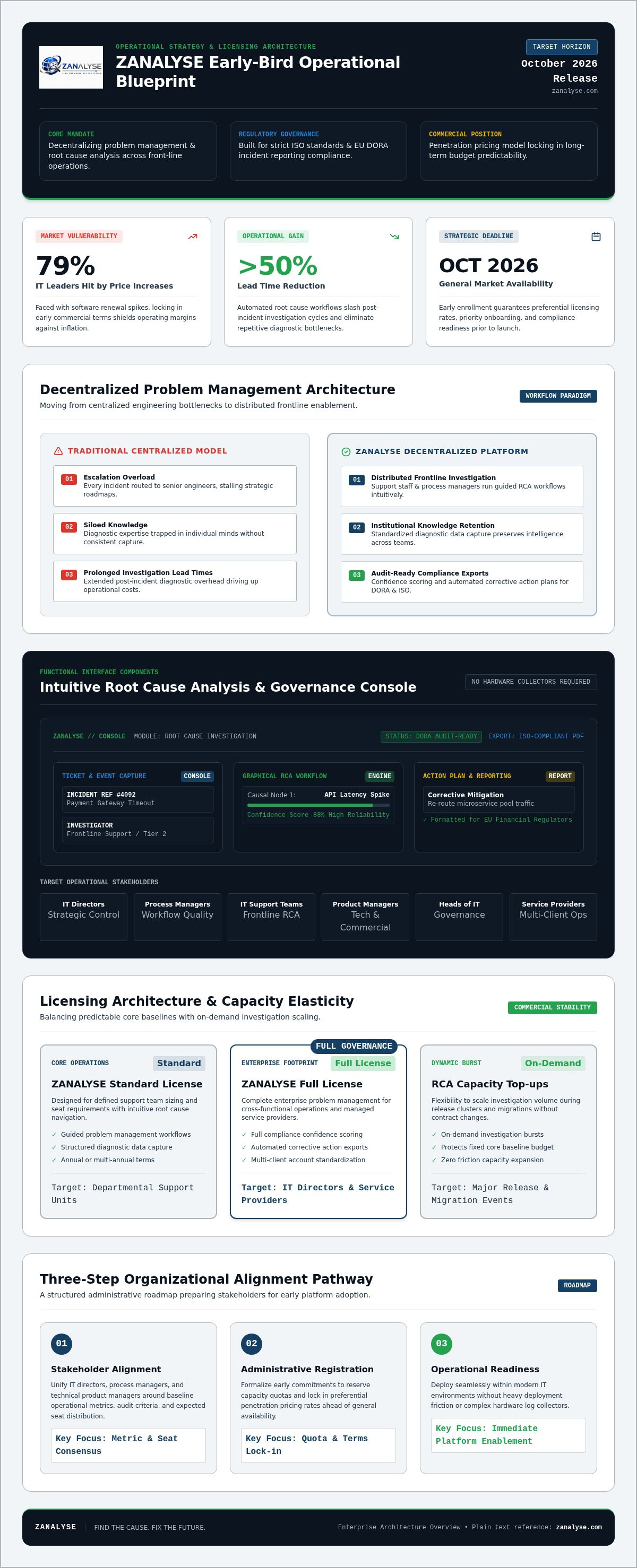
How to Lock in Early-Bird Rates and Prepare Your IT Organization
Securing advantageous licensing terms requires deliberate administrative coordination across both technical and commercial stakeholders. Rather than treating adoption as a simple procurement transaction, technical leadership must prepare internal operational structures to maximize immediate platform readiness. You don't need complex hardware log collectors or protracted infrastructure changes. ZANALYSE operates entirely within modern environments, eliminating heavy deployment friction.
Locking in the ZANALYSE Early-bird Pricing Plan follows a structured three-step implementation pathway:
- Stakeholder Alignment: Unify IT directors, process managers, and technical product managers around baseline operational metrics, audit criteria, and expected seat distribution.
- Administrative Registration: Formalize early-stage commitments to reserve capacity quotas and lock in preferential annual or multi-annual rate frameworks ahead of October 2026.
- Governance Mapping: Map existing diagnostic categories and escalation hierarchies to match automated investigation templates before full platform deployment.
Onboarding Steps for Decentralized Problem Management Teams
Decentralization succeeds only when front-line teams have direct access to repeatable operational tools. Preparing your support personnel and external service partners involves clear configuration milestones:
First, identify key diagnostic event types across your operational services. Next, configure role-based access so front-line analysts can execute structured investigations independently. Because the interface uses intuitive navigation, junior analysts can generate evidence-backed reports with built-in confidence scoring and automated corrective action plans without relying on senior developers.
Establish direct contact with enterprise licensing representatives today to confirm your organization's seat allocation under the Early-bird Pricing Plan before general release allocations close.
Secure Your Operational Advantage Before October 2026
Navigating regulatory pressures while scaling IT operations requires proven tooling and predictable costs. You don't have to let rising software renewals disrupt technical roadmaps. Engineered by ZANGAARD Digital Solutions ApS, ZANALYSE replaces senior-engineering bottlenecks with intuitive, decentralized problem management. By activating automated workflows across front-line support and service providers, your teams can slash incident lead times by over 50% while maintaining audit-ready compliance with ISO standards and DORA regulations.
Securing terms early gives your organization the commercial stability and operational readiness needed to stay ahead. Lock in your Early-bird Pricing Plan before the October 2026 launch to empower your engineering teams, protect your operational budget, and build long-term resilience.
Frequently Asked Questions
What is included in the ZANALYSE Early-bird Pricing Plan?
The ZANALYSE Early-bird Pricing Plan includes preferential licensing rates across annual or multi-annual agreements for either Standard or Full tiers. Organizations secure priority onboarding ahead of general release, access to structured root cause analysis workflows, automated action plans, and built-in confidence scoring. This guarantees immediate audit-readiness under DORA and ISO standards for technical operations across Europe, Canada, and Australia.
When does early-bird access transition to general availability?
The Early-bird Pricing Plan remains active until general availability opens in October 2026. Registering before this date locks in preferential commercial rates and ensures deployment priority. After the general launch, standard market licensing applies. Organizations across Canada, Europe, and Australia that secure early allocations retain their agreed commercial terms throughout their full annual or multi-annual contract term.
Can organizations upgrade from Standard to Full licenses later?
Yes, organizations can upgrade from a ZANALYSE Standard License to a ZANALYSE Full License as operational requirements expand. Upgrading maintains your underlying commercial advantages while unlocking broader analytical scope across complex multi-system environments. This flexibility allows IT directors and service providers across Europe, Canada, and Australia to adapt their root cause analysis coverage seamlessly as support teams and client portfolios grow.
How does early-bird licensing accommodate unexpected incident volume spikes?
Baseline tiers support steady-state operational investigations, while unexpected volume surges are managed using RCA Capacity Top-ups. If an infrastructure upgrade or external disruption triggers an abnormal cluster of issues, teams add modular investigation capacity without renegotiating their base contract. This preserves predictable operating costs while ensuring front-line support staff and external service providers maintain rapid investigation turnaround times.
Disclaimer
Some content on this website may be generated or assisted by artificial intelligence. While we strive to ensure that all information is accurate, relevant and up to date, AI-assisted content may contain errors or omissions. Content should therefore be considered informational and not as professional advice.


