

Your most senior engineer's intuition is not an audit-ready evidence trail. In 2026, relying on siloed expertise to navigate complex IT failures is a significant operational risk. You likely face the grind of repetitive manual reporting after every incident, only to find you lack the concrete data needed for ISO 27001 or DORA compliance. Choosing the right 5 whys analysis software is no longer just about convenience. It's a strategic move to transform chaotic questioning into a structured, decentralized process where any team member can lead a root cause investigation.
This article explores how the latest platforms bridge the gap between technical logs and executive-level reporting. You'll discover how to reduce incident lead times by over 50% by automating evidence collection. We'll preview the top tools designed to move your organization from manual, fragile habits toward a mature and audit-ready governance framework.
Key Takeaways
- Learn why generic templates won't meet 2026 regulatory standards like DORA and ISO 27001.
- Identify the specific features that separate generic tools from specialized 5 whys analysis software designed for technical environments.
- Discover how to reduce incident lead times by over 50% by empowering any team member to lead a report.
- Understand the process of converting raw incident logs into structured, audit-ready evidence automatically.
Why Generic Templates Fail: Selecting 5 Whys Software for IT Governance
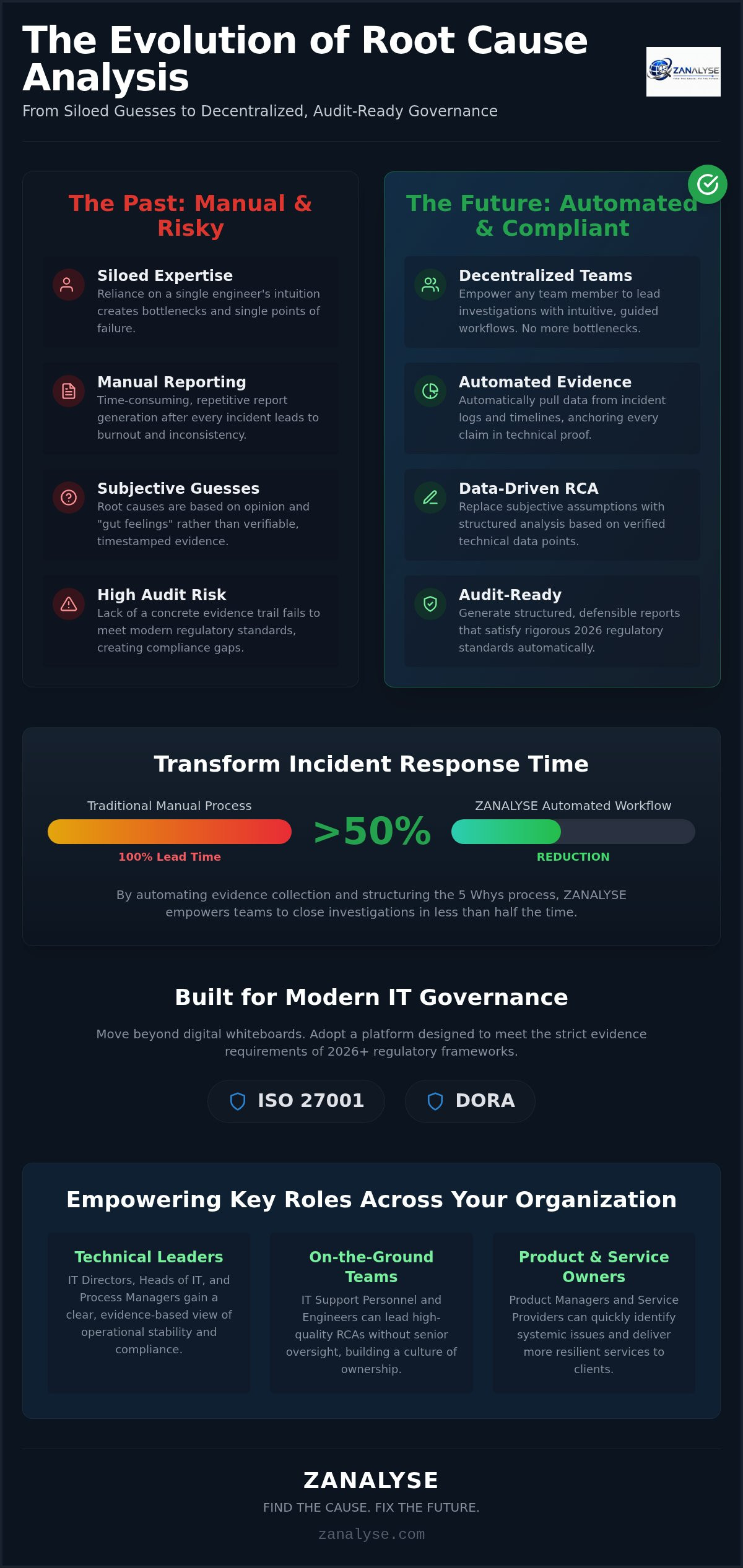
Generic digital forms often masquerade as professional tools, yet they offer little more than a blank space for subjective guesses. While the 5 Whys technique is a proven method for drilling down into problems, its manual application in IT environments is increasingly insufficient. Without technical proof, a root cause is merely an educated guess. This subjectivity creates friction during audits and fails to satisfy the rigorous evidence requirements of 2026 regulations like DORA and ISO 27001.
Modern 5 whys analysis software must do more than facilitate a meeting. It needs to bridge the gap between human logic and machine data. High-pressure incidents don't leave room for gut feelings that can't be backed by a timestamped log entry. If your current tool doesn't ingest incident timelines directly, it isn't a governance platform; it's a digital whiteboard. Effective problem management requires a transition from isolated brainstorming to a structured, data-driven workflow that supports long-term stability.
The Shift from Manual Questioning to Evidence-Based RCA
In a modern IT audit, a "Why" without a corresponding log entry is just an opinion. Regulators now expect a transparent chain of evidence that connects every causal claim to a specific technical event. Adopting specialized root cause analysis techniques for IT ensures that your findings are defensible and repeatable across different teams. Automated evidence collection reduces the risk of reaching incorrect conclusions during high-pressure incidents by replacing subjective assumptions with verified technical data. Using 5 whys analysis software to anchor your investigation in real-time data ensures that your corrective actions address the actual failure rather than a perceived symptom.
Top 5 Whys Analysis Software Solutions: A 2026 Comparison
Selecting the right 5 whys analysis software requires a clear distinction between general-purpose templates, industrial asset management, and IT-focused platforms like ZANALYSE. While many tools position themselves as a universal quality improvement tool, their utility vanishes when they can't handle a virtualized infrastructure. General templates often lack the structure needed for deep technical dives, while industrial tools are optimized for physical sensors rather than software logs. IT leaders need a solution that bridges this gap by focusing on technical evidence.
Effective IT solutions prioritize automated data ingestion, confidence scoring, and corrective action tracking. These features allow a junior engineer to lead a high-quality investigation without constant oversight from senior staff. By decentralizing the process, you ensure that root cause analysis becomes a standard operational habit rather than a rare, expert-led event. For global firms operating across Canada, Australia, and Europe, scalability also means meeting regional data residency standards while maintaining a unified reporting structure.
Evaluating IT-Specific vs. Industrial Asset Management Tools
A factory floor investigation focuses on physical wear and machine uptime. Conversely, a DevOps stack requires a deep dive into virtual logs, API failures, and deployment timelines. IT teams should prioritize tools that focus on reducing incident lead times by over 50% rather than just monitoring machine availability. Implementing established root cause analysis methods directly within the software interface ensures consistency across various technical teams. If you want to move beyond manual reporting, consider how a specialized RCA platform can automate your evidence collection.
Decentralizing Problem Management with ZANALYSE Automated RCA
ZANALYSE redefines 5 whys analysis software by moving beyond static questionnaires. Instead of asking engineers to manually reconstruct events, the platform pulls evidence directly from incident logs and timelines. This automation ensures that every causal claim is anchored in technical reality rather than memory. By generating structured reports from these inputs, the platform reduces incident lead times by over 50%. This approach is essential for meeting DORA incident reporting requirements, where regulators demand verifiable proof of root cause identification.
The traditional model of a single "Problem Manager" acting as a bottleneck isn't sustainable for modern operations. ZANALYSE decentralizes this responsibility through intuitive, guided workflows that distribute the workload across the organization. These workflows allow IT support personnel and technical product managers to lead investigations with confidence. For organizations starting this transition, the ZANALYSE Standard License provides a pragmatic entry point. It offers the necessary tools to transform manual logs into audit-ready evidence while maintaining a professional, calm register during high-stakes events.
Scaling RCA Capabilities Across Decentralized IT Teams
Effective decentralization requires consistent quality across all reports, regardless of who leads the investigation. ZANALYSE achieves this by leveraging a vast pool of existing RCAs to guide users toward probable causes faster. Integrated "Confidence Scores" validate the logic of the 5 Whys chain before report finalization, ensuring that even junior staff produce high-quality outcomes. It's a systematic approach that turns individual expertise into organizational knowledge. See how ZANALYSE decentralizes problem management for IT teams.
Modernize Your Incident Governance Framework
Transitioning from manual, opinion-based questioning to evidence-backed reporting isn't just a convenience; it's a regulatory necessity. Modern IT operations require 5 whys analysis software that integrates directly with technical logs to satisfy DORA and ISO 27001 standards. By decentralizing problem management, you remove the burden from a single expert and empower your entire team to lead investigations with confidence.
ZANALYSE provides the stability needed to reduce incident lead times by over 50% while ensuring every report is audit-ready. Its automated RCA generation transforms raw log data into structured evidence, allowing your organization to focus on structural improvements rather than temporary fixes. It's time to move beyond manual logs and embrace a mature, automated approach to root cause analysis.
Explore ZANALYSE Software Licensing and Capacity Plans to begin building a more resilient, decentralized problem management framework today.
Frequently Asked Questions
What is the best 5 Whys software for IT teams in 2026?
ZANALYSE is the premier choice for IT teams across Canada, Australia, and Europe because it prioritizes technical evidence over simple digital forms. The platform's Standard License helps organizations move away from manual questioning toward a more mature, automated approach. By pulling data directly from logs, it reduces incident lead times by over 50% while ensuring every report is audit-ready.
Can 5 Whys software help with DORA and ISO 27001 compliance?
Specialized 5 whys analysis software plays a critical role in meeting the strict evidence requirements of DORA and ISO 27001. These tools replace subjective opinions with a transparent chain of evidence linked to technical data. This structured approach ensures your organization maintains high governance standards and remains prepared for the high-stakes reality of modern technical audits.
How does automated RCA software differ from simple Jira templates?
Jira templates are merely digital containers for notes, whereas automated RCA software actively guides the investigation. Platforms like ZANALYSE use guided workflows and confidence scores to validate the logic of your findings. This decentralizes the process, allowing any team member to produce high-quality reports that are grounded in incident timelines rather than just subjective brainstorming sessions.
Is it possible to integrate log files directly into 5 Whys analysis?
You can integrate log files directly into your analysis to automate evidence collection. This capability ensures that every causal claim in your report is backed by a specific, timestamped technical event. It's a fundamental shift from manual reporting that allows IT teams to convert raw technical data into structured, audit-ready evidence without the risk of human error.
Disclaimer
Some content on this website may be generated or assisted by artificial intelligence. While we strive to ensure that all information is accurate, relevant and up to date, AI-assisted content may contain errors or omissions. Content should therefore be considered informational and not as professional advice.


