

A business case for automated RCA tools should connect the time your team spends investigating incidents with the operational improvements it needs. Assess whether a tool can support clearer decisions, faster analysis, and corrective actions that prevent repeat issues.
Downtime and SLA breaches create pressure to restore service quickly, but temporary fixes can leave recurring problems unresolved. This article explains how automated RCA works, how incidents affect operations, and how to assess whether a tool fits your needs. It also shows how evidence-based corrective actions can strengthen problem management over time.
Key Takeaways
- Use structured RCA methods to move beyond symptom fixes and build an evidence-based view of recurring incidents.
- Assess downtime and SLA breaches by considering their effects on service continuity, revenue, and customer trust.
- Turn investigation findings into assigned corrective actions, then monitor whether those actions prevent repeat failures.
- Explore the ZANALYSE Standard License when your team needs structured RCA reports and a shared approach to problem management.
What is Automated Root Cause Analysis?
Root cause analysis investigates why an IT incident occurred, rather than addressing symptoms alone. Automated RCA software organizes incident evidence and guides a structured investigation, helping teams develop and document a supported conclusion.
Traditional RCA Methods and Their Limitations
Traditional RCA often relies on interviews, incident records, and methods such as the 5 Whys, which asks why repeatedly, often five times, to trace a problem’s causes. This approach gives teams a clear starting point, but answers can depend on memory and individual judgment. Manual investigations can take hours to days, and a simple chain of questions may miss interacting causes. For complex problems, teams can combine the 5 Whys with a fishbone diagram or FMEA to examine multiple contributors.
Software-Supported RCA Methodologies
An RCA tool can organize logs, timelines, and incident data into a structured report, helping teams apply a consistent method and retain learning. The 5 Whys suits a focused issue; DMAIC structures improvement through Define, Measure, Analyze, Improve, and Control. The 8D method guides teams through a disciplined problem-solving process, including containment, cause analysis, corrective action, and prevention. For complex cases, combine methods rather than forcing every investigation into one template.
Compare tools by supported methods, evidence handling, explanation of findings, and integrations with your existing incident and monitoring systems. Review pricing structures by license, usage, and included capabilities rather than assuming a single model.
Deployment typically needs relevant logs, incident timelines, and incident records. Map those data sources, connect the necessary systems, set access controls, then test the investigation workflow with a recurring issue.
Automated findings can be wrong or incomplete when records lack context, so review evidence before acting. The Centers for Disease Control and Prevention notes that a statistical signal from automated surveillance does not necessarily indicate a true safety problem, illustrating why human validation matters.
Business impacts of downtime and SLA breaches
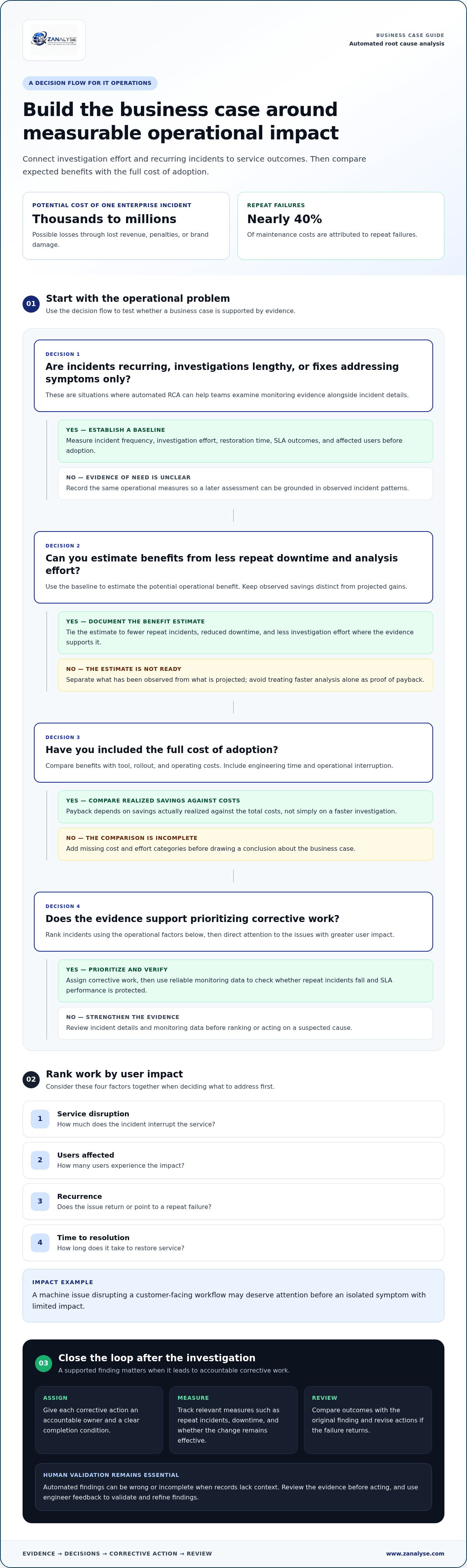
Automated RCA can help with recurring incidents, lengthy investigations, and fixes that address symptoms without resolving underlying causes. By organizing monitoring evidence alongside incident details, it helps teams examine how service disruptions occur and identify workflow breakdowns that repeatedly affect users.
The commercial effect can compound: one incident may cost enterprises thousands to millions through lost revenue, penalties, or brand damage. Repeat failures account for nearly 40% of maintenance costs.
To build the business case, measure incident frequency, investigation effort, restoration time, SLA outcomes, and affected users before adoption. Estimate benefits from reduced repeat downtime and analysis effort, then compare them with tool, rollout, and operating costs. Payback depends on realized savings against those costs, not on a faster investigation alone. Include engineering time and operational interruption, separating observed savings from projected gains.
Prioritize corrective work by user impact. Rank incidents by service disruption, users affected, recurrence, and time to resolution. A machine issue disrupting a customer-facing workflow may deserve attention before an isolated symptom with limited impact. Use reliable monitoring data to see whether corrective actions reduce repeat incidents and protect SLA performance.
Teams assessing this analysis can explore an automated RCA workflow as part of a repeatable business case.
Check for quick-fix buttons and user-experience-based prioritization, alongside contextual and historical cause information and automated fixes; scalable diagnostics can remediate the entire IT estate at once.
Corrective actions and continuous improvement
An RCA finding creates value only when it changes operational practice. Turn each supported cause into a corrective action that addresses the failure, assigns an owner, and records the expected outcome. If a recurring service fault traces to an outdated configuration, document the change and how the team will verify it. This makes the analysis accountable work, not another troubleshooting note.
Carry the evidence into the postmortem using the investigation record. ZANALYSE produces a structured RCA report with a timeline, findings, and proposed corrective actions, so reviewers can focus on whether the fix addresses the cause, whether infrastructure or process changes are needed, and how to reduce the risk of a similar incident.
- Assign: Give each corrective action an accountable owner and a clear completion condition.
- Measure: Track relevant metrics, such as repeat incidents, downtime, and whether the corrective change remains effective.
- Review: Compare outcomes with the original finding and revise actions if the failure returns.
Look for patterns across RCA reviews, not only within one incident. The Centers for Disease Control and Prevention notes that aggregate RCA review information may reveal process deficiencies contributing to increased infection rates. In IT operations, grouped findings can similarly help teams spot repeated workflow or infrastructure weaknesses, then prioritize broader improvements. Engineer feedback can also validate and refine automated findings over time.
Build continuous improvement into routine reviews: assess action effectiveness, capture lessons, and update troubleshooting practices when evidence points to a process gap. Structure your RCA corrective actions around documented findings and measurable outcomes.
ZANALYSE: ZANALYSE Standard License
ZANALYSE Standard License gives teams a structured way to investigate incidents and document corrective actions. Its intuitive navigation guides users through established RCA methods, helping make root cause analysis accessible beyond a small group of specialists.
Consider it when process managers, IT support staff, and service providers need a shared approach to problem management. ZANALYSE helps teams put incident investigations into a consistent workflow, supporting broader participation across operational work. Annual or multi-annual price plans and RCA Capacity Top-ups are also available.
Contact ZANALYSE to discuss how the platform could fit your problem management approach.
Make the Next Step a Measured One
Move from interest to a decision grounded in your team’s operational priorities. A business case for automated RCA tools should define the outcomes that matter and how you will evaluate them, keeping automation focused on practical needs.
ZANALYSE offers the ZANALYSE Standard License and ZANALYSE Full License, with annual or multi-annual price plans. Consider which option aligns with your intended RCA use and evaluation criteria.
Contact ZANALYSE to discuss your needs and determine a suitable next step for your problem management approach.
Frequently Asked Questions
Can an AI agent find the root cause of a production incident?
An AI agent can analyze incident evidence and surface likely causes, but teams should validate its reasoning before changing production systems. For example, ZANALYSE can rank a recent configuration change as a hypothesis linked to a spike in errors. Engineers can compare the evidence with system behavior and decide whether the change caused the incident.
Should you build or buy automated RCA?
Buy a tool when its established RCA methods and reporting fit your incident workflow, and building one would divert time from operations. Build when your requirements depend on unique systems or investigation logic that available tools cannot support. Include ongoing maintenance in the comparison: a custom solution needs people to maintain data connections, analysis logic, security controls, and reports.
What is automated root cause analysis (RCA) software and how does it work?
Automated RCA software helps turn incident evidence into an organized investigation that people can review. A typical workflow brings in logs and notes, aligns events into a timeline, and presents possible causes for assessment. For teams working across Canada, Australia, and Europe, consistent records can make investigation context easier to share across locations and handoffs.
What measurable ROI and cost savings do automated RCA tools deliver?
Measure value against your own baseline rather than relying on a generic savings estimate. Record investigation hours, repeat incidents, restoration time, and the operational impact of downtime before adoption. Then compare changes over a consistent review period with licence and operating costs. Reduced investigation effort matters most when the team can show that saved time supports other operational work. Any return estimate is model-based, not a guaranteed outcome.
How do automated RCA tools reduce mean time to resolution and downtime?
Automated RCA can reduce diagnostic delays by organizing evidence and helping responders focus on relevant causes instead of searching separate records manually. A generated timeline, for example, can clarify whether a service failure followed a deployment or a dependency issue. Teams still decide on the fix, but a clearer handoff from investigation to action can help limit delays and extended disruption.
Disclaimer
Some content on this website may be generated or assisted by artificial intelligence. While we strive to ensure that all information is accurate, relevant and up to date, AI-assisted content may contain errors or omissions. Content should therefore be considered informational and not as professional advice.


