

The incident may be over, but the work of learning from it isn’t. A Google Cloud Platform incident post-mortem follows service restoration and documents the impact, mitigation or resolution, root causes, and follow-up actions. Its purpose is to understand what happened and reduce the chance of recurrence, not assign blame.
That distinction matters when teams are under pressure. A useful review assumes people acted on the information available at the time, then examines how systems, decisions, and conditions contributed to the incident. Findings should lead to practical actions, not a document that is filed and forgotten.
This article explains what teams analyze, how they document and review findings, and how they track actions and share lessons. A clear, blameless process can turn incident data into organizational learning, whether you manage processes, support IT operations, or deliver services to clients in Canada, Australia, or Europe.
Key Takeaways
- Examine the conditions and contributing causes behind an incident, rather than assigning blame to individuals.
- Turn findings into clear corrective actions, then track progress in a project management tool and revisit it at a team meeting.
- Publish final reports in a shared location so teams can use past incidents to spot recurring problems.
- Make it easier for people to speak up by sharing findings openly and focusing discussions on practical lessons.
Blameless incident analysis and learning
A blameless review examines the conditions that shaped an incident, not who to punish. A Google Cloud Platform incident post-mortem records what happened and turns analysis into practical learning.
Root-Cause Analysis
Root-cause analysis traces how system conditions and decisions combined to produce an incident. Start with a UTC timeline, then use the 5 whys to move beyond the first visible fault. For example, a production compute failure may expose a wider infrastructure issue or an unrolled-out fix. Review earlier incidents and the engineering backlog for work that could have prevented or reduced the impact. This helps teams distinguish a trigger from contributing causes.
Incident Timeline and Customer Impact
An incident timeline records detection, mitigation, resolution, and customer impact. In the London cloud facility example, a power event was believed to have occurred, and the outage lasted roughly eight hours. Google mitigated it at 3pm UK time. The reported figures do not establish a customer count or specific SLA effect for that outage. Use monitoring data from both the platform operator and service owner to assess external impact alongside internal errors. Google Cloud CRE examples include a 1% internal error rate and an outage consuming 8% of a customer's 30-day error budget.
Postmortem Tools and Trend Analysis
Tools can organize evidence, timelines, causes, and actions in a reviewable record. A simple document and action tracker can support a Google Cloud Platform incident post-mortem without adding unnecessary process. Compare reports and review the archive regularly to spot recurring causes. Check for unfinished fixes and backlog work that could have reduced the impact.
Finding Incident Reports and Updates
To locate a report, search Google Cloud incident updates by affected service and approximate date, then match its timeline and impact details. For current service health and incident updates in the United States, consult Google Cloud’s service health updates. Google, AWS, and Azure publish incident information, but their report formats and processes differ.
Publishing findings and tracking action items
A post-mortem becomes useful when teams publish clear findings and carry agreed actions into their work. A consistent format helps engineering, support, and product teams act on the same evidence.
Writing Verifiable Action Items
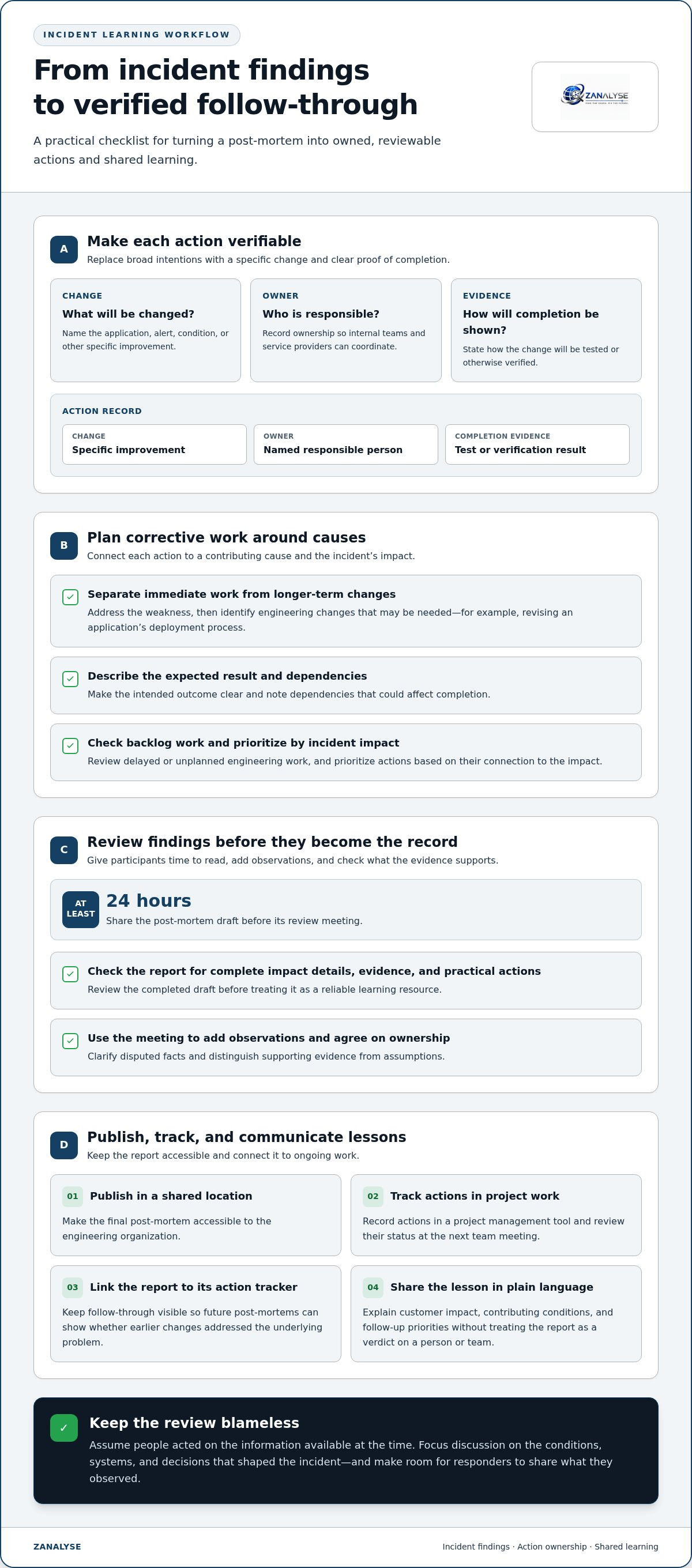
A verifiable action item states the change, its owner, and the evidence that will show it is complete. This makes progress visible instead of leaving teams with broad intentions such as “improve monitoring.” For example, specify which application needs an alert, what condition it should detect, and how the team will test it. Record each item in a project management tool and review its status at the next team meeting. Clear ownership helps internal teams and service providers coordinate follow-through.
Planning Corrective Actions
Corrective actions address contributing causes and aim to prevent the same class of incident from recurring. Separate immediate work to resolve a weakness from longer-term engineering changes, such as revising an application’s deployment process. For each action, describe the expected result and any dependencies that could affect completion. Review the engineering backlog for relevant delayed or unplanned work, then prioritize actions based on their connection to the incident’s impact.
Publish the final post-mortem in a shared location accessible to the engineering organization. Before publication, check that it includes complete impact details, supporting evidence, and practical actions. A review meeting gives participants room to add observations and agree on ownership. Keep the final document linked to its action tracker, so future post-mortems can show whether earlier changes addressed the underlying problem.
For teams seeking a structured way to develop root-cause findings, ZANALYSE’s annual or multi-annual price plans support ongoing use of its analysis platform.
Blameless culture and communication
A blameless culture treats an outage as a chance to learn, not evidence of individual fault. Begin discussions by assuming each person acted on the information available at the time. This shifts attention from “Who caused the failure?” to “What conditions shaped the response?” Teams can then discuss a monitoring alert, unclear handoff, or delayed decision as part of the system, without discouraging people from sharing what they observed.
Make speaking up part of the review. Ask responders what they observed, what information they had, and which choices seemed reasonable at the time. For example, an engineer may explain why an alert did not prompt immediate action, while a support person may identify a confusing escalation path. These details help teams understand how work unfolded and where processes or tools affected decisions.
Communication also depends on how the report is prepared. Review every completed postmortem draft before treating it as a reliable learning resource. Share the document at least 24 hours before its review meeting, giving participants time to read and add observations. In the meeting, clarify disputed facts and separate evidence from assumptions. That practice helps prevent an incomplete section from being mistaken for a settled conclusion.
After review, communicate the lessons to relevant stakeholders in plain language. Explain the customer impact, contributing conditions, and follow-up priorities without framing the report as a verdict on an individual or team. A clear message helps technical and commercial colleagues understand why a change matters. Build a more consistent root-cause analysis process to help teams turn incident evidence into shared learning.
A blameless post-mortem process encourages people to speak up about incidents. When they can raise concerns without fear of blame, teams can bring more observations into the review and learn together.
ZANALYSE: ZANALYSE Standard License
ZANALYSE Standard License helps teams turn incident data into structured root-cause findings. The browser-based platform guides users through recognised analysis techniques and generates reports from logs, timelines, and incident data, with evidence, confidence scores, and corrective actions.
Process managers, IT support personnel, and service providers can use it to make problem analysis accessible beyond a small group of specialists. Consider it when your team needs a clearer, more consistent way to work through incident evidence and produce reports with evidence, confidence scores, and corrective actions.
If you want to explore how structured root-cause analysis could support your process, visit ZANALYSE online.
Make the next incident easier to learn from
A mature incident process is built between outages, not only during reviews. Assign a clear owner to maintain the review format, keep lessons accessible, and check whether teams can apply them in daily operations. This gives process managers and IT leaders a practical way to make learning routine rather than dependent on individual memory.
Use your next Google Cloud Platform incident post-mortem to assess whether the process helps the people closest to the work contribute evidence and move analysis forward. If that work remains difficult to structure across teams, explore a platform designed to guide root-cause analysis. Contact ZANALYSE to discuss incident learning and consider a suitable next step for your team. Clear ownership and accessible analysis can help turn future incidents into lasting organizational knowledge.
Frequently Asked Questions
What customer impact and service-level agreement (SLA) effects were reported?
The outage’s customer count and specific SLA effect were not established. Other Google Cloud CRE examples cite a 1% internal error rate and an outage consuming 8% of a customer’s 30-day error budget.
What caused the incident, and which Google Cloud services and regions were affected?
A power event was believed to have occurred at Google’s London cloud facility. Incident reports may not always provide enough detail to determine the impact on individual services or regions.
What steps should customers take during and after a Google Cloud incident?
During an incident, check Google Cloud service health updates and use monitoring data from both the platform operator and service owner to assess impact. After service is restored, review the incident findings and follow-up actions to understand the impact and reduce the chance of recurrence.
Disclaimer
Some content on this website may be generated or assisted by artificial intelligence. While we strive to ensure that all information is accurate, relevant and up to date, AI-assisted content may contain errors or omissions. Content should therefore be considered informational and not as professional advice.


