

Data is not evidence. Modern sre root cause analysis tools must do more than group alerts; they must prove why a failure occurred to an auditor's satisfaction. You likely recognize the frustration of spending hours drafting post-mortems only to have them rejected for lacking structured data. It's a common cycle where expertise remains trapped with a few senior staff while incident lead times stay high despite your observability stack.
We will show you how to select tools that move beyond noise reduction to deliver automated, audit-ready results. By decentralizing problem management, you can empower junior staff and reduce incident lead times by over 50%. This article previews the leading platforms for 2026 that bridge the gap between technical operations and regulatory compliance requirements like DORA and ISO standards.
Key Takeaways
- Identify why the most effective sre root cause analysis tools in 2026 prioritize automated evidence collection over simple alert grouping.
- Move beyond the senior-expert bottleneck by adopting decentralized problem management workflows that empower your entire IT support team.
- Learn to generate structured, audit-ready incident reports automatically to ensure consistent compliance with DORA and ISO standards.
- Apply a 5-point evaluation framework to select platforms that bridge the gap between technical logs and clear stakeholder communication.
The Evolution of SRE Root Cause Analysis Tools in 2026
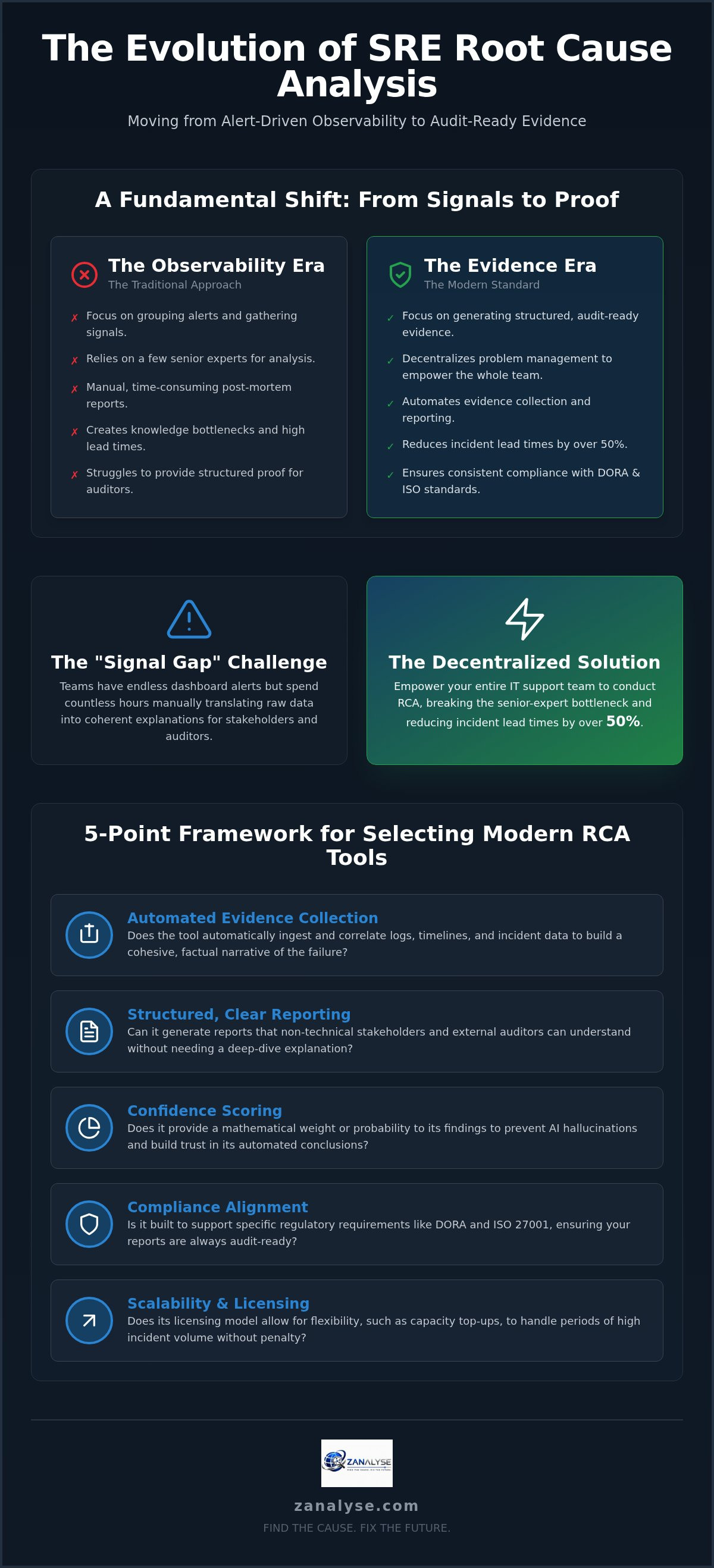
Traditional monitoring identifies that a system has failed, but it rarely explains why. In 2026, the industry has transitioned from the Observability Era to the Evidence Era. While observability focuses on gathering signals, modern sre root cause analysis tools serve as specialized platforms designed to explain the "why" and "how" of failures through structured data. Manual post-mortems are no longer sustainable. As microservice complexity grows, expecting a human to correlate thousands of ephemeral logs is a recipe for burnout and inaccuracy. Organizations are now adopting decentralized problem management, a standard that empowers every team member to contribute to Root-cause analysis (RCA) without relying solely on a few senior engineers.
Why Observability is No Longer Enough
Teams often face a "Signal Gap." You have the dashboard alerts, yet your engineers spend hours explaining the event to stakeholders. This creates a massive context-switching cost for senior SREs who must abandon technical work to write reports. Beyond internal efficiency, regulatory pressure is mounting. Standards like DORA and ISO 27001 now demand rigorous technical evidence for every incident. Relying on memory or messy Slack logs won't satisfy an auditor.
The Rise of Automated RCA Engines
Modern engines use logic-based analysis rather than simple pattern matching to find the source of a fault. Automated Root Cause Analysis is the process of converting raw logs into structured, actionable reports. These tools remove human bias by following objective data paths. Instead of guessing based on past experience, the system provides a clear, evidence-based timeline. This shift ensures that every incident report is consistent, regardless of who manages the investigation.
Choosing SRE RCA Tools for 2026: The 5-Point Framework
Selecting the right sre root cause analysis tools requires a shift in perspective. It's no longer just about finding a bug; it's about documenting the resolution process to satisfy stakeholders and regulators. To build a resilient operation, you should evaluate your options against this five-point framework:
- Evidence Collection: Does the tool ingest logs, timelines, and incident data automatically?
- Structured Reporting: Can it produce reports that auditors and non-technical stakeholders understand?
- Confidence Scoring: Does it provide a mathematical weight to its findings to prevent hallucinations?
- Compliance Alignment: Does it specifically support DORA and ISO 27001 reporting requirements?
- Scalability and Licensing: Does it allow for capacity top-ups during high-incident periods?
The Audit-Ready Evidence Requirement
A report that simply states "the server was rebooted" is no longer acceptable. Modern governance, especially under DORA, requires a granular trail of evidence. You must prove exactly what happened and why. This process is vital to creating organizational change because it turns failures into permanent lessons. ZANALYSE automates this by pulling disparate log sources into a cohesive timeline, ensuring you're always audit-ready.
Confidence Scores and Corrective Action Plans
Trust is a major hurdle for automated systems. Confidence scores allow you to verify the mathematical probability of a finding, preventing AI hallucinations. These scores lead directly into Corrective Action Plans (CAPs) to prevent recurrence. Adopting these sre root cause analysis tools ensures your team moves beyond temporary fixes toward structural improvements. See how the ZANALYSE Full License can stabilize your workflow.
Top SRE Root Cause Analysis Tools Compared
The landscape for sre root cause analysis tools has split into two distinct categories. On one side, you have broad service management platforms; on the other, you find specialized engines designed for deep technical evidence. Selecting the right tool depends on whether your priority is general alert noise reduction or meeting strict regulatory compliance standards.
ZANALYSE: Automating the Problem Management Lifecycle
Built specifically to generate audit-ready reports from logs and incident data, ZANALYSE reduces incident lead times by over 50% by automating the documentation phase. Organizations can choose between the ZANALYSE Standard License or the ZANALYSE Full License to scale their operations. A key benefit is decentralization. The platform empowers all IT staff to handle investigations, which breaks the knowledge bottleneck where only a few senior engineers can perform deep analysis.
Comparing Alternatives: When to Choose What
ServiceNow with AIOps remains the standard for large enterprises that require broad ITSM integration. It's a powerful legacy choice, but it often lacks the specialized focus needed for rapid, automated evidence collection. PagerDuty is the leader in incident response and is evolving to include automated timeline analysis. This makes it a strong option for teams already using their alerting ecosystem. For teams managing complex, modern environments, specialized engines are becoming the preferred choice. Recent academic shifts toward generative root cause analysis for distributed systems show why confidence scoring is now a critical feature. Unlike generic tools, these specialized platforms use scores to ensure findings are mathematically grounded and free from AI bias.
Implementation: Moving from Siloed to Decentralized RCA
Many organizations suffer from a persistent knowledge bottleneck where only about 10% of technical staff possess the expertise to perform deep analysis. This dependency on senior engineers stalls resolution and prevents junior staff from developing critical skills. By implementing modern sre root cause analysis tools, you can decentralize this process. It's about moving from a siloed approach to a model where the entire IT support team participates in problem management.
Standardizing the RCA Workflow
A mature workflow begins the moment an incident closes. Instead of staring at a blank document, staff use automated tools to generate a draft based on objective evidence. Training junior staff to validate these automated reports, rather than writing them from scratch, drastically reduces the barrier to entry. Senior SREs then shift their role from "writer" to "reviewer," approving findings rather than digging through logs. This method uses a vast pool of included RCAs to maintain a high standard of quality across every report. If you face seasonal peaks or large migrations, integrating RCA Capacity Top-ups ensures your team isn't overwhelmed by documentation requirements.
Measuring Success: Lead Time and DORA Metrics
Success isn't just about closing tickets. You must track Mean Time to Report as a core efficiency metric to ensure your team isn't lagging behind the technical resolution. High-quality sre root cause analysis tools help ensure that corrective actions are effective, meaning incidents stay fixed long-term. This data feeds directly into your DORA compliance scores, providing a clear view of operational health for leadership and auditors alike. To start transforming your team's efficiency and output, adopt a decentralized problem management strategy today.
ZANALYSE: The Logical Conclusion for SRE Excellence
The transition from reactive firefighting to structured problem management is no longer optional. Stability requires structure. While many sre root cause analysis tools focus on the initial alert, ZANALYSE addresses the entire lifecycle by converting technical signals into permanent organizational knowledge. It acts as a stabilizing force in chaotic environments, ensuring every incident leads to a verifiable improvement rather than just a temporary fix. By reducing the burden of manual reporting, your team can focus on technical innovation instead of administrative overhead.
Securing Audit-Ready Evidence Today
Compliance requirements like ISO 27001 and DORA demand more than just a summary of events; they require structured evidence. ZANALYSE turns raw log files into clear, authoritative timelines that satisfy even the most rigorous audits. For global teams, the ZANALYSE Full License provides a consistent framework to ensure problem management remains uniform across different regions and departments. This consistency is what transforms a standard IT shop into a mature service provider. Explore ZANALYSE Licenses and Capacity Plans to see how we can support your specific scale.
The Future of SRE is Automated
General availability for ZANALYSE is set for October 2026. This marks a shift toward proactive organizational learning. Instead of relying on a handful of experts to interpret data, the platform empowers your entire staff to contribute to operational excellence. This democratization of data ensures that knowledge stays within the organization, even as personnel change. Secure your spot in this new era of reliability by taking advantage of our Early-bird Pricing Plan for 2026. As part of the ZANGAARD family, we are committed to providing the tools necessary for long-term stability and process integrity.
Building a Resilient SRE Culture for 2026
The shift toward automated, audit-ready evidence marks the end of the manual post-mortem era. By adopting advanced sre root cause analysis tools, you can bridge the gap between technical operations and regulatory expectations. Transitioning to a decentralized model ensures that your entire team, not just a few senior experts, can resolve complex issues with confidence. This approach stabilizes your environment and turns every failure into a structured lesson for the whole organization.
ZANALYSE, a product of ZANGAARD Digital Solutions, is engineered to meet this challenge. It reduces incident lead times by over 50% while ensuring your reporting remains fully DORA and ISO 27001 compliant. Don't let your team's expertise remain siloed in undocumented threads. It's time to secure your organizational knowledge and move toward a predictable, high-performance future. Automate your SRE reports with ZANALYSE – See License Options. Your path to operational excellence starts with better evidence.
Frequently Asked Questions
What is the difference between observability and root cause analysis tools?
Observability platforms focus on monitoring health metrics and detecting anomalies in real time. In contrast, sre root cause analysis tools are specialized engines that interpret those signals to identify a definitive cause. While observability tells you that a service is down, RCA tools provide the structured evidence and logic required to understand the failure's origin and prevent its recurrence.
How do SRE RCA tools help with DORA compliance?
These tools help organizations meet the strict reporting standards of DORA by automating evidence collection. DORA requires financial entities to document every significant incident with a clear timeline and a root cause. Automated platforms generate these reports directly from log data, ensuring that every submission is consistent, detailed, and ready for regulatory review without requiring hours of manual work.
Can automated RCA tools replace senior SRE engineers?
Automation doesn't replace expertise; it scales it. Senior engineers often spend hours on repetitive documentation that could be handled by a machine. By using automated tools to draft post-mortems, senior staff can focus on verifying findings and designing more resilient systems. This shift transforms the senior SRE from a manual investigator into a high-level process architect and mentor.
What is a confidence score in the context of IT incident analysis?
A confidence score provides a verifiable metric of how certain an automated tool is about its findings. It uses mathematical logic to weigh the evidence gathered from logs and traces. This score helps teams decide whether to accept a finding immediately or investigate further. It's a critical safeguard that ensures every corrective action is based on solid, high-probability data.
Do ZANALYSE tools support on-premise installation?
ZANALYSE is a cloud-native platform and does not support on-premise installation. This delivery model ensures that you always have access to the latest logic engines and compliance frameworks without the overhead of maintaining local infrastructure. It also allows for seamless integration with other cloud-based observability stacks, providing a unified view of your technical environment and incident data.
How does decentralized problem management improve incident lead times?
Decentralization spreads the responsibility for problem management across the entire IT team. By providing junior staff with automated tools to draft reports, you eliminate the wait time for senior expert availability. This efficiency can reduce incident lead times by over 50%. It also accelerates the professional growth of junior personnel, as they learn to validate and approve high-quality technical evidence.
What are RCA capacity top-ups and how do they work?
Capacity top-ups are flexible credits that allow you to process additional root cause analyses beyond your monthly license limit. They provide a cost-effective way to manage unpredictable spikes in incident volume during migrations or peak commercial periods. You can apply these top-ups to your existing ZANALYSE license to maintain consistent documentation standards without needing to upgrade your entire annual plan.
Which RCA techniques are most commonly automated by modern software?
Modern sre root cause analysis tools typically automate log correlation, dependency mapping, and timeline generation. They use logic-based analysis to connect events across multiple microservices. Instead of manual searching, the software identifies the exact sequence of failure. This automation ensures that the resulting reports are objective and grounded in technical evidence, moving beyond the biases that often affect human-led investigations.
Disclaimer
Some content on this website may be generated or assisted by artificial intelligence. While we strive to ensure that all information is accurate, relevant and up to date, AI-assisted content may contain errors or omissions. Content should therefore be considered informational and not as professional advice.


