

What if more than a few specialists could lead your next incident review? The right saas rca platform should make evidence easier to follow and analysis easier to repeat, not add another disconnected process. Yet logs, timelines, findings, and corrective actions often sit in different places, leaving teams with inconsistent records and unclear product claims.
That makes platform fit a workflow question, not just a feature checklist. This guide explains how to assess evidence quality, structured analysis, collaboration, and problem-management follow-up. You’ll also learn what to verify about integrations, deployment, and data handling before adopting a platform, so more staff can contribute without losing consistency. If your IT teams work across Canada, Australia, or Europe, include regional requirements in that assessment.
Key Takeaways
- Define what you need from a saas rca platform before comparing features, including how it supports structured analysis rather than simply collecting alerts or logs.
- Check whether incident inputs, analysis guidance, and report evidence are clear enough for teams to review and act on consistently.
- Assess how the workflow helps more staff contribute to problem management while preserving a structured path from incident data to corrective actions.
- Before adoption, verify integration options, deployment details, and how the platform fits your organization’s review and follow-up processes, including regional requirements for teams in Canada, Australia, and Europe.
What a SaaS RCA Platform Should Do Beyond Automating Incident Reports
A saas rca platform supports structured root cause analysis using incident information, helping teams move from collected details to reviewed findings and corrective actions. It differs from an alerting tool, which flags events; a log collection tool, which gathers records; or broad IT service management software, which supports wider service workflows. An RCA platform focuses on the investigation itself.
Root-cause analysis (RCA) uses systematic methods to examine why an issue occurred, rather than stopping at the visible symptoms. An investigation may draw on logs, incident timelines, and team knowledge. A coherent workflow connects those inputs to evidence, possible explanations, confidence indicators, and actions for follow-up. This helps reviewers understand how a team reached its findings and what should happen next.
How does an RCA platform differ from a basic reporting tool?
A reporting tool can format incident notes into a consistent document. That helps with presentation, but it doesn’t necessarily guide how investigators examine the event or connect evidence to a conclusion. An RCA platform should support a repeatable analysis process, so the work doesn’t depend entirely on one specialist’s personal approach.
Guidance doesn’t replace judgment. Staff still need to check whether the evidence supports a proposed cause, consider relevant operational context, and review corrective actions for practicality. Confidence indicators can help communicate uncertainty, but they shouldn’t be treated as proof.
For IT teams and service providers, the distinction matters: the aim is not simply to produce a polished incident report. It’s to make investigation steps understandable and findings reviewable, so more people can contribute while maintaining a consistent approach to problem management.
How to Evaluate a SaaS RCA Platform: Evidence, Workflow, and Team Fit
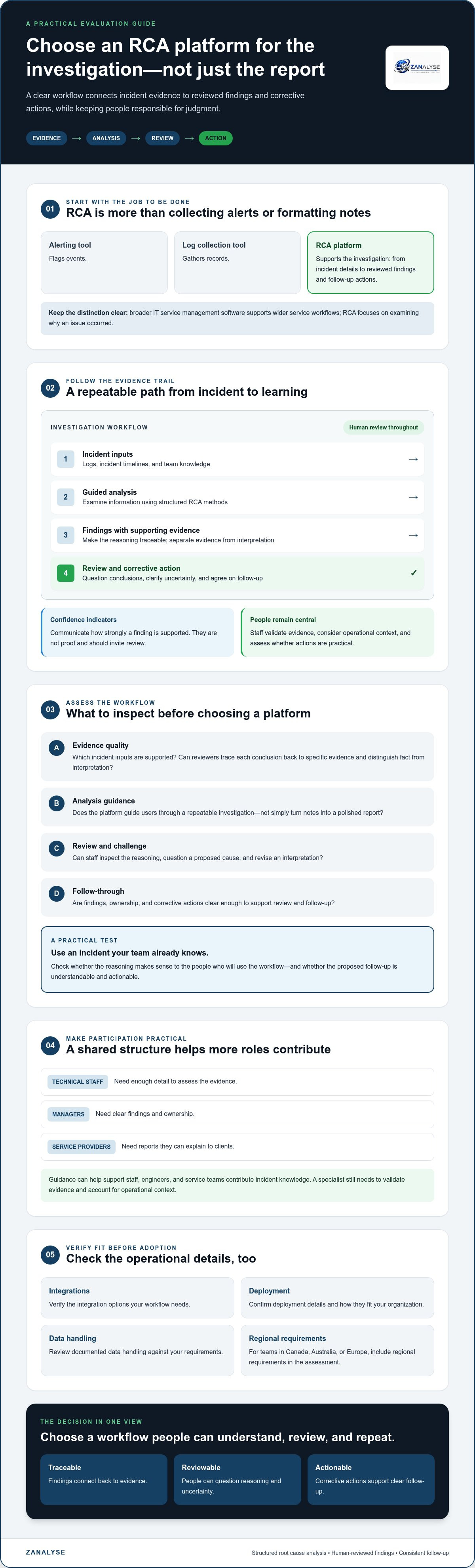
Evaluate the investigation, not just the finished report. A saas rca platform should show how incident inputs support findings and give your team a clear way to review proposed causes and decide what to do next. Ask which inputs the platform supports, what analysis methods it guides users through, and whether reviewers can trace conclusions back to specific evidence.
Check the report itself. Are logs, timelines, findings, confidence indicators, and corrective actions presented so their relationships are clear? Can a reviewer distinguish evidence from interpretation, understand uncertainty, and assess whether a proposed action addresses the identified cause? ASQ describes RCA as identifying the highest-level cause of a problem. A confidence score can help communicate how strongly a finding is supported, but it should invite review rather than replace it. For more context, see our article on IT incident confidence scoring.
Which questions reveal whether the workflow is trustworthy?
Ask: Can users inspect the evidence behind each finding? Does the platform explain the steps that connect incident details to a proposed cause? Can staff challenge or revise an interpretation? These questions reveal whether automation supports a consistent investigation or simply produces confident-looking conclusions. Test the workflow with an incident example your team knows, then check whether the reasoning and follow-up actions make sense to the people who will use them.
Include different roles in that review. Technical staff need enough detail to assess evidence; managers need clear findings and ownership; service providers need reports they can explain to clients. If your teams operate across Canada, Australia, or Europe, also check how the platform’s documented data handling and deployment options fit your organization’s regional requirements. Consider ZANALYSE’s structured RCA approach as one option to assess, while confirming availability, licensing, and deployment details before making a decision.
Can a SaaS RCA Platform Scale Problem Management Across Teams?
Yes, if the workflow makes investigation steps clear without making every decision automatic. Intuitive guidance can help support staff, engineers, and service teams contribute incident knowledge, while a shared structure helps reviewers compare findings and follow up consistently. A specialist still needs to validate evidence and consider operational context.
A practical process starts with incident data, such as logs and timelines. Staff examine the information using guided RCA methods, record possible findings and supporting evidence, and submit the analysis for review. Reviewers can question conclusions, clarify confidence, and agree on corrective actions with clear follow-up. This gives teams a common path from incident details to learning and action. An existing problem management reference guide can help align that workflow with your organization’s practices. For a broader perspective on matching systems to organizational needs, see this Iowa State University resource on evaluating information systems.
What should teams confirm before adopting ZANALYSE?
ZANALYSE is designed to guide users through established RCA techniques and produce reports with evidence, confidence scores, and corrective actions. Its general availability is scheduled for October 2026, so confirm current availability and licensing directly before planning adoption. Test whether its guided workflow fits your incident inputs and review process. Ask ZANALYSE to clarify hosting, security, and data-handling details rather than assuming how its deployment works.
Review licensing options as part of that assessment. ZANALYSE offers Standard and Full licenses, annual or multi-annual plans, and RCA capacity top-ups. Confirm which option fits your intended use and whether the platform’s documented capabilities meet your organization’s requirements.
Explore ZANALYSE’s platform information and verify availability and details before making a decision.
Build a More Consistent RCA Practice
The right saas rca platform should help your teams move from incident information to reviewable findings and follow-up, without making analysis the preserve of a few specialists. Compare tools by how clearly they connect evidence to conclusions, support human review, and fit the way your teams work.
ZANALYSE is designed to guide structured analysis and decentralize problem management across IT staff. Its reports can include evidence, confidence scores, and corrective actions, giving teams a consistent basis for review and follow-up. General availability is scheduled for October 2026, so confirm current availability and licensing before making plans.
Use your evaluation to check workflow fit, report quality, and documented data-handling details, especially if your teams operate across Canada, Australia, or Europe. A careful comparison can help your organization build a more repeatable approach to learning from incidents.
Frequently Asked Questions
What is a SaaS RCA platform?
A SaaS RCA platform is software delivered as a service that helps IT teams investigate incidents through a structured root cause analysis workflow. It can organize logs, timelines, and incident data into findings and reports rather than simply formatting notes. Teams still need to review the evidence and conclusions. The software supports analysis, but it doesn’t replace operational judgment.
How do you evaluate a root cause analysis platform?
Test a root cause analysis platform with an incident example your team knows well. Check which inputs it supports, whether findings can be traced to evidence, and whether confidence indicators and corrective actions are clear enough to review. Also confirm workflow, security, hosting, and data-handling details. If your organization operates across Canada, Australia, or Europe, include its regional requirements in that review.
Can an RCA platform help non-specialists perform root cause analysis?
Yes. Guided steps and a shared analysis structure can help staff contribute without requiring every investigation to begin with a specialist. For example, a support analyst can organize incident details and evidence for review by an experienced colleague. The team should still validate proposed causes and actions, since guidance can support consistent analysis but can’t supply missing context or replace expertise.
Does a SaaS RCA platform guarantee DORA or ISO 27001 compliance?
No. A SaaS RCA platform can help organize incident information and create structured reports, but using one doesn’t guarantee compliance with DORA or ISO 27001. Treat any compliance-related capability as one part of your assessment. Review relevant requirements, controls, evidence, and processes with the people responsible for them, and verify the platform’s documented capabilities before relying on it.
Visit ZANALYSE to check platform availability and discuss licensing options.
Disclaimer
Some content on this website may be generated or assisted by artificial intelligence. While we strive to ensure that all information is accurate, relevant and up to date, AI-assisted content may contain errors or omissions. Content should therefore be considered informational and not as professional advice.


